

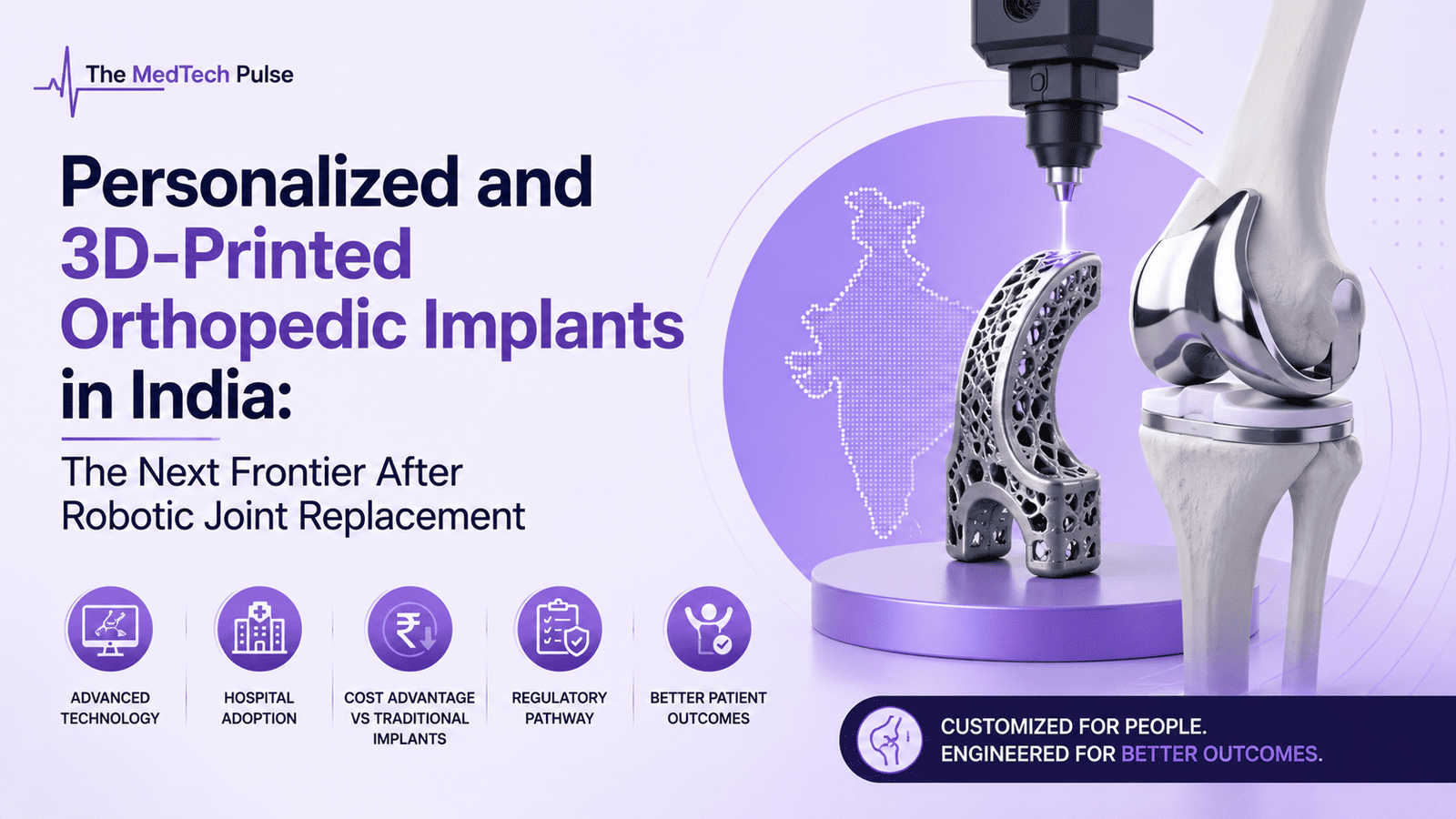
Robotic-assisted joint replacement has gotten most of the attention in Indian orthopedic MedTech over the past few years. But a quieter, arguably more consequential shift has been happening alongside it: implants themselves are becoming personalized. Instead of a surgeon selecting the closest-fitting size from a standard catalogue of hip, knee, spinal, or cranial implants, hospitals are increasingly designing implants from a patient’s own CT scan and printing them in medical-grade titanium, built to match that patient’s exact anatomy. Here’s where that shift genuinely stands in India — the market numbers, the hospitals actually doing it, and a regulatory gap that’s more significant than most coverage of this space acknowledges.
The Market Is Growing Fast, From a Small Base
India’s 3D-printed orthopedic implant market is projected at USD 285.6 million in 2026, expected to reach USD 1,245.3 million by 2034 — a 20.2% compound annual growth rate. That expansion is being driven by genuinely rising surgical volume: orthopedic procedures in India now exceed 1.8 million annually, and patient-specific implant adoption has reached 35% across Tier-1 hospitals specifically.
The shift toward personalisation within that broader implant market has been sharp and recent. Patient-specific solutions accounted for nearly 45% of total 3D-printed implant production in 2026, up from just 18% in 2022 — more than doubling in four years. Annual production volumes have crossed 0.5 million units, aided by advances in AI-based imaging and implant design software that have made the translation from CT scan to printable implant geometry considerably faster than it was even a few years ago. Material-wise, titanium alloys account for 58% of usage, prized for their strength-to-weight ratio and corrosion resistance — the same properties that make titanium the material of choice for implantable devices globally.
What the Technology Actually Delivers Clinically
The clinical case for patient-specific 3D-printed implants rests on a fairly intuitive premise: an implant built from a patient’s own imaging data fits that patient’s actual anatomy better than a standardised, mass-produced implant selected from a limited size range ever could. Indian market data backs that premise up with measurable outcomes: hospitals using 3D-printed implants report a 25% reduction in surgical complications and a 30% improvement in implant longevity compared to standard alternatives, alongside a 15–20 minute reduction in surgical time per procedure — a meaningful efficiency gain in high-volume orthopedic surgical schedules.
The clinical applications go well beyond routine joint replacement. In spine surgery internationally — with growing adoption in India — surgeons have used custom 3D-printed titanium vertebral bodies to reconstruct extensive bone loss following tumour resection, restoring spinal stability in cases that previously would have required either radical anatomical sacrifice or been deemed inoperable altogether. In craniomaxillofacial surgery, patient-specific titanium plates and implants have become close to routine practice in leading centres internationally, with surveyed surgeons generally rating printed implants as superior to conventional plates on surgical accuracy, operating time, and aesthetic outcome — and notably, no procedure type in that survey was rated worse with printed implants than with conventional ones.
Which Indian Hospitals Are Actually Doing This
This isn’t a purely theoretical or pilot-stage technology in India — it has real institutional adoption at the country’s leading centres. AIIMS Delhi and Manipal Hospitals are actively using 3D printing for surgical planning, implant design, and medical research, with AIIMS Delhi specifically having performed surgeries using 3D-printed titanium cranial implants for patients with complex skull defects, designed directly from each patient’s CT imaging.
The broader clinical use case that’s easiest to understand: a patient with a complex pelvic fracture can now receive a 3D-printed titanium implant that matches their exact bone structure — something categorically impossible with an off-the-shelf implant selected from a standard size range. That’s the core value proposition driving adoption across trauma, oncology-related bone reconstruction, and complex primary joint replacement cases where standard implants simply don’t fit well.
Hospitals that don’t want to invest in expensive in-house 3D printing equipment have another route into this technology: specialised third-party providers, such as 3D Paradise, allow hospitals to access 3D printing services for implants and surgical guides without capital investment in their own printing infrastructure — a model that’s likely to matter considerably for Tier-2 and Tier-3 hospital adoption, given how expensive metal 3D printing equipment remains.
The Cost Picture: Real, But Highly Variable
Unlike some device categories where a single benchmark price makes for a clean comparison, custom 3D-printed bone implant costs in India vary enormously depending on the case. The single biggest cost driver is defect size and complexity: a small model skull plate costs meaningfully less than a large pelvic, spinal, or post-tumour reconstruction implant. Beyond materials, custom implants require individualised design work before printing even begins — engineering and design time that adds real cost on top of the material and printing process itself, unlike a standard catalogue implant that’s already designed and simply selected off a shelf. Imported implants carry an additional cost premium from duties and logistics, which is precisely the gap domestic 3D-printing capacity is positioned to close, echoing the broader import-substitution story running across Indian MedTech.
On the manufacturing side, material cost itself is a genuine constraint on how cheap this technology can get: titanium powder, the primary input for metal 3D-printed implants, is priced at USD 300–400 per kg, and regulatory compliance costs for manufacturers have been increasing by roughly 15% annually — a cost pressure that disproportionately affects smaller manufacturers relative to larger, better-capitalised implant companies.
The Regulatory Gap Nobody Talks About Enough
Here’s the part of this story that gets far less attention than the market-growth numbers, and deserves to be stated plainly: as of recent peer-reviewed clinical commentary from Indian orthopedic surgeons, 3D-printed implants and devices are not currently included in the list of medical implants explicitly approved by Indian regulatory authorities. That’s a genuinely significant gap. It doesn’t mean 3D-printed implants aren’t being used in India — clearly, AIIMS Delhi and Manipal Hospitals are using them clinically, as this article has already described. What it means is that the specific regulatory category and approval pathway for patient-specific, additively manufactured implants hasn’t been as clearly codified as it has for standard, mass-manufactured implants under India’s existing Medical Devices Rules framework.
The clinical literature on this technology, drawing on Indian orthopedic surgeons’ own published commentary, has been candid about the broader adoption barriers this creates: while 3D printing costs are trending more affordable as the number of production units in the country increases, expenses related to printing equipment, design software, and specifically trained personnel remain considerably higher for surgical teams at smaller facilities compared to large tertiary care centres — meaning this technology’s benefits, for now, are concentrated in exactly the AIIMS- and Manipal-tier institutions already mentioned, rather than being broadly accessible across India’s hospital network. The same commentary is direct in calling on regulatory authorities — whether CDSCO domestically or with reference to international benchmarks like the US FDA — to formally address this gap, rather than leaving custom implant adoption to continue growing ahead of a clearly defined approval pathway.
What Would Actually Broaden Access
A few structural developments would meaningfully change how far this technology reaches beyond India’s leading tertiary centres:
- A clearly codified CDSCO approval pathway for patient-specific, additively manufactured implants — distinct from the standard implant approval process, given that each device is, by definition, a unique unit rather than a mass-produced product from a validated batch. This is squarely the kind of regulatory clarity CDSCO has been building for other novel device categories, such as its recent Software as a Medical Device guidance, and 3D-printed implants arguably need the same treatment.
- Continued growth in third-party 3D printing service providers, letting Tier-2 and Tier-3 hospitals access patient-specific implant design and manufacturing without the capital expense of in-house metal 3D printing equipment — a model already emerging, and one that mirrors how smaller device manufacturers have leaned on shared infrastructure at facilities like AMTZ rather than building everything in-house.
- Domestic titanium powder production capacity, given that raw material cost is a genuine and rising constraint on affordability — an upstream manufacturing gap that echoes the broader “assembly vs. deep value-addition” challenge flagged across India’s PLI-driven medical device manufacturing push.
- Trained biomedical design personnel, since the shortage of individuals skilled in translating CT imaging into printable implant geometry is explicitly flagged in the clinical literature as a genuine bottleneck, separate from equipment cost.
The Bigger Picture
3D-printed orthopedic implants represent one of the more genuinely patient-centred technology shifts happening in Indian MedTech right now — not a device category chasing cost reduction for its own sake, but one directly built around better anatomical fit and, per the available Indian outcomes data, measurably fewer complications and longer-lasting implants. The market growth trajectory is real and well-documented. What’s less resolved, and worth watching closely through 2026 and into 2027, is whether India’s regulatory framework catches up to formally recognise and govern this device category with the same clarity it now has for standard implants — because right now, some of the country’s best hospitals are practising ahead of a regulatory pathway that hasn’t fully caught up to them.
References
- Sky Market Insights — India 3D Printed Orthopedic Implants Market Size, Share and Growth Report By 2034 (https://www.skymarketinsights.com/report/india-3d-printed-orthopedic-implants-market)
- PMC / National Library of Medicine — Impact of 3D Printing on Orthopedic Surgery in India: Has the Technology Really Arrived? (https://pmc.ncbi.nlm.nih.gov/articles/PMC11189093/)
- PMC / National Library of Medicine — 3D-Printed Patient-Specific Surgical Instruments and Implants: A Technological Leap in Precision Medicine (https://pmc.ncbi.nlm.nih.gov/articles/PMC12768163/)
- Phillips Corporation — 3D Printing Medical Devices India | Surgical Innovation 2026 (https://www.phillipscorp.com/india/3d-printing-medical-devices-india/)
- 3D Paradise — 3D Printing for Healthcare in India: Costs, Benefits & Use Cases (https://paradise-3d.com/how-3d-printing-is-transforming-healthcare-in-india/)
- GetWellGo — Advanced 3D Printed Bone Implants in India for Global Patients (https://getwellgo.com/post/advanced-3d-printed-bone-implants-in-india)
Note: Market size and adoption figures are drawn from industry market research and are directional estimates. Regulatory status regarding CDSCO approval pathways for 3D-printed implants reflects published clinical commentary current as of the writing of this article; readers evaluating a specific procedure or device should confirm current regulatory status directly with CDSCO or their treating hospital. This article is for informational purposes and is not medical advice.