

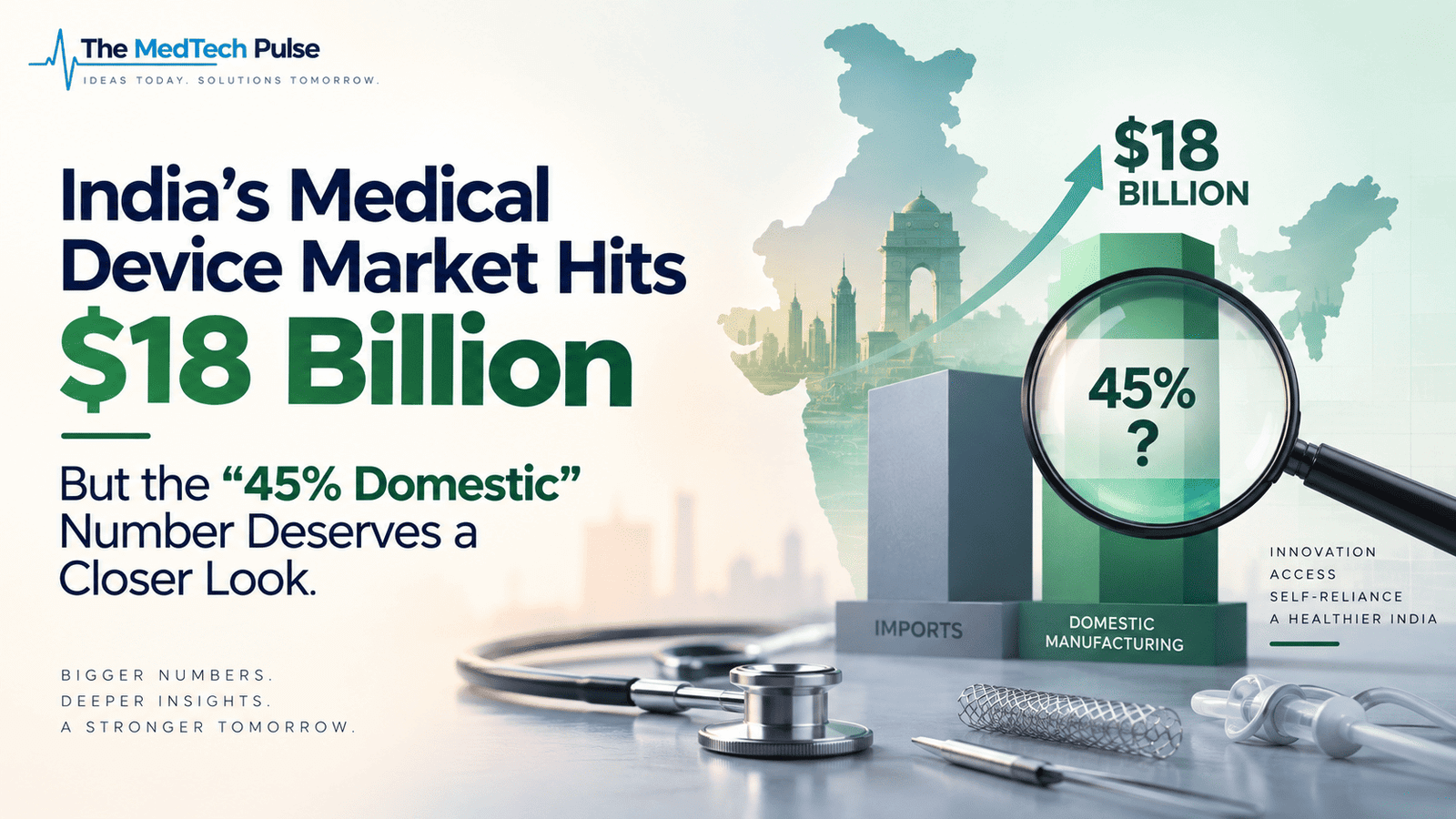
India’s medical device sector has crossed a genuinely significant threshold: multiple independent market research estimates now place the market at approximately $18 billion, up from roughly $12–15 billion just a couple of years ago. That growth is real, well-documented, and worth taking seriously. What deserves more scrutiny is a specific claim circulating alongside it — that domestic manufacturing’s share of this market has risen to “nearly 45%.” The data tells a considerably more complicated, and less flattering, story.
The $18 Billion Figure Checks Out
Unlike some of the more scattered market-size estimates that circulate for this sector, the $18 billion figure has genuinely strong, convergent support. Market Research Future places India’s medical devices market at $18.00 billion in 2025, rising to $19.49 billion in 2026. The India Brand Equity Foundation (IBEF) cites approximately $18.3 billion. Mordor Intelligence’s 2026 estimate sits at $18.30 billion, up from $16.97 billion the year before. That’s a genuinely tight cluster of independent estimates — enough to treat $18 billion as a reasonably solid current market-size figure, even accounting for the wider range other sources have cited historically (some estimates for FY2026 run as low as $11–15 billion depending on methodology and scope).
Projections for where this goes next vary more widely — Mordor projects $26.66 billion by 2031, Market Research Future projects $39.95 billion by 2035, and the more bullish IBEF and government-aligned figures continue to cite a $50 billion target by 2030, a figure industry analysts have increasingly flagged as aspirational rather than a base-case forecast.
Where the “45% Domestic” Claim Actually Comes From
Here’s the discrepancy worth flagging directly: recent Department of Pharmaceuticals commentary has referenced a government target of 40–45% domestic value addition for the medical device sector — but this is explicitly a target the government is pushing manufacturers toward, not a figure describing where the sector currently stands. Department of Pharmaceuticals Secretary Manoj Joshi has been on record stating that a meaningful share of what counts as “Made in India” medical device manufacturing today is closer to assembly than genuine deep manufacturing — directly at odds with a claim that domestic value addition has already reached anywhere near 45%.
The actual, current picture on import dependence looks quite different. A Parliamentary Committee on Health report found that India imports 88% of implants, 63% of all surgical instruments, and 52% of electronic equipment including CT scanners and MRI machines — figures that describe a sector still overwhelmingly import-reliant in its highest-value categories, not one approaching near-parity between domestic and imported supply. Separate industry analysis puts India’s broader import dependence at 70–80% in value terms as of FY2026, and even more conservative estimates place it at roughly 70% overall. A related figure that may be the actual source of confusion: multinational companies including GE Healthcare, Siemens Healthineers, Philips, Medtronic, and Abbott collectively hold approximately 40–45% of India’s medical device market revenue — a genuine, well-supported statistic, but one describing multinational companies’ market share, not the share of the market that is domestically manufactured. These are two entirely different metrics, and conflating them meaningfully overstates how far India’s import-substitution push has actually progressed.
The Trade Gap, in Concrete Numbers
Perhaps the clearest evidence of where things actually stand: the same Parliamentary Committee report cited FY25 figures showing India importing $8.8 billion worth of medical devices against just $4 billion in exports — a trade gap of roughly $4.8 billion in a single year, and one the committee flagged explicitly as exposing India to geopolitical risk, currency volatility, and global supply chain disruption. IBEF separately confirms medical device exports surpassed ₹33,908.56 crore (roughly $4.01 billion) in FY25 — consistent with the Parliamentary Committee’s figure, and a useful independent cross-check that the export side of this picture, at least, is being reported consistently across sources.
What Has Genuinely Improved
None of this is to say nothing has changed — real progress has been made, just not to the extent the “45% domestic” framing suggests. Under the Production Linked Incentive (PLI) Scheme for Medical Devices — a ₹3,420 crore outlay running from FY2022-23 to FY2026-27 — 22 to 24 greenfield manufacturing plants have been commissioned (figures vary slightly by reporting date), collectively booking roughly ₹12,344 crore ($1.48 billion) in cumulative sales and ₹5,869 crore ($703 million) in exports. Domestic manufacturing has genuinely commenced for categories that were almost entirely imported five years ago: MRI and CT equipment, linear accelerators, mammography systems, C-arms, ultrasound equipment, heart valves, stents, and dialysis products.
Cumulative foreign direct investment into India’s medical devices sector has reached ₹20,658 crore ($2.34 billion) since FY19, including ₹2,944 crore ($333 million) in FY26 alone through December 2025 — a meaningful signal of continued investor confidence in the sector’s manufacturing trajectory, even if the domestic-share figures themselves remain more modest than some framing suggests.
Where the Real Gaps Remain
The Parliamentary Committee’s category-specific import figures point precisely to where India’s manufacturing ambition still has the furthest to travel: implants (88% imported), surgical instruments (63% imported), and electronic imaging equipment including CT and MRI (52% imported) — exactly the high-value, technically demanding categories that require the deepest engineering and manufacturing capability to genuinely localise, rather than simply assemble from imported components.
Rajiv Nath, Forum Coordinator of the Association of Indian Medical Device Industry (AiMeD), has been consistent in framing this gap as an opportunity rather than a failure: “With demand rising and the Make in India thrust, there is an opportunity to reduce import dependence and build global competitiveness. But this requires bold reforms, targeted investment and procurement systems that reward quality.” That’s a notably candid assessment from the industry’s own leading trade body — acknowledging that opportunity and current reality remain some distance apart, and that closing the gap requires deliberate policy work, not just continued market growth.
The Parliamentary Committee itself recommended that public procurement give preference to Indian-manufactured medical devices with domestic content of at least 50% — a recommendation that, notably, implies the current baseline domestic-content requirement sits meaningfully below that threshold, further underscoring that a 45% current domestic-share figure doesn’t align with the policy conversation actually happening around this sector.
What This Means Going Forward
India’s medical device sector crossing $18 billion is a genuine, well-documented milestone, and the manufacturing progress made under the PLI scheme, the National Medical Devices Policy 2023, and various state-level initiatives is real and worth recognising. But the accurate story of India’s shift toward global manufacturing competitiveness is one of steady, still-early progress against deep import dependence in the highest-value categories — not a sector that has already closed half the gap. Multinational companies still generate roughly 40–45% of India’s medical device revenue, imports still dwarf exports by nearly $5 billion annually, and the government’s own 40–45% domestic value-addition figure is explicitly a forward-looking target, not a current achievement.
That distinction matters for how the industry, investors, and policymakers should read the sector’s trajectory. Genuine global manufacturing ambition — the kind reflected in indigenous devices like the Supraflex Cruz coronary stent clearing international regulatory bars, or VoxelGrids’ helium-free MRI scanner tackling import dependence at its technical root — is real and accelerating. But it’s happening from a base that remains far closer to 20–30% domestic in the sector’s highest-value categories than to 45%, and closing that remaining gap, as AiMeD’s own leadership has said, will require sustained reform rather than assuming the milestone has already been reached.
References
- Market Research Future — India Medical Devices Market Size, Share & Growth Report (https://www.marketresearchfuture.com/reports/india-medical-devices-market-17774)
- Mordor Intelligence — India Medical Devices Market Growth Segments & Share 2031 (https://www.mordorintelligence.com/industry-reports/india-medical-devices-market)
- Business Today — Why India’s Medical Devices Manufacturing Has Seen Limited Success (https://www.businesstoday.in/magazine/deep-dive/story/why-indias-medical-devices-manufacturing-has-seen-limited-success-549744-2026-08-18)
- The Tribune — India Importing 88% Implants, 63% Surgical Instruments (https://www.tribuneindia.com/news/health/india-importing-88-implants-63-surgical-instruments-431776/amp)
- IBEF — Medical Devices Industry in India: Market Share, Growth & Scope (https://www.ibef.org/industry/medical-devices)
- InsightRx — MedTech Market in India 2026: Import Dependence, the PLI Reality Check, and Where Margin Actually Sits (https://www.insightrx.in/insights/medtech-market-india-2026)
- US International Trade Administration — India Medical Devices Market Intelligence (https://www.trade.gov/market-intelligence/india-medical-devices)
- Businesses Estate — Top 10 Medical Devices Companies in India 2026 (https://www.businessesestate.com/medical-devices-companies-in-india/)
Note: Market size and domestic-manufacturing-share figures vary meaningfully across sources depending on methodology and category scope. This article presents the $18 billion market-size figure as well-supported by convergent independent estimates, while treating the “45% domestic manufacturing share” claim as inconsistent with Parliamentary Committee import data, official Department of Pharmaceuticals statements describing 40-45% domestic value addition as a target rather than a current figure, and multiple independent import-dependence estimates. Readers should treat domestic-share figures as contested and evolving rather than settled.