

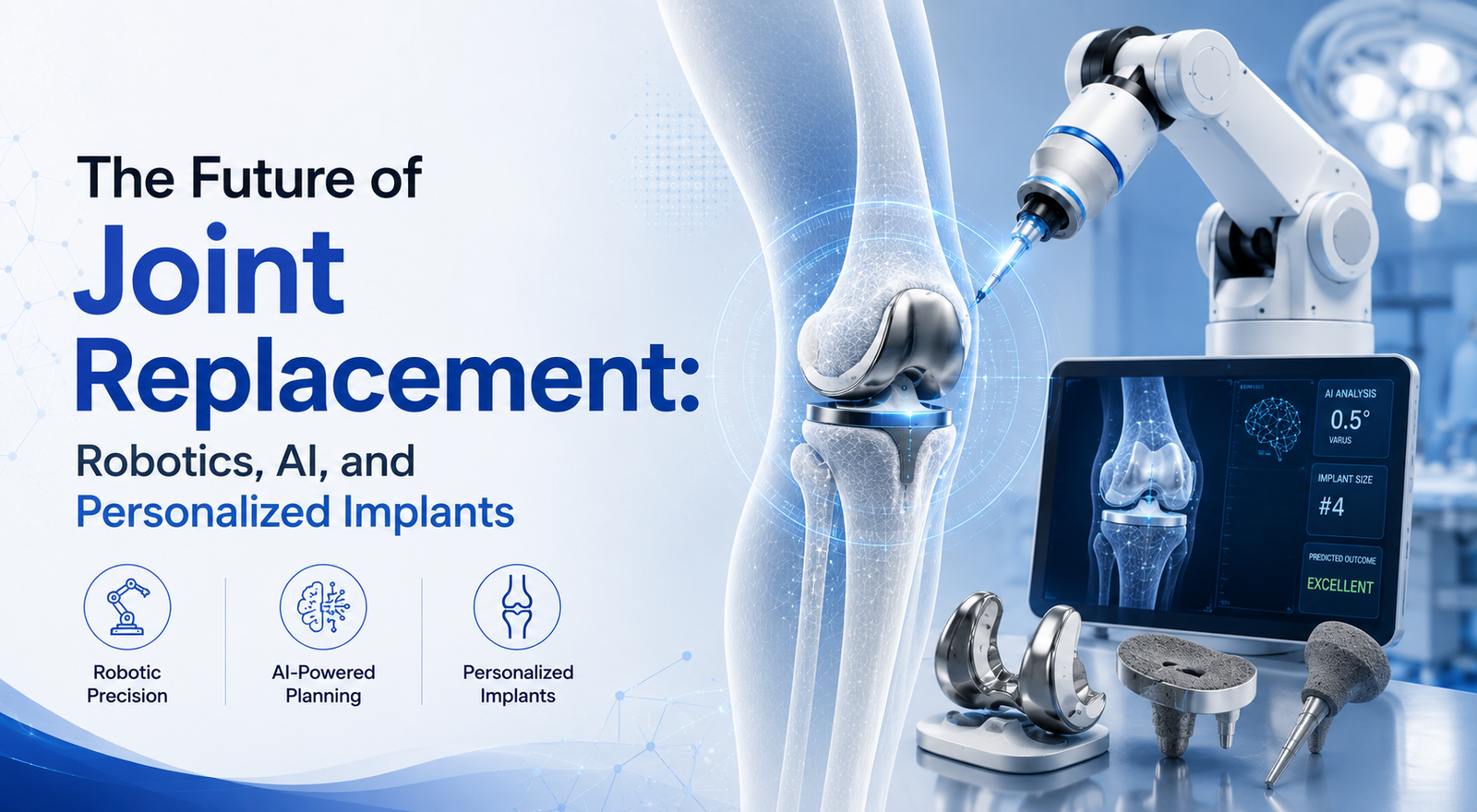
Joint replacement surgery has always been about restoring mobility and relieving pain — but the way surgeons get there is changing fast. Robotic-assisted joint replacement, artificial intelligence, and personalized implants are moving from “emerging technology” to standard-of-care conversation in operating rooms around the world. For patients facing hip or knee replacement, and for the clinicians who perform these procedures, understanding where the field is headed matters more than ever.
Why Joint Replacement Is Entering a New Era
Total knee and hip replacements are among the most common — and most successful — orthopedic procedures performed today. Yet outcomes have historically varied based on surgeon experience, implant fit, and manual instrumentation. The next generation of joint replacement technology is designed to close that gap, combining data-driven planning with mechanical precision to make every procedure more consistent, more predictable, and more tailored to the individual patient.
Robotic-Assisted Joint Replacement: Precision at the Point of Care
Robotic-assisted surgery is arguably the most visible shift in modern orthopedics. Robotic platforms don’t replace the surgeon — they extend the surgeon’s control with sub-millimeter accuracy in bone preparation and implant alignment.
Key benefits driving adoption of robotic knee and hip replacement include:
- Preoperative 3D planning using CT or MRI data to map joint anatomy before the patient ever enters the OR
- Real-time intraoperative feedback that keeps bone cuts and implant positioning within the planned parameters
- Soft-tissue balancing that adjusts for ligament tension dynamically, reducing the guesswork long associated with manual techniques
- Reduced variability between surgeons and cases, which is increasingly tied to lower revision rates
As robotic systems become more compact and more integrated into standard surgical workflows, the barrier to adoption — cost, training time, OR footprint — continues to shrink, making robotic-assisted joint replacement accessible to a broader range of hospitals and surgical centers, not just high-volume academic centers.
Artificial Intelligence: The Quiet Engine Behind Better Outcomes
While robotics gets the spotlight, AI is doing much of the heavy lifting behind the scenes. Machine learning models are increasingly used across the entire episode of care:
Preoperative planning – AI-driven imaging analysis can predict optimal implant size, position, and alignment based on thousands of prior cases, helping surgeons plan with a level of detail that would take hours to calculate manually.
Predictive analytics – Algorithms trained on large orthopedic registries can flag patients at higher risk for complications, prolonged recovery, or revision surgery, allowing care teams to intervene earlier with tailored protocols.
Surgical workflow optimization – AI-assisted scheduling and resource planning is helping surgical centers reduce OR turnover time and standardize perioperative protocols, which has a direct impact on infection rates and length of stay.
Post-operative monitoring – Wearable sensors paired with AI analytics now track gait, range of motion, and activity levels after surgery, giving clinicians objective recovery data instead of relying solely on patient-reported outcomes.
Together, these applications point toward a future where joint replacement isn’t just a single surgical event, but a continuously optimized care pathway — from the first consultation to full return to activity.
Personalized Implants: One Size No Longer Fits All
Perhaps the most patient-centered shift in orthopedics is the move toward personalized, patient-specific implants. Traditional implants come in a limited range of standard sizes, requiring surgeons to work within the constraints of what’s available. Personalized implant technology flips that model.
Using CT or MRI scans, manufacturers can now design and 3D-print implants and cutting guides matched to a patient’s unique bone geometry. This approach offers several advantages:
- Improved anatomical fit, which can translate to more natural joint kinematics and function
- Reduced intraoperative adjustments, since guides and implants are pre-matched to the patient’s anatomy
- Potential for shorter surgical times, as less on-the-fly modification is required
- Better alignment with a patient’s native biomechanics, particularly valuable for younger, more active patients who place higher long-term demands on their joints
As additive manufacturing costs continue to decline and design software becomes more sophisticated, patient-specific implants are moving from a niche offering to a mainstream option in comprehensive joint replacement programs.
What This Means for Surgical Teams
For surgeons and hospital systems, this convergence of robotics, AI, and personalized implants isn’t just a technology upgrade — it’s a shift in how surgical teams plan, execute, and evaluate procedures. Success in this new environment depends on more than the hardware itself. It requires:
- Surgical teams trained across multiple robotic and digital planning platforms
- Reliable, high-quality intraoperative products — from instrumentation to secure wound closure — that support consistent outcomes once the technical portion of the procedure is complete
- Data infrastructure capable of capturing and analyzing outcomes across the full care pathway
- A patient communication strategy that explains these advances in accessible, non-technical terms
It’s worth remembering that even the most advanced robotic or AI-guided procedure still ends with fundamentals: precise soft-tissue handling and reliable wound closure that supports healing and minimizes complications. As surgical precision improves upstream, the products used to close and protect the incision remain just as critical to a patient’s overall outcome and recovery experience.
Looking Ahead
The future of joint replacement will likely be defined by integration — robotic precision, AI-driven decision support, and personalized implants working together rather than as isolated technologies. Over the next several years, expect to see:
- Wider adoption of robotic platforms in mid-size and community hospitals
- AI models that combine imaging, genetic, and lifestyle data to further personalize implant selection
- Expanded use of patient-specific implants beyond hip and knee into shoulder and ankle replacement
- Greater emphasis on connected recovery tools that extend care beyond the hospital walls
For patients, this means joint replacement surgery that is increasingly tailored to their body, their activity level, and their long-term goals. For clinicians, it means new tools — but the same core responsibility: delivering safe, effective, and lasting outcomes.
The technology is evolving quickly. The commitment to patient outcomes remains the constant.