

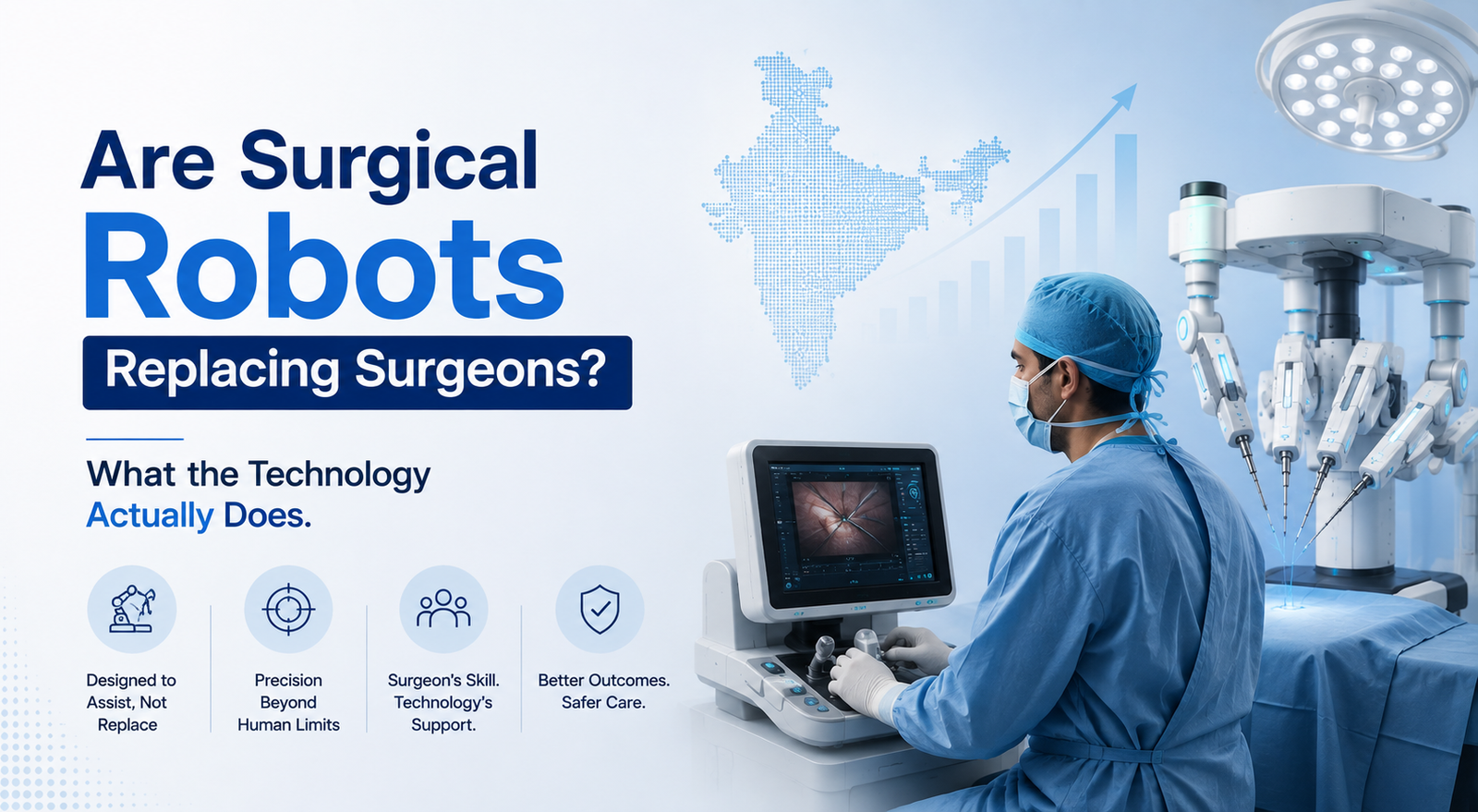
Walk into any conversation about the future of healthcare and it won’t take long before someone brings up surgical robots. Headlines love to frame it as a showdown: man versus machine, with the operating room as the arena. But ask anyone who has actually spent time in a modern OR, and you’ll get a very different answer. Robotic-assisted surgery isn’t replacing surgeons — it’s changing what a surgeon’s hands, eyes, and instruments are capable of.
This piece breaks down what surgical robots actually do, where the myths come from, and why the surgeon remains firmly in control from first incision to final closure.
The Myth: Autonomous Robots Performing Surgery
The fear (or fantasy, depending on who you ask) is that a robot rolls into the OR, scans the patient, and operates independently while the surgical team watches. That’s not how any FDA-cleared surgical robotic system works today, and it’s not the direction the technology is heading in the near term.
Every commercially available surgical robotic system — from the widely known da Vinci platform to newer entrants in orthopedics, spine, and general surgery — is a surgeon-controlled tool. The surgeon sits at a console (or stands tableside, depending on the platform) and directs every movement in real time. The robot doesn’t decide where to cut, how deep to go, or when a suture is placed. The surgeon does.
What Surgical Robots Actually Do
So if the robot isn’t operating on its own, what’s the point? The value of robotic-assisted surgery comes down to a handful of concrete capabilities:
1. Enhanced Precision and Range of Motion
Robotic instruments can rotate and articulate in ways the human wrist cannot, reaching angles that would be impossible with a scalpel or standard laparoscopic tool. This is particularly valuable in tight anatomical spaces — the pelvis, the thoracic cavity, small joints — where a few degrees of extra articulation can mean the difference between a clean dissection and a complicated one.
2. Tremor Filtration
Robotic systems filter out the natural micro-tremors present in every human hand. Over a multi-hour procedure, that stabilization reduces fatigue-related variability and helps maintain consistent instrument control from the first minute to the last.
3. 3D Visualization
Most robotic platforms pair with high-definition, magnified 3D imaging systems that give surgeons a far more detailed view of the surgical field than the naked eye or a standard 2D laparoscope. Better visualization supports more accurate tissue handling — which matters just as much during closure as it does during resection or repair.
4. Minimally Invasive Access
Robotic platforms are largely built around minimally invasive techniques, enabling complex procedures through small incisions instead of large open ones. That translates to real, measurable patient benefits: less blood loss, reduced postoperative pain, shorter hospital stays, and faster return to normal activity.
5. Data and Ergonomics
Less discussed but increasingly important: robotic consoles reduce the physical strain on surgeons who might otherwise be hunched over an operating table for hours. Some systems also capture procedural data that can support training, quality improvement, and outcomes research.
What the Robot Does Not Do
It’s worth being explicit about the boundaries, because this is where public misconceptions cluster:
- It doesn’t make clinical judgments. Decisions about anatomy, pathology, and surgical approach remain entirely with the surgical team.
- It doesn’t operate without a surgeon actively controlling it. There is no “autopilot mode” for surgery.
- It doesn’t replace surgical skill. If anything, operating a robotic platform well requires additional specialized training on top of core surgical expertise.
- It doesn’t eliminate the need for sound technique in wound closure. Precise tissue approximation, appropriate suture or staple selection, and proper tension are still fundamentally decisions made — and executed — by the surgeon or their team, whether the case is robotic, laparoscopic, or open.
Why the “Replacement” Narrative Persists
Part of the confusion comes from terminology. Phrases like “robotic surgery” and “AI-powered surgery” get used loosely in media coverage, blurring the line between robot-assisted instrumentation (available and mainstream today) and autonomous surgical AI (still largely experimental and, in most applications, far from clinical reality). Combine that with genuine advances in AI-assisted image analysis, and it’s easy to see how the narrative gets ahead of the technology.
There’s also a simpler explanation: “robots replacing doctors” is a more attention-grabbing headline than “sophisticated tool improves surgical outcomes.” The former sells clicks. The latter is what’s actually happening.
The Real Trend: Augmentation, Not Automation
The more accurate framing — and the one gaining traction among clinicians, hospital systems, and medtech companies alike — is surgical augmentation. Robotic platforms extend a surgeon’s capabilities rather than substitute for them. This mirrors a broader pattern across surgical technology: tools evolve to make skilled hands more precise, more consistent, and more capable in complex anatomy, without removing the clinical decision-making that defines good surgical care.
That principle holds true across the entire surgical workflow, not just the resection or repair phase. Whether a procedure is performed robotically, laparoscopically, or through open technique, the fundamentals of tissue handling and wound closure remain a surgeon-driven skill — supported by instrumentation and materials designed to work reliably in the surgeon’s hands, not around them.
Looking Ahead
Expect continued growth in robotic-assisted procedures across general surgery, urology, gynecology, orthopedics, and cardiothoracic surgery, along with incremental integration of AI-driven decision support tools — things like real-time image guidance and pattern recognition to flag anatomical structures. These will make the surgeon’s job easier and safer, but the trajectory is additive, not substitutive.
The Bottom Line
Surgical robots are not replacing surgeons. They’re expanding what surgeons can do — improving precision, visualization, and access while leaving clinical judgment, technical skill, and hands-on decision-making exactly where they’ve always belonged: with the surgical team. The technology’s real story isn’t about machines taking over the OR. It’s about giving skilled surgeons better tools to do what they already do best.