

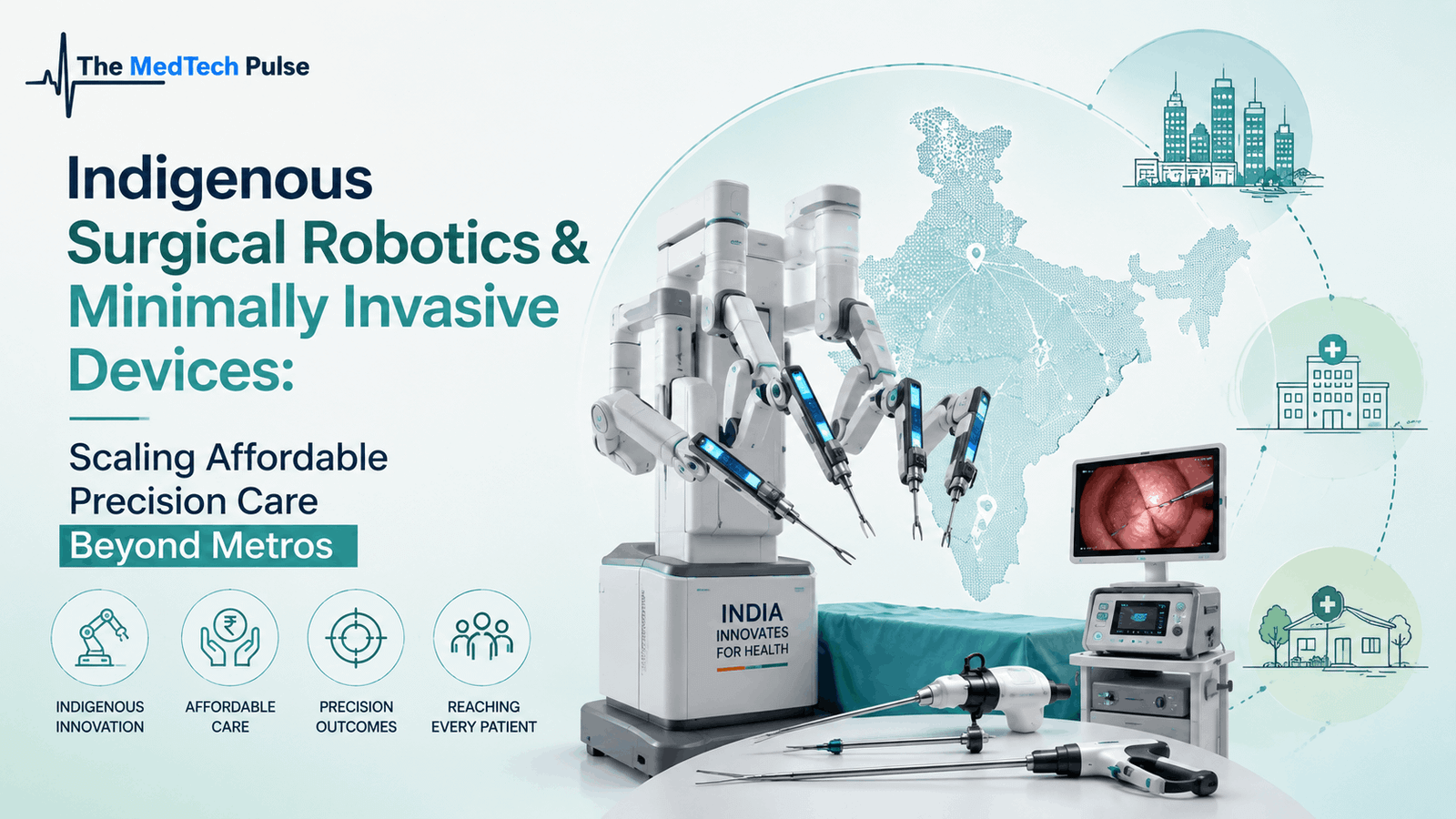
India’s surgical robotics story is entering a new chapter — one written not in Silicon Valley or Sunnyvale, but in Gurugram, Pune, and Surat. For nearly two decades, robot-assisted surgery in India meant one thing: an imported Intuitive Surgical da Vinci system, priced beyond the reach of most tier-2 and tier-3 hospitals. That is changing fast, and the shift has direct implications for near-home care MedTech devices India 2026 planners, hospital administrators, and clinicians outside the metros.
Made-in-India Robots vs. Imports: The Price Gap That Changes Everything
The clearest signal of disruption is price. A da Vinci system in India is typically priced between ₹16–18 crore, while SS Innovations’ indigenous SSi Mantra platform costs roughly ₹4.5 crore — less than a third of the da Vinci’s price tag. Company leadership has also noted that consumables and maintenance contracts for the Mantra run a third to half the cost of competing systems, which materially lowers the per-surgery cost that gets passed on to patients.
That price gap isn’t just theoretical. SS Innovations’ robots have now been used in over 5,000 surgical procedures, and the company is preparing a US FDA 510(k) submission and expects a European CE mark in the first half of 2026 — a sign that “affordable” doesn’t have to mean “compromised” on regulatory rigor. Outcome data specific to Indian tier-2 deployments is still emerging, but early hospital reports (Rajiv Gandhi Cancer Institute, Noble Hospitals Pune) describe comparable precision across general surgery, cardiothoracic surgery, urology, and gynaecology using five robotic arms, a 3D HD headset, and 3D 4K imaging.
Taking Robotics Beyond the Metros
The real test of “indigenous” innovation isn’t a metro installation — it’s whether the technology reaches Amritsar, Jodhpur, or Surat. SS Innovations’ MantraM roadshow, a mobile robotic training and demonstration unit, is explicitly built for this. Described as “more than just a mobile robotic training and demonstration unit… a national movement to democratise and decentralise access to world-class surgical education,” the vehicle is equipped with backup 5 kVA generators, high-speed telecom infrastructure, and satellite-enabled connectivity designed to support future telesurgery in underserved regions.
This decentralisation matters because specialist shortages, not just equipment costs, have historically kept robotic urology, gynaecology, and cardiac care confined to major cities. Even smaller Tier-2 surgical units — such as cardiothoracic programmes newly set up in cities like Amritsar — are demonstrating that specialised, high-acuity care can be safely delivered outside metro hubs when infrastructure and training investments follow.
Training and Infrastructure: The Real Bottleneck
Hardware is only half the equation. Robotic-assisted surgery demands console-time training, OT redesign, biomedical engineering support, and structured proctorship — infrastructure most tier-2/3 hospitals lack. Recognising this, premier institutes are formalising national training pipelines: AIIMS Delhi, for instance, signed an MoU with Intuitive to establish a robotic-assisted surgery training centre aimed at equipping surgeons and care teams across specialities including urology, gynaecology, and general surgery, with experienced robotic surgeons mentoring new surgeons nationwide. Indigenous manufacturers are running parallel, lower-cost mobile-simulation programmes to seed this skill base in smaller cities rather than waiting for surgeons to travel to Delhi or Mumbai.
Policy Tailwinds: PLI, CDSCO, and SAHI
Three policy threads are converging to make indigenous precision-care manufacturing viable:
- PLI Scheme for Medical Devices India: The government’s Production Linked Incentive scheme — a PLI scheme medical devices components initiative with a ₹3,420 crore outlay — has already helped 21 approved projects begin manufacturing 54 unique medical devices, including MRI machines, CT scanners, dialyzers, and heart valves, as of March 2025, attracting cumulative investment tied to a broader ₹1.76 lakh crore across 14 PLI sectors.
- CDSCO’s software and AI regulatory framework: With robotics increasingly software-defined, CDSCO’s Draft Guidance Document on Medical Device Software, issued October 21, 2025, clarifies how existing Medical Devices Rules, 2017 apply to SaMD (standalone apps) versus SiMD (software integrated into hardware), with Class A–D risk ranking and mandatory technical documentation for AI-based tools.
- SAHI — Strategy for AI in Healthcare for India: Launched by the Health Ministry at the India AI Impact Summit, SAHI is a national guidance framework enabling safe, ethical, evidence-based, and inclusive adoption of AI across India’s healthcare system, paired with BODH, a privacy-preserving benchmarking platform for evaluating health AI models without sharing underlying datasets.
What’s Next: AI-Integrated Robotics and 3D-Printed Guides
As CDSCO’s software rules mature, expect faster approval pathways for AI-assisted navigation, predictive analytics overlays, and patient-specific 3D-printed surgical guides — technologies that could further cut costs for smaller hospitals by reducing OT time and complication rates. Globally, incremental AI features like tremor reduction and anatomical overlays are already standard on premium systems; India’s regulatory clarity on SaMD/SiMD classification positions domestic manufacturers to build these capabilities compliantly rather than as an afterthought.
Practical Takeaways for Hospitals and MedTech Teams
- Cost planning: Budget for capital cost (~₹4.5 crore indigenous vs. ~₹16–18 crore imported) and the recurring consumables/AMC gap — the latter often decides long-term ROI.
- Regulatory readiness: Track CDSCO’s finalised MDSW guidance if your device includes any AI or connected-software component.
- Training first, hardware second: A robot without a trained surgical team and biomedical support staff will sit idle — invest in console-hours before console-count.
- Watch policy signals: PLI disbursement data, SAHI rollout guidance, and India Health 2026 expo announcements will shape which components and AI modules get faster approvals.
The direction is unmistakable: affordable, indigenous, software-integrated robotics are no longer a metro-only story. The next milestone isn’t another Delhi installation — it’s a sustained, trained, well-regulated robotic surgery programme in a district hospital.
FAQs
Q: Are Made-in-India surgical robots as safe as imported systems like da Vinci? A: Indigenous systems like SSi Mantra are approved by CDSCO and have been used in thousands of procedures across general surgery, cardiac, urology, and gynaecology. Long-term comparative outcome studies are still accumulating as adoption scales, so hospitals should review site-specific outcome data and surgeon experience.
Q: Why are Made-in-India robots so much cheaper? A: Lower R&D and manufacturing costs, domestic component sourcing (supported by the PLI scheme), and a deliberate pricing strategy to expand access outside metros all contribute to the roughly one-third price point compared to imported systems.
Q: What regulations govern AI-enabled surgical robotics in India? A: The Medical Devices Rules, 2017 apply, supplemented by CDSCO’s Medical Device Software guidance (covering SaMD/SiMD classification) and the newly launched SAHI framework, which sets national principles for responsible AI adoption in healthcare.
Q: Can smaller hospitals outside metros realistically adopt robotic surgery? A: Yes — with caveats. Lower capital and consumable costs make it financially closer to reach, but hospitals need dedicated OT infrastructure, trained surgical teams, and biomedical support. Mobile training initiatives are specifically designed to close this gap.
References
- MedTech Dive — How SS Innovations is expanding robotic surgery’s reach
- Business Standard — The SSI Mantra: India’s own surgical robot boasts cheaper price tag
- Healthcare Radius — SSI launches India’s first surgical robot roadshow with MantraM
- Digital Health News — “Made-in-India” MantraM Surgical Robot Unveiled in Gujarat
- Web Asha Technologies — Pune’s First Made-in-India Surgical Robot
- India Briefing — India’s Medical Devices Sector: PLI Progress & 2026 Outlook
- Operon Strategist — PLI Scheme Boosts Medical Device Manufacturing in India
- Cyril Amarchand Blogs — Medical Device As Software: Has CDSCO Guidance Changed The Rules?
- Qualysec — CDSCO Medical Device Software Compliance Guide 2026
- News on Air (PIB) — Minister of State for Health Anupriya Patel Announces SAHI Framework for AI in Healthcare
- News on Air (PIB) — Health Minister Unveils National AI-in-Healthcare Strategy and Data Platform (SAHI & BODH)
- News on Air (PIB) — AIIMS Delhi signs MoU with Intuitive to establish centre for robotic-assisted surgery