

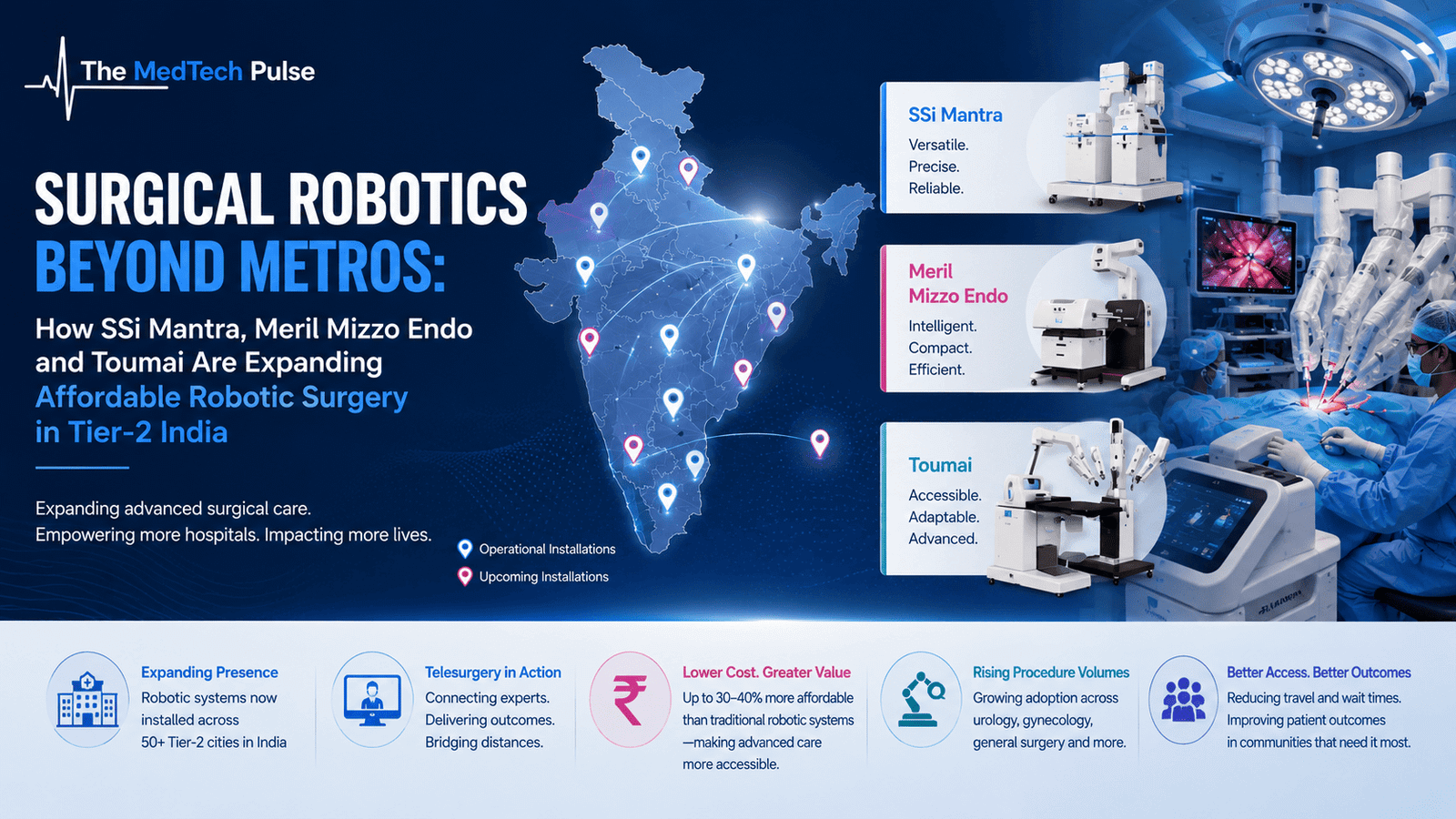
Robotic surgery in India used to mean one thing: a da Vinci system in a handful of flagship hospitals in Delhi, Mumbai, Chennai, or Bengaluru, available to patients who could pay a premium and travel to get it. That picture has changed faster than most people realise. Between an Indian-designed platform performing surgery across continents, a domestically manufactured system that’s sparked a genuine “Made in India vs Made in China” regulatory dispute, and a Chinese robot quietly building an installation base in Tamil Nadu, 2025–2026 has been the most consequential stretch yet for who actually gets access to robotic surgery in India.
Here’s the real map of what’s happening — installations, telesurgery milestones, and what it costs.
SSi Mantra: India’s Own Platform, Now Doing Surgery Across Continents
SS Innovations International (SSII), founded by Dr. Sudhir Srivastava, built the first surgical robotic system made in India, and by 2025–2026 it had become the most aggressively deployed indigenous robotics platform in the country — and increasingly, the world.
The installation numbers
The scale of rollout has been genuinely fast. “Dispatching over 103 SSI Mantra systems in a single year is not just a milestone, it reflects the trust of surgeons, hospitals, and healthcare systems in our technology,” said Sudhir Srivastava, Founder, Chairman, and CEO of SS Innovations International, reflecting on 2025. By Q2 2026, cumulative installations had reached 224 systems across 12 countries, with SS Innovations placing 30 SSi Mantra systems during the quarter alone — exceeding analyst expectations of 25 — and quarterly revenue reaching $13.9 million, up 39% year over year, with system sales increasing 41% to $12.4 million.
Adoption inside India has spread well beyond the usual metro flagship institutions: the SSI Mantra has been introduced and adopted at leading healthcare institutions including the Apollo group, Manipal group, IRCAD, Aster group, Medanta Patna, Marengo, KGMU, ESI, AIIMS, and the Chittaranjan Institute of Cancer, among others. To physically reach beyond metro hospitals, the company took the platform on the road: the SSI MantraM “Made in India” Surgical Robot Yatra travelled thousands of kilometres across Rajasthan, Madhya Pradesh, Maharashtra, and Gujarat, allowing doctors to experience advanced robotic and telesurgery capabilities firsthand.
Telesurgery: the real differentiator
What sets SSi Mantra apart isn’t just installation count — it’s that it is also the only robotic system currently approved for telesurgery in India by the Central Drugs Standard Control Organisation (CDSCO). That approval has translated into a genuinely unusual clinical track record:
- On August 8, 2025, a robotic telesurgery was performed between Chennai and Salem using a dual-console SSI Mantra 3 setup — a robotic transabdominal preperitoneal (TAPP) hernia repair conducted via a secure fibre network, marking what researchers describe as the first successful inter-hospital telesurgical procedure in India.
- India’s first robotic telesurgery in Andhra Pradesh was performed at Tirumala Medicover Hospital in Vizianagaram — a Tier-3 city — bridging significant geographical distance between the surgeon and patient using the SSI Mantra system.
- Two robotic cardiac surgeries were performed via telesurgery over a distance of 286 km, remotely at Manipal Hospital Jaipur by a surgeon operating from Gurugram; the first procedure, a telerobotic-assisted internal mammary artery harvesting, was completed in just 58 minutes with an ultra-low latency of 35–40 milliseconds.
- A total of 18 inter-hospital telesurgeries were performed between two Indian cities within an eight-hour period on February 14, 2026, including 13 gastric bypass procedures performed by Dr. Mohit Bhandari of Mohak Bariatrics and Robotics, Indore, and five complex gynaecological surgeries performed by Dr. Priya Bhave Chittawar of HER Health Hospital, Bhopal — all using the SSi MantrAsana Tele Surgeon Console, a compact, chair-based version of the surgeon command centre designed for portability.
- Most strikingly for the global positioning of Indian MedTech: SS Innovations enabled a robotic telesurgery spanning approximately 22,000 km between Hospital Internacional de Colombia and Mohak Bariatrics and Robotics in Indore — a robotic sleeve gastrectomy performed remotely from Colombia, completed with a network round-trip latency of approximately 275–285 milliseconds.
Beyond India, FDA review of the SSi Mantra 510(k) application is now expected by the end of Q1 2027, while European CE marking remains targeted for end of 2026 — meaning the “affordable Indian robot” story is increasingly also becoming an export story.
Meril’s Mizzo Endo 4000: Ambitious Launch, Contested Origins
Meril Life Sciences, headquartered in Vapi, Gujarat, entered the surgical robotics race in September 2025 with a soft-tissue robotic platform positioned as a serious rival to both SSi Mantra and global incumbents.
What the device claims to do
The Mizzo Endo 4000 is a versatile platform supporting general, gynaecology, urology, thoracic, colorectal, bariatric, hepatobiliary, ENT, gastrointestinal, and oncology surgeries, integrating AI-powered 3D anatomical mapping, an open console design, and 5G-enabled telesurgery. Meril has also built the commercial infrastructure around it: beyond the robotic platform itself, Meril has developed a complete ecosystem — training at Meril Academy, clinical support, a robust service network, and integration with its broader surgical portfolio, from sutures and implants to advanced operation theatre solutions.
The “Made in India or Made in China” controversy
This is the part of the Mizzo Endo story that any honest account has to include, because it’s directly relevant to how “indigenous” MedTech claims get scrutinised in India. In September 2025, Gurugram-based SS Innovations wrote to CDSCO alleging that Gujarat-based Merai Newage — a Meril subsidiary — had imported a fully manufactured surgical robotic system, the KANGDUO 2000, from China, merely re-labelling and repackaging it as the Mizzo Endo 4000 without local manufacturing or value addition. SS Innovations accused the company of misrepresenting imported devices as designed and made in India, and questioned how CDSCO issued a manufacturing licence when the company reportedly lacked production facilities in India.
Meril pushed back firmly. Meril Group CEO Vivek Shah told reporters that the Mizzo Endo 4000 is an India-manufactured product, fully integrated and validated at Meril’s own facility in compliance with Indian regulations, stating that “while select high-quality components are sourced globally — as is standard in advanced robotics — the safety architecture, core assembly, software integration, and quality checks are entirely performed in India,” and that leveraging a global supply chain while building domestic capability is “fully aligned to generate employment and capability within India and across the globe.” Shah also directly addressed the sourcing question: he acknowledged that some parts used in the robotic system have been sourced from the US, UK, and some Asian countries, including China, but insisted the device is “not Made in China.”
The dispute also surfaced a genuine regulatory gap. Rajiv Nath, Forum Coordinator of the Association of Indian Medical Device Industry (AiMeD), noted that under the current Drugs and Cosmetics Act, even labelling or repackaging is accepted as “manufacturing,” allowing organisations that rebrand imported products to obtain such a licence — calling this unfair to manufacturers who have invested heavily in genuine greenfield component manufacturing, and arguing that medical devices should be brought under a separate, more precise set of regulations.
As of this writing, CDSCO has not publicly issued findings on the SSI complaint. The dispute is worth flagging for readers evaluating “Made in India” claims across the broader MedTech sector, not just this one device: it illustrates exactly the “assembly vs. genuine manufacturing” tension that runs through India’s PLI scheme and CDSCO regulatory reforms more broadly.
Meril’s other robotics play: MISSO and the cost argument
Separate from the Mizzo Endo controversy, Meril’s earlier robotics product — MISSO, an orthopaedic knee-surgery robot — offers the clearest published cost comparison in Indian surgical robotics, and it’s worth using as a benchmark for the affordability argument the whole sector makes. While global leaders like the da Vinci Surgical System command prices upwards of ₹6 crore, MISSO is priced at approximately ₹2 crore, making it accessible to a much wider range of hospitals, including those in Tier 2 and Tier 3 cities. Globally, the gap is even starker: the da Vinci Surgical System costs over $2 million — approximately ₹16 crore — restricting its use largely to top-tier metropolitan hospitals. Meril’s stated ambition for MISSO specifically targets the geography this article is about: a phased rollout plan of 100 installations in the first year, scaling to 1,000 within three years, explicitly aimed at Tier-2 and Tier-3 hospitals rather than repeating the metro-only distribution pattern of imported systems.
Toumai: The Chinese Entrant Building an Indian Foothold
The third major platform reshaping India’s robotic surgery landscape isn’t Indian at all — it’s MicroPort MedBot’s Toumai, and its India entry has been notably fast and multi-city.
Kokilaben Dhirubhai Ambani Hospital in Mumbai announced the launch of the Toumai Robotic Surgery System, marking the first installation of this advanced surgical system in India, with the hospital emphasising the device’s telesurgery range: the system enables real-time remote operation with zero perceptible delay across distances of up to 5,000 km. Early clinical uptake was rapid: Kokilaben Hospital performed over 50 urology procedures using Toumai and began multi-specialty expansion within its first month.
The platform has since spread well beyond Mumbai and into genuinely Tier-2 territory: Meenakshi Super Speciality Hospital in Madurai selected the Toumai MT-1000 Pro after an extensive evaluation process that included consulting surgeons from the Cleveland Clinic and visiting hospitals in New Zealand and Sydney — the first installation of the MT-1000 Pro model in Tamil Nadu. And Dr. G. Viswanathan Hospital in Trichy installed the MedBot Toumai to support precision-led complex surgical procedures, extending the platform’s Tamil Nadu footprint to a third city.
Globally, Toumai has moved fast on the telesurgery front too — in April 2025, Toumai became the world’s first surgical robot to receive regulatory approval for commercial remote surgery, and the system has since achieved FDA-IDE approval in the US and performed the UK’s first telesurgery. That international telesurgery momentum matters for India specifically because it puts real competitive pressure on SSi Mantra’s current position as the only CDSCO-approved telesurgery platform domestically — a status that’s unlikely to remain exclusive for long as more players seek the same regulatory clearance.
Comparing the Three: What This Means for Tier-2 Hospital Adoption
Putting these three platforms side by side reveals a genuinely competitive, multi-model market rather than a single winner:
- SSi Mantra leads on telesurgery regulatory status (currently the only CDSCO-approved platform for it) and sheer installation velocity (224 systems across 12 countries by Q2 2026), with an explicit strategy of physically touring Tier-2 and Tier-3 states to build surgeon familiarity before installation.
- Meril’s Mizzo Endo 4000 brings the broadest surgical-specialty range and Meril’s existing distribution and training infrastructure across India, but carries an unresolved “genuine domestic manufacturing vs. relabelled import” question that hospitals and patients evaluating “Made in India” claims should be aware of. Meril’s separate MISSO platform, meanwhile, offers the sector’s clearest published price point — roughly a third of da Vinci’s cost — aimed specifically at Tier-2/3 hospitals.
- Toumai is the fastest-moving import entrant, already installed in three Tamil Nadu cities within roughly a year of its first Indian installation, backed by aggressive global telesurgery credentials from its Chinese parent company MicroPort MedBot.
What’s Still Missing From the Picture
A few things worth flagging honestly for readers evaluating this space:
- Public procedure-volume and outcomes data remains thin. Most of what’s publicly available is installation counts and milestone press releases rather than peer-reviewed outcomes comparisons across platforms — the Chennai–Salem SSi Mantra case report is a rare exception.
- Published pricing for Mizzo Endo 4000 and Toumai in India is not yet public, unlike MISSO’s disclosed ₹2 crore price point. Cost comparisons across all three platforms — critical for genuine Tier-2 hospital adoption decisions — remain an information gap the sector hasn’t filled yet.
- The Mizzo Endo origin dispute is unresolved. Any hospital or patient making decisions partly on “indigenous, Make-in-India” grounds should treat that specific claim as contested pending CDSCO’s findings, rather than settled fact.
The Bigger Picture
Robotic surgery access in India is genuinely decentralising — not through a single champion platform, but through three different companies racing into Tier-2 and Tier-3 cities at once, each with a different value proposition: SSi Mantra’s telesurgery-first, India-designed approach; Meril’s broad specialty coverage and existing distribution muscle; and Toumai’s fast, well-funded international expansion. For patients in Trichy, Madurai, Indore, Bhopal, and Vizianagaram, that competition is already translating into robotic procedures that, until very recently, would have meant a trip to Chennai, Mumbai, or Delhi. Whether pricing follows the MISSO model of genuine Tier-2 affordability — or converges back toward metro-hospital economics as adoption scales — is the question that will determine how far this decentralisation actually goes.
References
- PMC / National Library of Medicine — From Concept to Clinical Practice: Interhospital Robotic Telesurgery Using the SSI Mantra 3 Surgical Robotic System
- Medical Dialogues — Made-in-India Surgical Robot Enables 22,000 km Cross-Continental Telesurgery
- Robotics and Automation News — SSi Mantra surgical robot gains telesurgery approval as remote robotic surgery expands globally
- First India — Indian Medtech company Decentralizing and Democratizing Robotic Surgery in 2026
- MissionIR — SS Innovations International Inc. Indian Surgical Robotics Growth Points to Broader Market Opportunity
- DD News — India’s first robotic system performs telesurgeries over a distance of 286 km
- ThePrint — Made in India or Made in China? Two firms spar over a next-gen surgical robot
- OC Academy — Surgical Robotics India: Meril Unveils Mizzo Endo 4000 System
- NITI Aayog Frontier Tech Hub — Democratizing Robotic Surgery: How MISSO Cuts Costs And Expands Access
- Healthcare Radius — Kokilaben Hospital launches India’s first Toumai robotic surgery system
- TipRanks — MicroPort Medbot Gains Indian Reference Site for Toumai Robotic Surgery System
- Digital Health News — Trichy-based Dr G Viswanathan Hospital Launches MedBot Toumai Surgical Robot
- MicroPort MedBot — Toumai Surgical Robot Achieves Global Commercialization Milestone with 100 Orders
Note: The dispute regarding the origin of Meril’s Mizzo Endo 4000 was unresolved by CDSCO as of the most recent reporting available. This section is presented factually based on both parties’ public statements; readers should look for CDSCO’s final determination before treating either party’s claim as settled. Pricing figures for Mizzo Endo 4000 and Toumai in the Indian market were not publicly disclosed at the time of writing; the ₹2 crore MISSO price point is used here as the sector’s only disclosed benchmark and should not be assumed to apply to other platforms.