

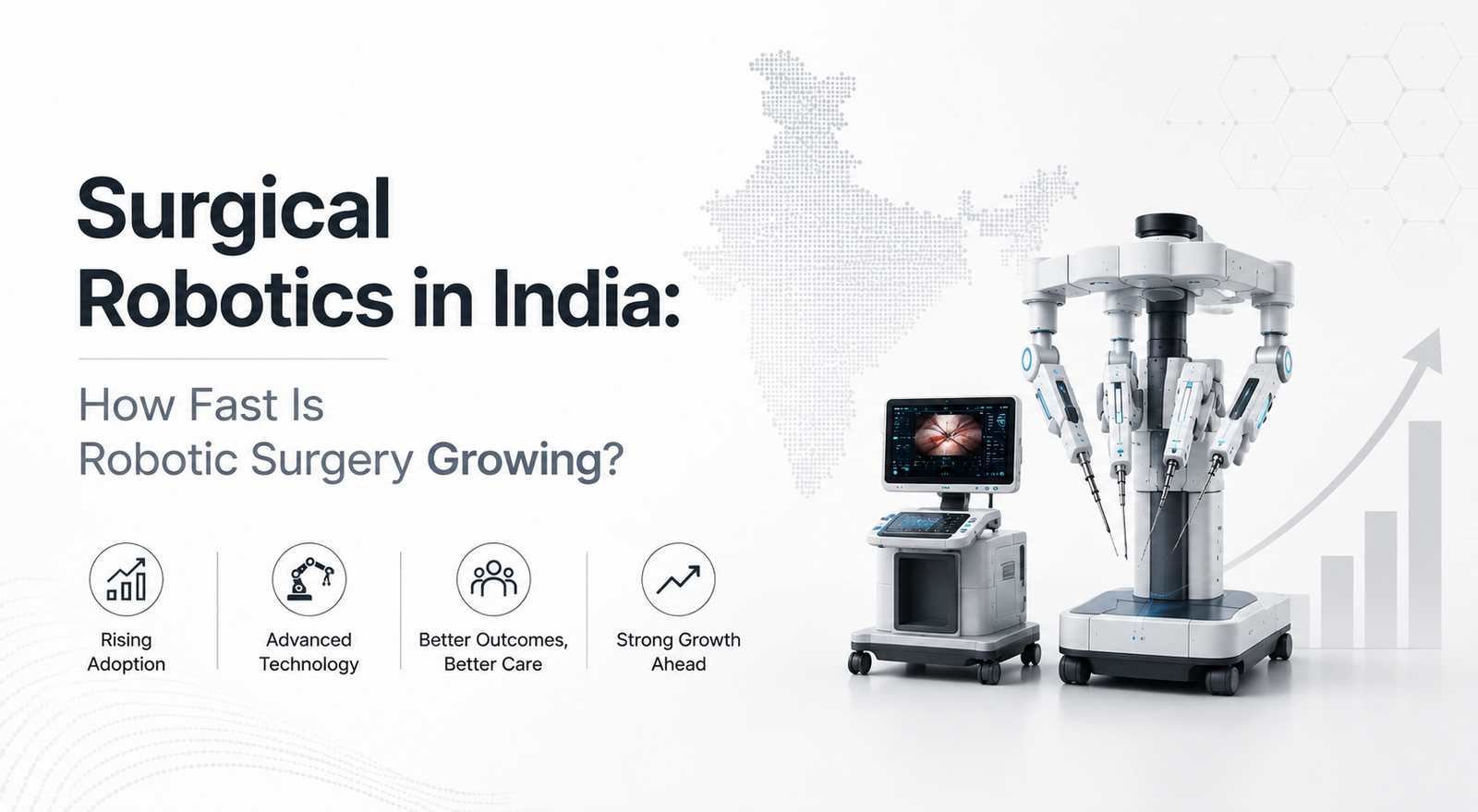
Ten years ago, robotic-assisted surgery in India was largely confined to a handful of metro hospitals and a small circle of specialist surgeons. Today, robotic platforms are being installed in Tier 2 and Tier 3 cities, government hospitals are running training programs around them, and homegrown manufacturers are building systems designed specifically for Indian price points. The question is no longer whether robotic surgery will become mainstream in India — it’s how fast that shift is happening, and what it means for hospitals, surgeons, and patients along the way.
The Numbers: A Market Growing in Double Digits
Market research firms don’t always agree on exact figures — estimates for India’s surgical robotics market range from under a billion dollars to several billion, depending on scope and methodology — but they agree on the direction. Most analysts place India’s robotic-assisted surgery (RAS) market on a compound annual growth rate (CAGR) somewhere between 14% and 22% through the early 2030s, which is significantly faster than the global average for surgical robotics.
To put that in perspective: one widely cited estimate puts the Indian surgical robotics market at roughly $850 million in 2023, with projections reaching close to $3.7–4 billion by 2031. Other industry trackers put India’s robotic-assisted surgery services segment on pace to roughly quintuple in value over the same period. Regardless of which model you follow, the trajectory is unmistakable: India is one of the fastest-growing robotic surgery markets in the Asia-Pacific region, trailing only China and Japan in overall installed base.
For context, India performs an estimated 3 crore (30 million) surgeries every year, the vast majority still using conventional open or laparoscopic techniques. Robotic-assisted procedures remain a small fraction of that total today — but it’s a fraction that’s expanding quickly as more hospitals bring systems online and more surgeons complete robotic training.
What’s Driving the Growth?
1. Rising Burden of Chronic and Complex Disease
India’s growing rates of cancer, cardiovascular disease, and orthopedic conditions are pushing more patients toward procedures where robotic precision offers a clear clinical edge — particularly in urology, oncology, and joint replacement.
2. Demand for Minimally Invasive Surgery
Patients and surgeons alike are gravitating toward techniques that mean smaller incisions, less blood loss, shorter hospital stays, and faster return to daily life. Robotic platforms extend the benefits of laparoscopic surgery with greater dexterity and 3D visualization, making complex minimally invasive procedures more consistently achievable.
3. Homegrown Manufacturing
A defining trend in this cycle of growth is indigenization. Indian companies have begun designing and manufacturing surgical robots domestically, aimed at bringing per-procedure costs down and reducing reliance on imported systems. This includes India’s own surgical robotic platforms now used for cardiac, general, and gynecological procedures — with one Indian-made system reportedly completing the country’s first robotic telesurgery, performed over a fiber-optic network across several kilometers.
4. Government Push into Public Hospitals
Robotic surgery is no longer the exclusive domain of premium private hospitals. Government institutions — including AIIMS and several state medical colleges — have added robotic systems and training curricula, in some cases posting rapid case volumes shortly after installation. This public-sector expansion is central to the government’s broader push to modernize surgical infrastructure and improve access outside major metros.
5. Expansion Beyond Metro Cities
Robotic programs that were once concentrated in Delhi, Mumbai, Chennai, and Bengaluru are increasingly reaching Tier 2 and Tier 3 cities, supported by training centers and lower-cost domestic platforms that make adoption more financially viable for mid-sized hospitals.
Which Specialties Are Leading Adoption?
Robotic surgery adoption in India isn’t uniform across specialties. The clearest growth is currently concentrated in:
- Urology — historically the anchor specialty for robotic platforms, covering prostatectomies and kidney procedures, and typically the largest single revenue segment.
- General Surgery — including hernia repair, gallbladder removal, and colorectal procedures, an area expected to grow quickly as platforms become more versatile.
- Gynecology — hysterectomies and other reproductive surgeries performed with greater precision and reduced recovery time.
- Orthopedics — a rapidly rising segment, driven by robotic and AI-assisted total knee and hip replacement systems that improve implant positioning accuracy.
- Cardiothoracic and Oncologic Surgery — smaller in volume today but growing as surgeons gain confidence with robotic platforms for complex resections.
The Challenges That Still Slow Adoption
Rapid growth doesn’t mean frictionless growth. A few structural constraints continue to shape how quickly robotic surgery scales across India:
- High capital and per-procedure costs, which remain the single biggest barrier for hospitals outside major metros
- Uneven distribution of trained robotic surgeons, particularly in rural and semi-urban regions
- Limited reimbursement support for robotic procedures compared with conventional surgery in much of the private insurance market
- Infrastructure gaps in smaller hospitals that make housing and maintaining robotic systems difficult
Domestic manufacturing and modular, lower-cost platforms are beginning to chip away at the cost barrier, but training capacity and reimbursement policy will likely determine how quickly adoption spreads beyond well-resourced hospital networks.
What This Means for Surgical Teams and Patients
For surgeons, robotic platforms are increasingly framed not as a replacement for skill but as an extension of it — offering enhanced visualization, tremor filtration, and articulated instrument control that can support more consistent outcomes in technically demanding procedures. For patients, the appeal is straightforward: smaller incisions, less postoperative pain, reduced blood loss, and shorter hospital stays.
That said, robotic assistance doesn’t remove the fundamentals of good surgical technique — including how tissue is handled and how wounds are closed. As robotic and minimally invasive procedures become more common, the choice of sutures and staples used to close smaller, more precise incisions matters just as much as it does in open surgery, if not more, given how closely patients now scrutinize scarring and recovery time.
Where This Is Headed
India’s robotic surgery market is still small relative to procedure volume overall, but its growth rate places it among the fastest-expanding markets globally. With domestic manufacturing lowering entry costs, government hospitals building training pipelines, and demand for minimally invasive care rising across both metro and non-metro India, robotic-assisted surgery is on track to move from a premium offering to a standard part of the surgical toolkit over the next decade.
The pace of that shift will depend on how quickly training, reimbursement, and infrastructure catch up with the technology — but the direction of travel is no longer in question.
FAQs
How fast is the robotic surgery market growing in India? Most industry estimates place India’s robotic-assisted surgery market growth between 14% and 22% CAGR through the early 2030s, among the fastest growth rates in the Asia-Pacific region.
Which surgical specialties use robotic surgery the most in India? Urology, general surgery, gynecology, and orthopedics currently lead adoption, with oncology and cardiothoracic surgery growing steadily.
Is robotic surgery available outside major Indian cities? Yes. While adoption began in metro hospitals, robotic platforms are increasingly being installed in Tier 2 and Tier 3 cities and government hospitals, supported by lower-cost domestic systems and expanding training programs.
What is limiting faster adoption of robotic surgery in India? The main barriers are high system and procedure costs, a shortage of trained robotic surgeons outside major cities, and limited insurance reimbursement for robotic procedures compared with conventional surgery.