

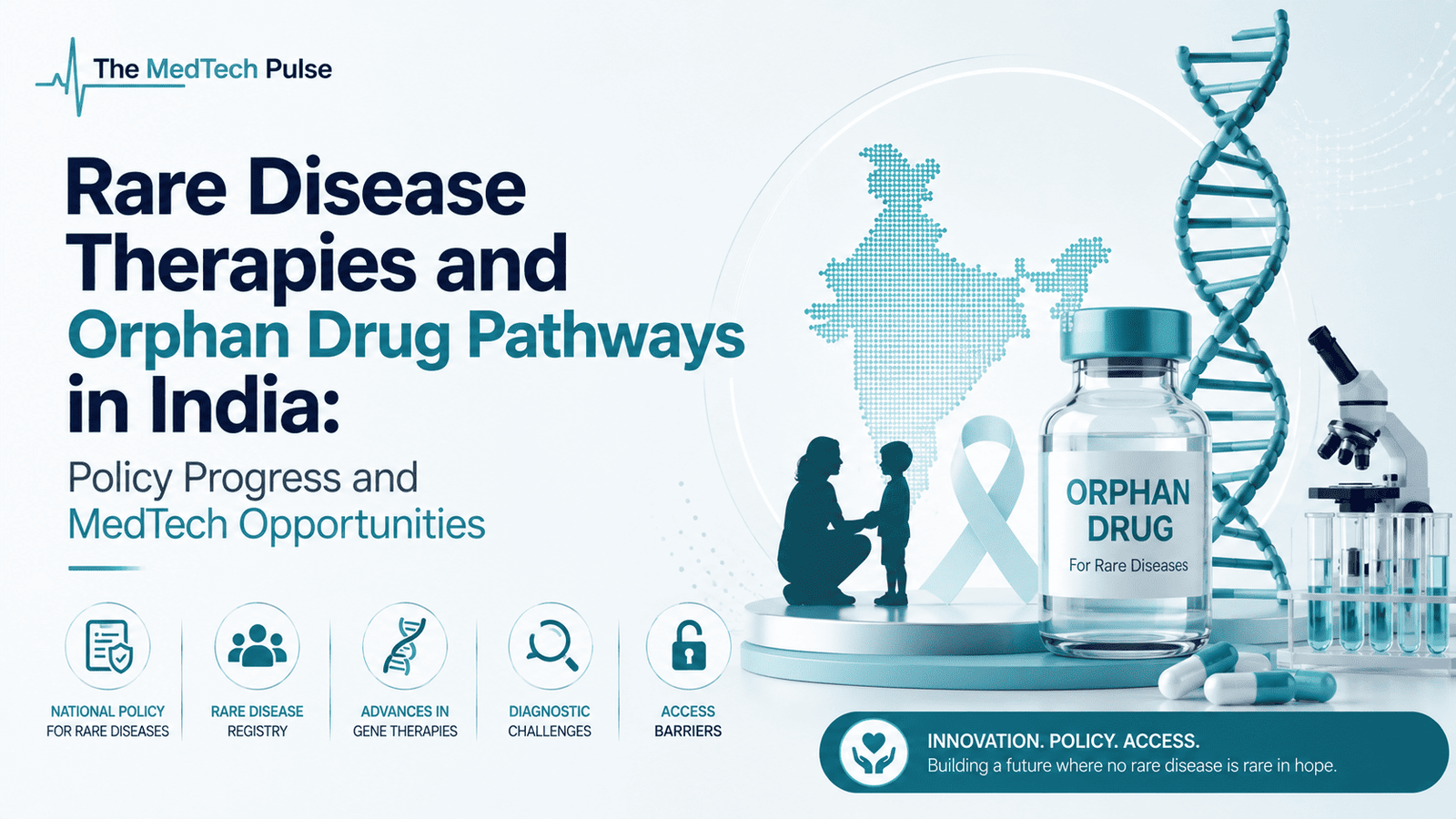
There are somewhere between 6,000 and 8,000 recognised rare diseases worldwide, and fewer than 5% have any approved therapy at all. In India specifically, about 95% of rare diseases have no approved treatment, and less than 1 in 10 diagnosed patients receive any disease-specific therapy. Those aren’t small numbers when you consider the scale of India’s population — even conditions classified as individually “rare” collectively affect millions of Indians. The country’s policy response, the National Policy for Rare Diseases (NPRD) 2021, has been running for five years now. Here’s an honest look at what it’s actually delivered, where the gaps remain, and where genuine MedTech and biotech opportunity sits inside those gaps.
What the NPRD 2021 Actually Set Out to Do
The Ministry of Health & Family Welfare launched the National Policy for Rare Diseases in March 2021, replacing an earlier, more limited National Policy for Treatment of Rare Diseases from 2017. The 2021 policy is considerably more comprehensive in scope — it addresses prevention, awareness, research, diagnosis, treatment, affordable orphan drug development, insurance coverage, and a framework for progressive action, built on recommendations from an expert committee and patient advocacy groups.
The policy’s most direct financial commitment is aimed at the most severe, one-time-treatable cases: the government provides financial assistance of up to ₹20 lakh, under the Umbrella Scheme of Rashtriya Arogya Nidhi and in line with PMJAY (Ayushman Bharat) norms, to eligible patients for treatment at government tertiary hospitals — specifically for rare diseases classified under “Group 1,” meaning those amenable to one-time treatment or intervention rather than requiring lifelong therapy. The policy also promotes the establishment of a National Rare Disease Registry, coordinated through ICMR, intended to build a proper hospital-based data foundation for a category of disease where India has historically had very little systematic epidemiological information at all.
The Infrastructure Being Built: NIDAN Centres and Centres of Excellence
Diagnosis, not just treatment, has been a persistent bottleneck for Indian rare disease patients — many go years and see multiple specialists before receiving an accurate diagnosis, given how thin genetic counselling and specialised testing infrastructure has historically been outside a handful of major urban hospitals. The government’s response on this front has been the establishment of five National Inherited Diseases Administration Kendras (NIDAN centres) under the Unique Methods of Management and Treatment of Inherited Disorders (UMMID) project, specifically designed to strengthen India’s rare disease diagnostic infrastructure through specialised genetic screening.
Separately, 11 government health facilities have been designated as Centres of Excellence (CoE) for rare disease diagnosis and treatment, backed by a budget of ₹92.8 crore (approximately $11.3 million). These CoEs function as the referral backbone the NPRD envisions — specialised centres patients and their local doctors can be directed toward once a rare disease is suspected, rather than each hospital attempting to build standalone rare disease expertise independently.
The Funding Gap the Courts Had to Step In On
This is where the NPRD’s real-world implementation record gets more complicated than the policy document itself suggests. Despite the ₹20 lakh per-patient assistance mechanism written into the 2021 policy, actual disbursement lagged badly enough that it became a matter of parliamentary and judicial concern. A Rajya Sabha member of parliament raised concerns that the NPRD had not reached a single patient with rare diseases even months after its introduction — a striking implementation gap for a policy explicitly designed around urgent, often life-threatening treatment needs.
That gap eventually required court intervention. The Delhi High Court directed the Government of India to establish a dedicated National Fund for Rare Diseases (NFRD), with an allocation of ₹974 crore (approximately $115 million) for the 2024–2026 period — a judicially mandated funding commitment that exists specifically because the NPRD’s original financing mechanism wasn’t translating into patients actually receiving treatment at the pace or scale the policy promised on paper.
Why Treatment Costs Are So High: The Global Gene Therapy Price Problem
Part of what makes rare disease policy so financially fraught, in India and everywhere else, is the extraordinary cost of the therapies themselves — particularly the new generation of gene therapies that have started reaching approval globally for genetic rare diseases. Zolgensma, the gene therapy for spinal muscular atrophy, costs around $2.1 million per dose internationally — a single-dose treatment priced well beyond what any but the wealthiest health systems can reliably fund, let alone what an individual Indian family could pay out of pocket. That pricing reality is exactly why India’s ₹20 lakh (roughly $24,000) per-patient assistance ceiling, while meaningful for many Group 1 conditions, is nowhere near sufficient to cover an imported gene therapy priced in the millions of dollars — a mismatch between policy design and the actual cost of the newest treatment category that NPRD’s financial framework hasn’t yet caught up to.
India’s Answer: Building Low-Cost Domestic Therapeutics
This is where India’s rare disease story connects directly to the broader indigenous biotech push running through the rest of this series — and it’s arguably the most genuinely promising part of the picture. Rather than only trying to subsidise access to expensive imported therapies, Indian researchers have been actively developing low-cost domestic alternatives for a defined set of priority conditions.
At the 49th Annual Meeting of the Indian Society of Human Genetics in 2025, researchers detailed this pipeline directly: thirteen rare diseases — including Gaucher’s disease, Wilson’s disease, tyrosinemia type 1, phenylketonuria, cystic fibrosis, hyperammonaemia, and Lennox-Gastaut syndrome — have been prioritised for small-molecule drug development domestically, while a separate group of conditions, including spinal muscular atrophy, Duchenne muscular dystrophy, achondroplasia, mucopolysaccharidosis, Pompe’s disease, and Niemann-Pick disease, have been prioritised specifically for gene or enzyme replacement therapy development.
The results so far are concrete, not just aspirational: of nine drugs the research team has been actively working on, four have already been developed in India and made available at significantly reduced prices — nitisinone for tyrosinemia type 1, eliglustat for Gaucher’s disease, trientine for Wilson’s disease, and an oral cannabidiol solution for Lennox-Gastaut syndrome. That’s a genuinely meaningful achievement: four rare disease drugs that would otherwise require costly imports are now being manufactured domestically at a fraction of international pricing — directly analogous to the BIRSA 101 and NexCAR19 model of Indian institutions building affordable versions of therapies that are priced out of reach globally.
Looking ahead, the same research community has flagged efforts underway to establish a dedicated Cell and Gene Therapy Mission, bringing together scientific institutions and industry partners specifically to accelerate this kind of domestic therapeutic development — a structural, mission-level commitment that would formalise what’s currently a more distributed set of individual research efforts.
Where the Real Barriers Still Sit
A recent scoping review of India’s rare disease policy landscape, published in the International Journal of Community Medicine and Public Health, is worth quoting for its directness about what still isn’t working. The review found significant deficits in rare disease awareness among healthcare professionals and the general public, with limited clinical training and delayed diagnoses remaining common across the system. It also found that primary care in India generally lacks the resources for early genetic screening or effective referral pathways to the specialised centres the NPRD has established — meaning even where diagnostic and treatment infrastructure exists, patients often aren’t reaching it in time because their first point of contact with the healthcare system isn’t equipped to recognise or refer rare disease presentations appropriately.
The same review pointed to health technology assessment (HTA) frameworks — the methodology used to evaluate whether a therapy’s cost is justified by its clinical benefit — as poorly suited to rare diseases specifically, a challenge that isn’t unique to India but that Indian policy hasn’t yet adapted its standard HTA approach to address. Conventional HTA methodology, built around cost-per-outcome comparisons across large patient populations, struggles to evaluate therapies for conditions that, by definition, affect very few patients — and India’s health financing decisions for rare diseases have had to work around, rather than through, a properly adapted assessment framework.
The MedTech and Biotech Opportunity Inside This Gap
Everything described above — diagnostic delay, thin primary-care awareness, funding mechanisms racing to catch up with treatment costs, an HTA framework not built for small patient populations — represents a genuine, still largely unaddressed opportunity for Indian MedTech and biotech companies, not just a policy problem for government to solve alone:
- Genetic diagnostic infrastructure and awareness tools. With primary care flagged as the weakest link in early rare disease recognition, there’s real room for diagnostic decision-support tools — potentially AI-assisted, similar to the pattern already emerging in TB and diabetic retinopathy screening — that help general physicians recognise rare disease presentation patterns and route patients to NIDAN centres or CoEs faster than the current largely informal referral pathway allows.
- Low-cost domestic drug and gene therapy manufacturing, following the model the Indian Society of Human Genetics collaboration has already proven works for at least four conditions — an approach that could plausibly extend to more of the thirteen small-molecule and six gene/enzyme-therapy priority conditions already identified, given the right manufacturing and clinical trial investment.
- Rare disease-specific health technology assessment methodology, an area that’s more policy-and-analytics focused than device-focused, but one where Indian health economics and public health institutions could build genuinely novel HTA frameworks suited to small patient populations — filling a gap flagged explicitly in the peer-reviewed literature as unresolved.
- Registry and data infrastructure, since the ICMR-coordinated National Rare Disease Registry is still in a build-out phase — better data on prevalence, natural disease history, and treatment response within the Indian population specifically would strengthen the case for both future domestic drug development and more precisely targeted government funding allocation.
The Bottom Line
India’s rare disease policy has made genuine, if uneven, progress since 2021: a formal national policy exists, diagnostic infrastructure through NIDAN centres and Centres of Excellence has been built, and — perhaps most encouragingly — Indian researchers have already delivered four domestically manufactured, significantly cheaper rare disease drugs, with a further pipeline of nine conditions in active development. But the gap between the NPRD’s stated ₹20 lakh per-patient commitment and the multi-million-dollar reality of modern gene therapy pricing is stark enough that courts had to intervene to force a properly funded National Fund for Rare Diseases into existence. For the roughly 95% of rare diseases still without any approved treatment, and the primary care system still poorly equipped to recognise them early, the space between what NPRD promises on paper and what reaches patients in practice remains the defining challenge — and, for Indian MedTech and biotech companies willing to build in this genuinely underserved category, the defining opportunity.
References
- Springer Nature / Egyptian Journal of Medical Human Genetics — Prospective and Challenges of Rare Genetic Diseases in India (https://link.springer.com/article/10.1186/s43042-025-00831-3)
- International Journal of Community Medicine and Public Health — Equity for the Rare: A Review on India’s Rare Disease Challenges and Policy Responses (https://www.ijcmph.com/index.php/ijcmph/article/view/14922)
- Ministry of Health & Family Welfare, Government of India — National Policy for Rare Diseases, 2021 (https://rarediseases.mohfw.gov.in/uploads/Content/1624967837_Final-NPRD-2021.pdf)
- Springer Nature / Orphanet Journal of Rare Diseases — Navigating Health Policies and Programs in India: Exploring Opportunities to Improve Rare Disease Management and Orphan Drug Research (https://link.springer.com/article/10.1186/s13023-024-03377-6)
- Drishti IAS — National Policy of Rare Diseases (https://www.drishtiias.com/daily-updates/daily-news-analysis/national-policy-of-rare-diseases)
- Springer Nature / Journal of Rare Diseases — National Strategies and Government Initiatives for Rare Diseases Management in India (https://link.springer.com/article/10.1007/s44162-026-00179-1)
- PMC / National Library of Medicine — Comparative Policy Analysis of National Rare Disease Funding Policies in Australia, Singapore, South Korea, the United Kingdom and the United States (https://www.ncbi.nlm.nih.gov/pmc/articles/PMC11186122/)
- PMC / National Library of Medicine — 49th Annual Meeting of the Indian Society of Human Genetics and International Conclave on Neurogenetics (ISHG-2025): India’s March Towards Low-Cost Rare Disease Therapeutics (https://www.ncbi.nlm.nih.gov/pmc/articles/PMC12272627/)
- Press Information Bureau, Government of India — Details of National Policy for Rare Diseases (https://www.pib.gov.in/PressReleaseIframePage.aspx?PRID=2043516®=48&lang=2)
Note: Funding figures and infrastructure counts reflect the most recently available published data as of the writing of this article. Patients or caregivers seeking rare disease diagnosis, treatment, or financial assistance under NPRD should contact a designated Centre of Excellence or NIDAN centre directly, or consult the Ministry of Health & Family Welfare’s rare disease portal for current eligibility criteria. This article is for informational purposes and is not medical or legal advice.