

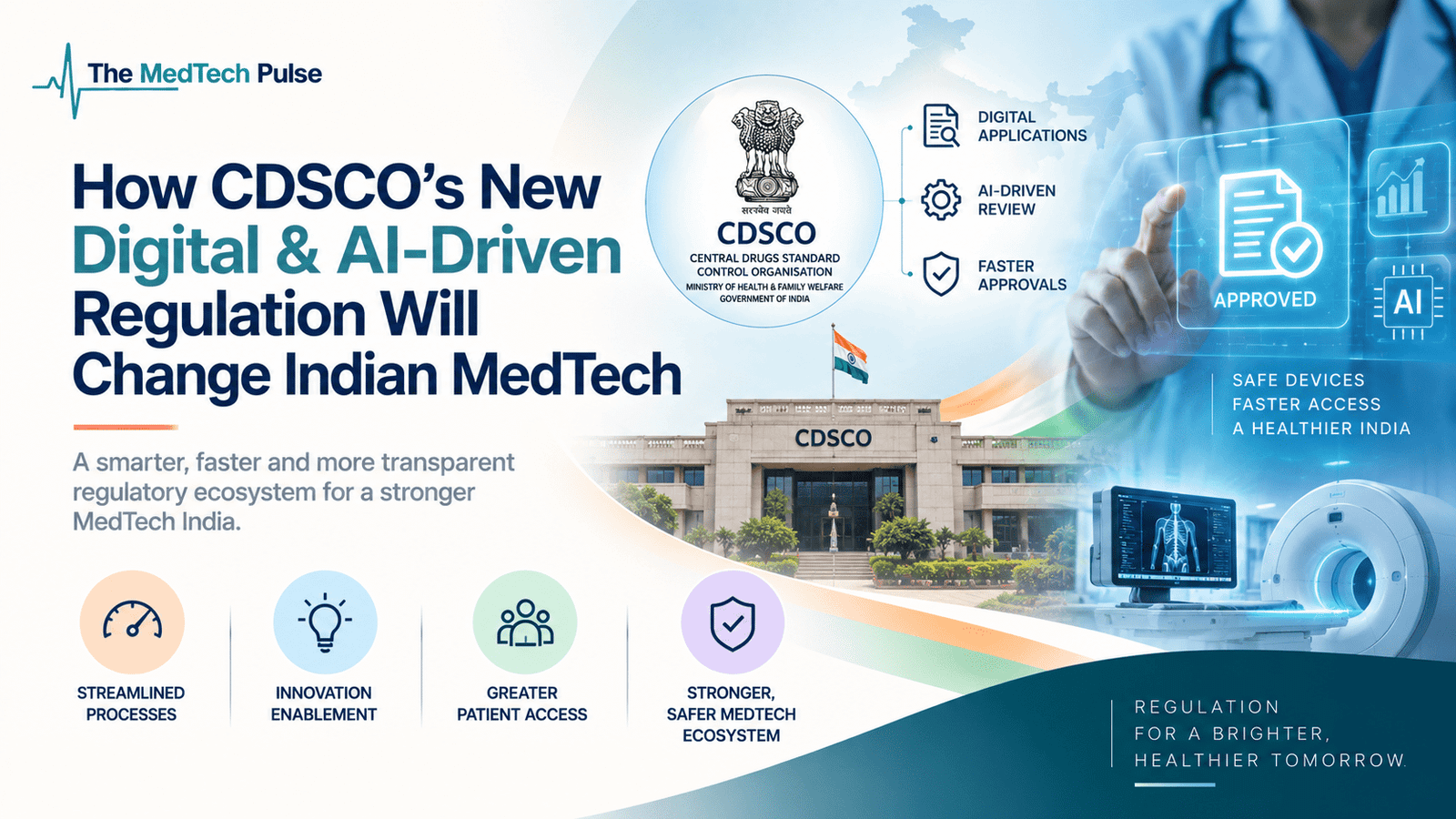
Getting a medical device or drug approved in India has never been famous for speed. For years, MedTech companies — Indian startups and multinational importers alike — have budgeted extra months into their launch timelines simply to account for regulatory friction: paperwork routed manually between offices, certificate verification that depended on someone physically checking a document, and approval queues where visibility into where an application actually stood was often limited. That’s the backdrop against which India’s Central Drugs Standard Control Organisation (CDSCO) has just laid out one of its most ambitious modernisation plans yet — a genuinely end-to-end digital regulatory platform, backed by active AI pilots and a newly finalised rulebook for software-based medical devices.
Regulatory digitisation isn’t a glamorous headline, but it’s arguably one of the highest-leverage things a regulator can do for an entire industry’s growth trajectory. Every month shaved off an approval timeline is a month sooner a diagnostic tool reaches a hospital, a device reaches a patient, or an Indian export reaches an overseas buyer. Here’s what’s actually changing, and what it means for the companies operating inside this system.
What the New Digital Platform Will Offer
Speaking at the inaugural Global Drug Regulatory Conclave (GDRC) 2026, organised by the Pharmaceuticals Export Promotion Council of India (Pharmexcil) in association with CDSCO, Drugs Controller General of India (DCGI) Dr. Rajeev Singh Raghuvanshi confirmed that CDSCO will roll out the first phase of a comprehensive, end-to-end Digital Drug Regulatory System (DDRS) within the next 18 months.
The ambition here is genuinely structural, not cosmetic. The DDRS is designed as a single-window interface bringing manufacturers, distributors, and pharmacovigilance stakeholders into one unified platform, capable of tracking a product’s entire regulatory lifecycle — from initial filing and approval through to post-market safety surveillance — in one continuous digital thread, rather than the more fragmented, stage-by-stage process companies currently navigate.
One feature worth flagging specifically: the platform is planned to include visibility indicators tracking individual companies’ compliance histories, including any Not of Standard Quality (NSQ) findings and Good Manufacturing Practice (GMP) audit outcomes. That’s a meaningful transparency mechanism — designed in part to help government procurement agencies make better-informed decisions during tender evaluations, based on a company’s actual verifiable compliance track record rather than self-reported claims or fragmented historical records.
Dr. Raghuvanshi noted that CDSCO has already digitised more than 99% of its regulatory processes — a strong foundation the DDRS is meant to build on and unify, rather than a wholesale rebuild from scratch. Alongside the platform itself, CDSCO is piloting a digital ticketing system intended to automate reviewer allocation and pre-screen incoming applications before they even reach a human reviewer’s desk — a change the regulator projects could cut first-response times by up to 80% and reduce overall processing time by roughly 40%.
The Role of AI in Regulation
Beyond the platform architecture, CDSCO has confirmed it is actively piloting Artificial Intelligence tools across several regulatory functions, with the explicit goal of building a faster, more agile, and genuinely data-driven regulatory system. This isn’t AI bolted onto an unchanged process as a marketing feature — combined with the digital ticketing pilot, it represents a real attempt to automate the routine, high-volume triage work that currently consumes significant reviewer time, freeing up CDSCO’s scientific and technical staff for the genuinely complex regulatory judgment calls that still require human expertise.
One of the most concrete near-term deliverables from this digitisation push is QR-code-based authentication for two of the most frequently requested export-facing documents in the pharmaceutical and device industry: Good Manufacturing Practice (GMP) certificates and Certificates of Pharmaceutical Product (COPP). Dr. Raghuvanshi confirmed these certificates have already started being issued with QR codes, allowing overseas regulators to instantly verify authenticity rather than relying on slower manual verification processes.
The practical impact here is substantial and specific: Dr. Raghuvanshi stated that this QR-code authentication helps exporters save up to six months previously spent securing the clearances needed for product registration in overseas markets. For companies where regulatory delay directly costs market entry time — and, for smaller manufacturers particularly, real revenue — that’s not a minor administrative convenience; it’s a genuine competitive advantage for Indian exporters navigating international regulatory recognition.
Impact on MedTech Startups, Manufacturers, and Importers
Different players across India’s MedTech ecosystem will feel these changes differently, and it’s worth breaking that down.
For Indian MedTech startups, faster, more transparent regulatory processing directly addresses one of the most commonly cited barriers to bringing a new device or diagnostic to market: unpredictable approval timelines that make it difficult to plan fundraising, manufacturing scale-up, and go-to-market strategy with any confidence. A digital ticketing system with faster first-response times, combined with clearer visibility into where an application stands within the DDRS, should meaningfully reduce the planning uncertainty that has historically made regulatory timelines one of the harder variables for early-stage companies to model.
For established domestic manufacturers, the QR-code certificate authentication and streamlined export NOC processes translate into faster access to international markets — directly relevant for manufacturers pursuing export growth alongside their domestic business, a strategic priority across Indian MedTech given the government’s broader push to convert the sector from import-dependent to genuinely export-competitive.
For importers and multinational device companies, the picture is somewhat different. CDSCO has separately been expanding its “trusted jurisdiction” framework — increasingly recognising CE marking under EU MDR/IVDR and other major international regulatory approvals for accelerated clinical investigation waivers. Combined with a faster-moving digital platform and more CDSCO reviewers on staff (following the government’s earlier approval of 1,500 additional CDSCO posts), well-documented dossiers from companies with existing international approvals should see measurably faster review cycles than under the previous, more paper-intensive system.
Across all three categories, one theme is consistent: predictability is improving as much as raw speed. A regulator that can be planned around — where timelines are trackable and reasonably consistent — is, in many ways, as valuable to industry as one that’s simply fast in aggregate.
Connection With SaMD and AI Medical Software Regulation
Running in parallel with the platform and AI-in-regulation announcements is a separate but closely connected development: CDSCO’s finalised Guidance Document on Medical Device Software (MDSW), issued July 21, 2026, following review of stakeholder feedback on the draft first circulated in October 2025.
This guidance matters enormously for the growing number of Indian companies building AI-enabled diagnostic and digital health tools — a category the government has separately identified, through Union Health Minister J.P. Nadda’s “AI in MedTech” roadmap, as the first major large-scale opportunity for responsible AI adoption in Indian healthcare, given AI diagnostics’ potential to extend specialist-level expertise into primary and secondary care settings that currently lack it.
The final MDSW guidance takes a broader, function-based approach to classification — determining regulatory status based on a software product’s actual intended medical purpose rather than rigid labelling, reducing ambiguity for standalone software, embedded software, mobile apps, AI/ML-based tools, and cloud-hosted platforms alike. Several provisions are particularly relevant for AI-focused MedTech companies specifically:
- AI/ML training data disclosure requirements — manufacturers must now disclose whether datasets used to train their models are drawn from real-world data, public databases, or synthetic sources, directly supporting reviewer assessment of bias risk and generalisability.
- The Algorithm Change Protocol (ACP) — perhaps the guidance’s most practically significant feature for AI/ML developers, allowing companies that define predefined, bounded modification rules in advance to make minor algorithm updates without a fresh licence application for every iteration, reflecting how machine learning products genuinely evolve post-deployment.
- Explicit cybersecurity and Software Bill of Materials (SBOM) requirements, alongside expectations around Quality Management Systems built on standards including IEC 62304, ISO 14971, and IEC 82304-1 — bringing India’s expectations closer in line with how the US FDA and EU already regulate software-based medical devices.
Importantly, this guidance doesn’t create a new approval pathway; MDSW continues to follow the existing Medical Devices Rules, 2017 process. What it delivers is far greater clarity on classification and documentation expectations — precisely the kind of regulatory certainty that AI diagnostics developers have been asking for as they try to scale from pilot deployments to genuine clinical adoption across India’s hospital network.
Challenges and Opportunities
The opportunity side of this transformation is substantial: faster approvals, greater regulatory predictability, stronger export competitiveness, and — through the MDSW guidance specifically — a considerably clearer runway for India’s fast-growing AI diagnostics sector to scale responsibly rather than operating in regulatory ambiguity.
The challenges are equally real, though. An 18-month timeline for the DDRS’s first phase means the platform’s full benefits won’t materialise immediately — companies navigating approvals in the near term will still be working through a partially digitised, transitional system. AI pilots across regulatory functions, while promising, will need to prove their accuracy and consistency at scale before companies and reviewers alike can fully rely on them for triage and pre-screening. And for smaller manufacturers and startups with limited regulatory-affairs bandwidth, the MDSW guidance’s more detailed documentation expectations — AI bias assessment, SBOM disclosure, cybersecurity documentation — represent a genuinely higher compliance bar than existed under the previous draft framework, even as the Algorithm Change Protocol offsets some of that burden for ongoing AI/ML updates specifically.
Conclusion
CDSCO’s combined push — a genuinely end-to-end digital regulatory platform, active AI pilots in regulatory functions, QR-authenticated export certificates, and a finalised, internationally aligned MDSW guidance — represents one of the most consequential regulatory modernisation efforts India’s MedTech sector has seen in years. The direction of travel is clear: faster, more transparent, more internationally credible regulation, with genuine clarity now extended to the AI-enabled software category that’s central to where Indian MedTech innovation is heading next. Whether the 18-month DDRS timeline holds, and whether AI-assisted regulatory triage delivers the projected efficiency gains in practice, will be the real test — but the direction itself is unambiguously positive for an industry that has long cited regulatory unpredictability as one of its biggest operational headaches.
Frequently Asked Questions
Q: When will CDSCO’s new digital platform actually be available? The first phase of the Digital Drug Regulatory System (DDRS) is targeted for rollout within 18 months of the July 2026 announcement, meaning companies should expect a phased transition rather than an immediate, complete system change.
Q: Does the MDSW guidance apply to all health-related apps and software? No. The guidance specifically applies to software that serves a genuine medical purpose under the Medical Devices Rules, 2017 — general wellness apps, quality system software, and enterprise resource planning tools fall outside its scope. Classification depends on the software’s actual intended medical use.
Q: What is the Algorithm Change Protocol, and why does it matter for AI companies? It’s a mechanism allowing AI/ML-based medical device software developers to make minor, predefined algorithm updates without filing a new licence application for every iteration — a significant practical benefit given how frequently machine learning models are refined post-deployment.
Q: How does QR-code certificate authentication actually help exporters? It allows overseas regulators to instantly verify the authenticity of Indian GMP and COPP certificates rather than relying on slower manual verification, which CDSCO states can save exporters up to six months in overseas market registration timelines.
Q: Will these changes make it easier for foreign medical device companies to enter India, or primarily help domestic manufacturers? Both, in different ways. Domestic manufacturers benefit most directly from faster export certificate verification and reduced approval friction; importers with existing international approvals (particularly CE marking under EU MDR/IVDR) benefit from CDSCO’s expanding trusted-jurisdiction recognition framework, which the digital platform and additional reviewer capacity should process more efficiently.
References
- Medical Dialogues — Digital Drug Regulation: CDSCO to Introduce Integrated Compliance Platform in 18 Months (https://medicaldialogues.in/news/industry/pharma/digital-drug-regulation-cdsco-to-introduce-integrated-compliance-platform-in-18-months-176181)
- BioSpectrum India — CDSCO is Piloting AI Across Regulatory Processes to Create Data-Driven Regulatory System: DCGI (https://www.biospectrumindia.com/news/16/28242/cdsco-is-piloting-ai-across-regulatory-processes-to-create-data-driven-regulatory-system-dcgi.html)
- KNN India — CDSCO To Launch Integrated Digital Drug Regulatory Platform In 18 Months (https://knnindia.co.in/news/newsdetails/sectors/cdsco-to-launch-integrated-digital-drug-regulatory-platform-in-18-months)
- Medical Buyer — CDSCO Issues Final Guidance on Regulating Medical Device Software (https://medicalbuyer.co.in/cdsco-issues-final-guidance-on-regulating-medical-device-software/)
- National Law Review — Code Compliance: Decoding India’s Medical Device Software Guidance (https://natlawreview.com/article/code-compliance-decoding-indias-medical-device-software-guidance)
- Emergo by UL — India CDSCO Finalizes Guidance on Medical Device Software (https://www.emergobyul.com/news/india-cdsco-finalizes-guidance-medical-device-software)
- Asianet Newsable — Nadda Unveils Paper on AI in MedTech, Lists Priorities for Healthcare (https://newsable.asianetnews.com/india/nadda-unveils-paper-on-ai-in-medtech-lists-priorities-for-healthcare-articleshow-bgk2gcp)
Note: The Digital Drug Regulatory System announcement was made at the Global Drug Regulatory Conclave (GDRC) 2026 on July 30–31, 2026; the final MDSW guidance was issued July 21, 2026. This article reflects publicly available information as of early September 2026; the DDRS remained in planning and early rollout stages at the time of writing.