

India’s diagnostic imaging landscape runs on equipment that hospitals can rarely afford to let sit idle. A single MRI suite can represent tens of crores of capital investment, and when a scanner goes down, it isn’t just a maintenance ticket — it’s cancelled patient appointments, lost diagnostic revenue, and, in many cases, patients turned away to whichever competing facility has a working machine. As India’s imaging equipment base has expanded rapidly across metro and Tier-2 hospitals alike, a quieter but equally important industry has grown alongside it: the companies responsible for keeping that equipment running, maintained, and — increasingly — affordably renewed rather than replaced.
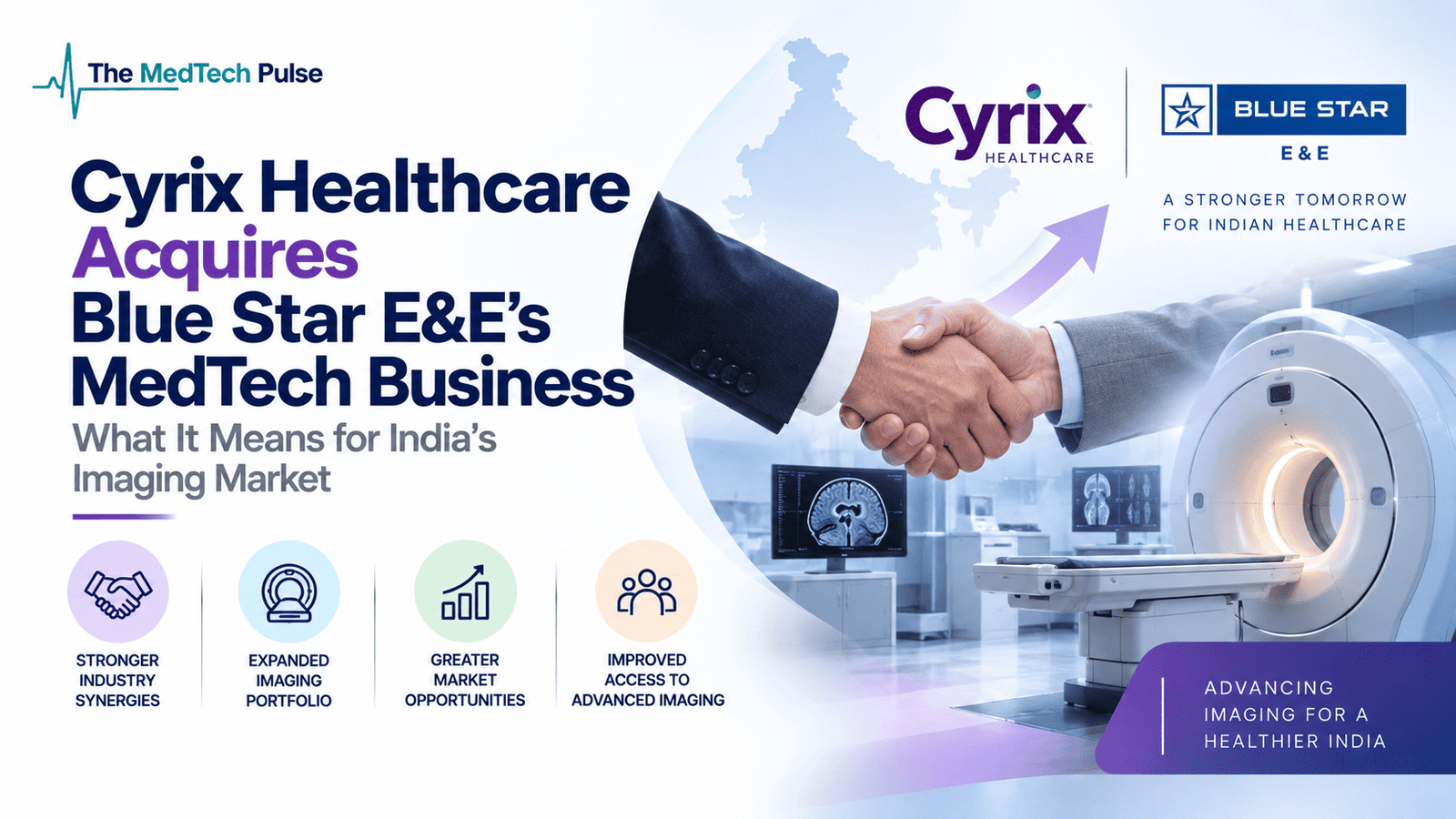
Kochi-based Cyrix Healthcare just made its biggest move yet in that space. The company has completed its acquisition of Blue Star Engineering & Electronics Limited’s (Blue Star E&E) MedTech Solutions business, a deal that meaningfully expands Cyrix’s footprint in multi-brand CT and MRI servicing and its fast-growing refurbished equipment vertical.
Details of the Acquisition
The transaction was structured as a slump sale — a business transfer executed as a going concern rather than a sale of individual assets — with Blue Star Limited first intimating the execution of the Business Transfer Agreement (BTA) on August 14, 2026. The deal closed roughly two and a half weeks later: the transfer of Blue Star E&E’s MedTech business became effective September 1, 2026, with Cyrix Healthcare’s formal acknowledgment of the transfer received the same day, and the completion publicly announced shortly after.
Consideration for the deal is structured in tranches, subject to potential adjustments, with the final payment scheduled by March 31, 2027 — a staggered payment structure fairly typical of transactions of this scale, where part of the total value is often tied to post-acquisition performance or integration milestones rather than settled entirely at closing.
What Cyrix has acquired is Blue Star E&E’s MedTech division specifically — the part of Blue Star’s business focused on high-end medical diagnostic equipment and services, encompassing multi-brand CT and MRI imaging equipment sales, installation, maintenance, repairs, and refurbishment.
Why This Deal Is Strategically Important
To understand why this acquisition matters beyond the transaction itself, it helps to understand what Cyrix Healthcare has spent over two decades building. Founded in 2004 and headquartered in Kochi, Cyrix has positioned itself around a model it calls Total MedTech Management — an integrated, brand-agnostic approach to medical equipment sales, servicing, and lifecycle management, designed explicitly to replace the fragmented, multi-vendor servicing arrangements that have historically been the norm for Indian hospitals managing equipment from several different original equipment manufacturers (OEMs) simultaneously.
The company reports working with more than 25,000 hospitals, supported by a team exceeding 1,200 MedTech engineers, delivered through its Care360 service umbrella — covering annual maintenance contracts, NABL-accredited calibration, asset tracking and management, and a dedicated board-level and component-level repair facility called ReviveLab, which the company states restores original electronic boards (rather than substituting duplicate or imported alternatives) with a success rate above 85%, even on complex or legacy equipment where OEM spare parts have become scarce, expensive, or discontinued altogether.
The Blue Star acquisition strengthens this model in a very specific, high-value category: multi-brand CT and MRI servicing. Imaging equipment sits at the top of most hospitals’ capital equipment budgets and represents some of the most technically demanding servicing work in the entire medical equipment category — precision components, complex software, and manufacturer-specific diagnostic protocols that require genuinely deep technical expertise across multiple OEM platforms simultaneously. Absorbing Blue Star E&E’s established relationships and technical capability in this exact category is a direct scale-up of Cyrix’s most complex and highest-value service line, not a diversification into unfamiliar territory.
Benefits for Hospitals, Diagnostic Centres, and the Refurbished Equipment Market
For hospitals and standalone diagnostic centres, the immediate practical benefit of this kind of consolidation is straightforward: fewer vendor relationships to manage for equipment that, in most facilities, already comes from several different manufacturers. Rather than separate OEM-specific service contracts and separate points of contact for every CT or MRI system on the premises, a single, larger, brand-agnostic partner with deeper bench strength across more equipment brands reduces coordination overhead and, in principle, improves response times when equipment goes down.
The acquisition’s more distinctive impact, though, lands on Cyrix’s AURUM vertical — its refurbished medical imaging equipment platform, offering renewed MRI machines, CT scanners, and Cath Lab systems sourced from established global manufacturers including GE, Siemens, and Philips. Every AURUM installation reportedly ships with a one-year warranty comparable to new OEM equipment, following certified restoration and performance validation by Cyrix’s in-house engineering team.
AURUM’s stated purpose is squarely about access and affordability: enabling small and medium hospitals, and diagnostic centres in smaller towns, to offer advanced imaging for neurological, cardiac, orthopedic, and musculoskeletal studies without the capital outlay a brand-new system demands. That’s a genuinely important gap to fill in a country where advanced diagnostic imaging has historically clustered around metro hospitals, leaving patients in smaller cities and towns facing long travel distances for an MRI or CT scan. The Blue Star acquisition adds directly to AURUM’s sourcing base and technical servicing depth at a moment when Cyrix has been explicit about wanting to expand this vertical’s reach — meaning more refurbished, warrantied imaging systems potentially becoming available to exactly the hospital tier that needs them most.
For India’s broader refurbished medical equipment market — still a relatively young category compared to more mature refurbished-equipment markets in the US and Europe — a larger, more credible domestic player consolidating both sourcing and servicing capability under one roof is a meaningful maturity signal. Refurbished equipment adoption depends heavily on trust: hospitals need confidence that a renewed system will perform reliably and that a genuine servicing and warranty infrastructure stands behind it, not just a one-time sale.
What This Signals About the Indian MedTech Services Sector
This acquisition is worth reading as one data point in a broader pattern taking shape across Indian MedTech in 2026: consolidation in equipment servicing and lifecycle management, running in parallel with the country’s separate, well-documented push toward domestic device manufacturing and import substitution through initiatives like the Production Linked Incentive (PLI) scheme.
These two trends are more connected than they might first appear. A stronger multi-brand servicing and refurbishment ecosystem doesn’t add new manufacturing capacity to India’s device sector, but it does mean existing high-value imaging equipment — whether imported or, increasingly, domestically manufactured — reaches more hospitals, stays functional for longer, and costs less over its operating lifetime than a model built purely around new-equipment purchases. In a market where MRI and CT systems remain among India’s most import-dependent device categories, extending the useful life of every unit already in the country through better servicing and structured refurbishment is a genuinely complementary strategy to new manufacturing capacity coming online.
It’s also worth noting what this deal says about scale as a competitive requirement in MedTech services specifically. As hospitals increasingly prefer single, accountable service partners over fragmented OEM-specific contracts, and as refurbished equipment adoption grows, the companies best positioned to win are those with the broadest multi-brand technical bench strength and the deepest sourcing networks — precisely the kind of scale this acquisition is built to deliver.
Conclusion and Future Outlook
With the transaction formally completed and final payment due by March 31, 2027, Cyrix Healthcare’s next phase is integration — folding Blue Star E&E’s MedTech personnel, service contracts, and customer relationships into its existing Care360 and AURUM platforms. Given the company’s stated ambitions to expand operations across India and into the Middle East and North Africa (MENA) region, this deal is likely best understood as one step in a broader scale-up strategy rather than a standalone transaction. For India’s hospitals and diagnostic centres, the practical outcome to watch for over the coming months is whether this consolidation translates into faster imaging equipment servicing, broader refurbished-system availability, and — ultimately — more reliable diagnostic imaging access reaching further into India’s Tier-2 and Tier-3 healthcare infrastructure.
Frequently Asked Questions
Q: What exactly did Cyrix Healthcare acquire from Blue Star? Cyrix acquired Blue Star Engineering & Electronics Limited’s (Blue Star E&E) MedTech Solutions business — the division handling high-end medical diagnostic equipment, including multi-brand CT and MRI imaging equipment sales, installation, maintenance, repairs, and refurbishment.
Q: When did the deal officially close? The Business Transfer Agreement was executed on August 14, 2026, with the transfer becoming effective September 1, 2026. Final payment consideration is due by March 31, 2027, under a tranche-based payment structure.
Q: How does this acquisition affect hospitals already using Blue Star’s servicing contracts? While specific transition details for existing customer contracts weren’t fully disclosed publicly, acquisitions of this kind typically involve folding existing service agreements and customer relationships into the acquiring company’s broader platform — in this case, Cyrix’s Care360 service ecosystem — generally with continuity of service as a priority during integration.
Q: What is AURUM, and how does this deal affect it? AURUM is Cyrix Healthcare’s refurbished medical imaging equipment vertical, offering renewed MRI, CT, and Cath Lab systems from major OEMs with a one-year warranty. The Blue Star acquisition adds to AURUM’s sourcing base and technical servicing depth, supporting Cyrix’s stated ambition to expand affordable, refurbished imaging access to smaller hospitals and diagnostic centres across India.
References
- InvestyWise — Blue Star: MedTech Business Sale to Cyrix Healthcare Completed (https://www.investywise.com/blue-star-updates-on-medtech-business-sale-completion/)
- Cyrix Healthcare — Official Website, Total MedTech Management Solutions (https://cyrixhealthcare.com/)
- Cyrix Healthcare — AURUM: Reliable, Refurbished Imaging Systems (https://cyrixhealthcare.com/cyrix-aurum)
- Cyrix Healthcare — Clinical Equipment Management for Hospitals, Care360 (https://cyrixhealthcare.com/services/clinical-equipment-management)
- IndiaMART — Cyrix Healthcare Private Limited, Company Profile (https://www.indiamart.com/cyrixhealthcare/profile.html)
Note: This article reflects publicly available information as of early September 2026. Full financial terms of the transaction, beyond the disclosed tranche payment structure and March 31, 2027 final payment date, were not publicly disclosed at the time of writing.