

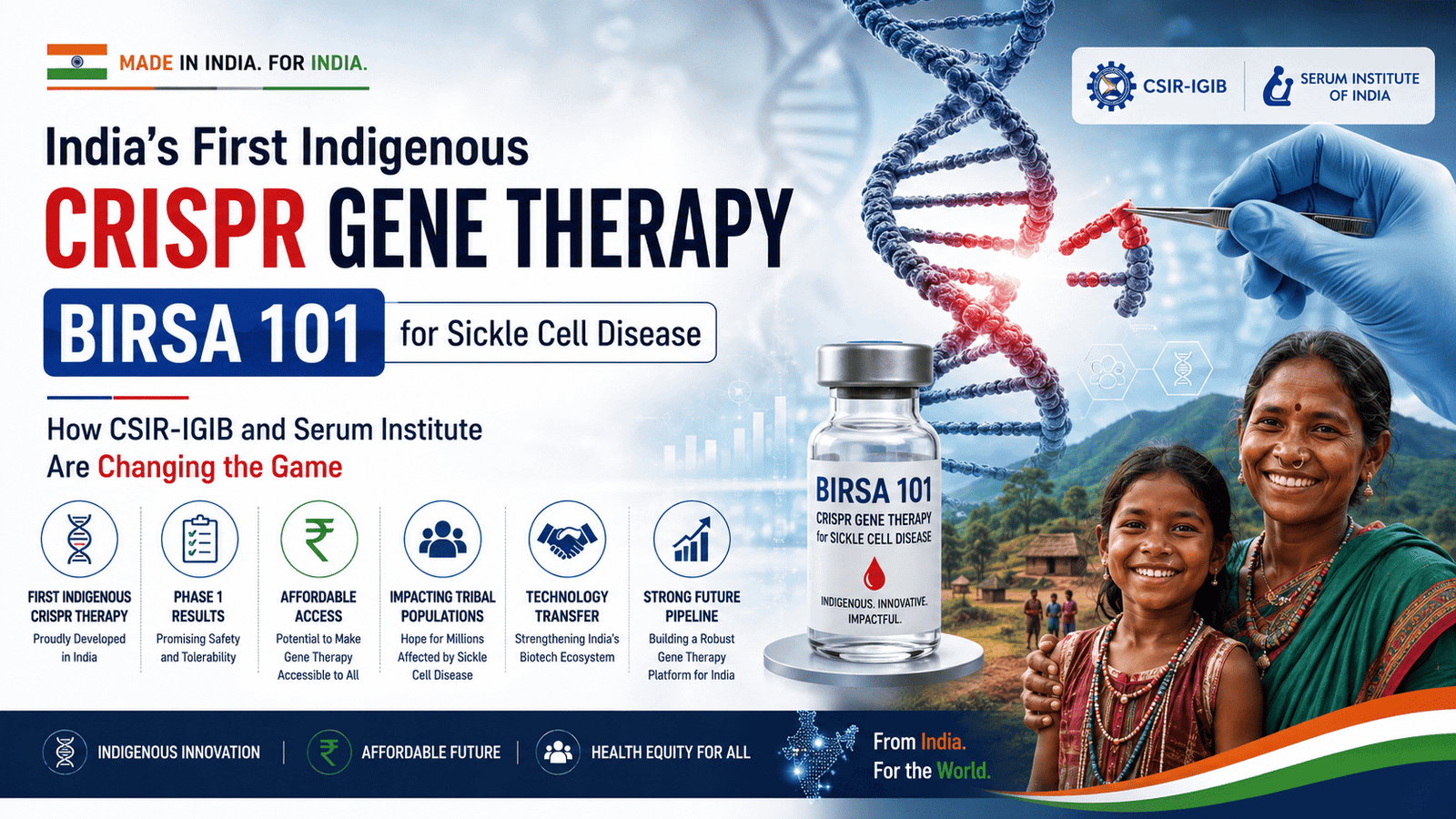
On November 19, 2025, Union Minister Dr. Jitendra Singh stood in front of India’s scientific establishment and announced something the country’s biotech sector had been quietly working toward for years: a homegrown CRISPR gene therapy for sickle cell disease, priced not in millions of dollars but in lakhs of rupees.<cite index=”2-1″>The Minister said that the transfer of BIRSA 101 and the CRISPR platform to a world-leading manufacturer like Serum Institute guarantees affordability, scalability, and global-standard manufacturing pathways, ensuring that advanced gene-editing</cite> reaches the people who need it most.
The therapy is called BIRSA 101 — named after Bhagwan Birsa Munda, <cite index=”1-1″>a tribal freedom fighter, on his 150th birth anniversary on November 15, 2025</cite>. That naming isn’t ceremonial. Sickle cell disease in India is overwhelmingly a tribal health issue, and BIRSA 101 was built specifically to address it.
Here’s what the therapy actually is, how it was developed, what it costs compared to the rest of the world, and what still needs to happen before it reaches patients at scale.
Why Sickle Cell Disease Needed an Indian Solution
Sickle cell disease (SCD) is a genetic blood disorder in which red blood cells become rigid and crescent-shaped instead of round and flexible. These misshapen cells block blood flow, causing excruciating pain crises, chronic anaemia, organ damage, strokes, and a significantly shortened lifespan.
The burden in India falls disproportionately on tribal communities. <cite index=”21-1″>India has the largest tribal population density globally, with 8.6% of the population, or 67.8 million people, identified as tribal according to the 2011 Census, and the tribal health expert committee under the Ministry of Health and Family Welfare has flagged SCD as one of the ten major health issues disproportionately affecting these communities.</cite> A 2024 systematic review and meta-analysis put national SCD prevalence at around 1.17%, with sickle cell trait prevalence closer to 5.9% — but <cite index=”6-1″>in some tribal groups, carrier rates run as high as 30–40%.</cite>
Until BIRSA 101, treatment options in India were limited and largely symptomatic. <cite index=”6-1″>Hydroxyurea and blood transfusions only manage symptoms, while bone marrow transplants — the only existing cure — are expensive (₹20–50 lakh) and require a matched donor, which most patients simply don’t have.</cite>
Globally, the picture is even starker. The US FDA approved the world’s first CRISPR-based cure for SCD, Casgevy (exagamglogene autotemcel), in December 2023. <cite index=”13-1″>Vertex Pharmaceuticals set its list price at $2.2 million, while Bluebird Bio’s competing gene therapy, Lyfgenia, was priced at $3.1 million.</cite> Even in the US, <cite index=”17-1″>the FDA’s own estimate put the number of eligible patients at around 20,000, and access barriers linked to that price tag have been considerable.</cite> For a country like India, where such pricing is simply unworkable at population scale, an indigenous alternative wasn’t a luxury — it was a necessity.
What BIRSA 101 Actually Is
BIRSA 101 was developed at the CSIR–Institute of Genomics and Integrative Biology (CSIR-IGIB) in Delhi, using an in-house engineered CRISPR platform called enFnCas9. <cite index=”3-1″>A technology transfer agreement was signed between CSIR-IGIB and the Serum Institute of India to enable scalable, affordable enFnCas9 CRISPR-based therapies for sickle cell disease and other genetic disorders.</cite>
Mechanistically, it works the same way as the global gene-editing therapies: doctors collect blood-forming (hematopoietic) stem cells from the patient, edit the faulty gene responsible for the sickle-shaped haemoglobin using CRISPR, and reinfuse the corrected cells back into the patient. <cite index=”7-1″>Blood is collected from patients carrying the sickle cell mutation, stem cells are modified, and reinfused to produce healthy red blood cells, addressing the disease at its root.</cite> Dr. Jitendra Singh described the process to the public in simpler terms, calling it <cite index=”2-1″>a form of “precise genetic surgery.”</cite>
Because it edits a patient’s own cells rather than introducing donor material, it avoids the organ-rejection risk and donor-matching bottleneck that limits bone marrow transplants — the same fundamental advantage that made Casgevy a landmark therapy in the West, just built on India’s own IP and manufacturing base.
Phase 1 Results and the Road to Clinical Scale-Up
The therapy has already moved past the lab bench. <cite index=”7-1″>Souvik Maiti, Director of CSIR-IGIB, confirmed that Phase 1 clinical trials involved three patients and were funded by the Department of Science & Technology, catalysed by the Ministry of Tribal Affairs.</cite> The rationale, as Maiti put it, was straightforward: <cite index=”7-1″>global therapies were prohibitively expensive, which made an indigenous solution necessary.</cite>
The next phase is where BIRSA 101 will be tested at meaningfully larger scale, and it’s explicitly designed around the population it’s meant to serve. <cite index=”4-1″>Steps to commence further clinical trials are already in progress, with CSIR-IGIB collaborating with the Department of Biotechnology, the Department of Science and Technology, the Drug Controller General of India (CDSCO), CSIR, and the Ministry of Tribal Affairs. Participants will be drawn from Madhya Pradesh, Chhattisgarh, and Jharkhand, with trials set to begin in 2026, run jointly by CSIR-IGIB, Serum Institute of India, and AIIMS Delhi.</cite>
That trial geography is deliberate — Madhya Pradesh, Chhattisgarh, and Jharkhand are among the states with the country’s highest tribal SCD burden, and running trials there (rather than only in metro tertiary centres) is meant to build both clinical evidence and local trust in the communities that will eventually receive the therapy.
The Cost Story: ₹50 Lakh vs ₹20–25 Crore
This is arguably the most consequential number in the entire announcement. <cite index=”4-1″>CRISPR-based gene-editing therapy for SCD reportedly costs INR 20–25 crore per patient globally, owing primarily to high licensing fees. The newly developed indigenous platform is expected to cost around INR 50 lakh.</cite>
Put in dollar terms, that’s roughly a 97–98% reduction from the ~$2.2–3.1 million price tags of Casgevy and Lyfgenia in the United States. <cite index=”10-1″>Those global prices exist despite sickle cell disease affecting a relatively small population of around 100,000 people in the US</cite> — the pricing reflects the enormous R&D and manufacturing overhead built into Western biotech commercialisation models, not the underlying cost of the science itself.
Government officials have been direct about the intent behind this pricing gap. Dr. Jitendra Singh <cite index=”9-1″>emphasised that the breakthrough has demonstrated the country’s capability to produce pathbreaking therapies at a fraction of global costs, potentially replacing treatments priced at ₹20–25 crore overseas.</cite> Even ₹50 lakh is a significant sum for most Indian households, so the real test will be how the therapy is subsidised, insured, or bundled into public health schemes once it exits clinical trials — a detail that hasn’t yet been finalised publicly.
The CSIR-IGIB and Serum Institute Technology Transfer Model
What makes BIRSA 101 more than a one-off lab success is the institutional model behind it. CSIR-IGIB, a public research institute, did the fundamental science; Serum Institute of India — the world’s largest vaccine manufacturer by doses produced — is handling scale-up, manufacturing, and eventual commercial deployment.
This is deliberately structured the same way India built its vaccine manufacturing dominance. <cite index=”8-1″>The technology transfer agreement between CSIR-IGIB and Serum Institute mirrors India’s successful public-private model used in developing several vaccines, and is designed to ensure affordability, scalability, and global-standard manufacturing.</cite> Serum Institute’s leadership was present at the launch — <cite index=”2-1″>Dr. Umesh Shaligram, Executive Director of Serum Institute of India, attended alongside Dr. N. Kalaiselvi (Director General, CSIR) and Dr. Souvik Maiti (Director, CSIR-IGIB).</cite>
CSIR-IGIB has also invested in the infrastructure to support a pipeline beyond BIRSA 101 itself: <cite index=”8-1″>a new advanced research and translational facility has been inaugurated at the institute, strengthening India’s genomic medicine capabilities.</cite>
What’s Next: Thalassemia and Beyond
BIRSA 101 isn’t a one-disease platform. <cite index=”4-1″>Thalassemia — a genetic blood disorder characterised by reduced or absent haemoglobin production — is also a target for this technology, with IGIB and Serum Institute developing a parallel therapy using a mechanism similar to the one used for sickle cell disease.</cite> Longer term, officials have framed the enFnCas9 platform as a foundation for other genetic disorders, not a single-indication product. <cite index=”6-1″>This public–private partnership between CSIR-IGIB and Serum Institute sets a model for future therapies targeting thalassemia, haemophilia, and rare genetic disorders as well.</cite>
How BIRSA 101 Fits Into India’s Sickle Cell Elimination Mission
BIRSA 101 doesn’t exist in isolation — it plugs into a much larger national screening effort. <cite index=”24-1″>The National Sickle Cell Anaemia Elimination Mission (NSCAEM) was inaugurated on July 1, 2023, by the Prime Minister at Shahdol, Madhya Pradesh, aiming to eliminate sickle cell anaemia in India by 2047 through universal screening of 7 crore individuals aged 0–40 in affected tribal areas by FY 2025–26.</cite>
That screening drive has already surfaced the true scale of the problem. <cite index=”20-1″>As of the mission’s most recent public milestone, of 6 crore people screened for sickle cell, over 18.85 lakh individuals across India have been identified as either suffering from the disorder or carrying the trait — 2.15 lakh diagnosed with the disease itself, and 16.7 lakh identified as carriers.</cite>
That diagnostic pipeline is exactly the population BIRSA 101 is meant to eventually serve — patients identified through NSCAEM screening, concentrated in the same high-prevalence tribal states where the therapy’s clinical trials are now being run.
The Bigger Picture: What BIRSA 101 Signals for Indian Biotech
Sickle cell disease was, for a long time, treated as a manageable-but-incurable condition in India — something to be lived with rather than cured. BIRSA 101 changes that framing, and it does so through a model that other countries with large underserved patient populations will likely study closely: public research institution does the discovery science, a domestic manufacturer with global-scale production experience handles translation and scale-up, and government ministries coordinate patient identification and trial logistics through an existing national screening programme.
Whether BIRSA 101 succeeds at true population scale will depend on things that haven’t been publicly settled yet — final CDSCO approval timelines, pricing subsidies for patients, and the platform’s real-world safety and durability data as trials expand beyond the initial three-patient cohort. But the ₹50 lakh vs ₹20–25 crore cost gap alone marks a genuine inflection point in what “world-first” biotech is allowed to look like when it’s built for a market that global pharma has historically priced out.
References
- Press Information Bureau, Government of India — Union Minister Dr. Jitendra Singh launches India’s first indigenous “CRISPR” based gene therapy for Sickle Cell Disease, November 2025
- Drishti IAS — BIRSA 101
- Vision IAS — BIRSA-101 Current Affairs
- Observer Research Foundation — Birsa-101: India’s Path Towards Affordable CRISPR Therapies
- StudyIQ — BIRSA 101: India Launches World’s Most Affordable CRISPR Gene Therapy for Sickle Cell Disease
- Digital Health News — India Launches First Indigenous CRISPR Gene Therapy BIRSA 101 for Sickle Cell Disease
- Ministry of Tribal Affairs, Government of India — National Sickle Cell Anaemia Elimination Mission
- Outlook India — National Sickle Cell Anemia Elimination Mission: Over 18.85 Lakh Identified
- PIB / News on Air — India achieves Milestone of 6 Crore Screenings under National Sickle Cell Anemia Elimination Mission
- American Society of Hematology — Sickle cell disease in India: the journey and hope for the future
- ScienceDirect — Prevalence of Sickle cell disease, Sickle cell trait and HBS-beta-thalassemia in India: A systematic review and Meta-analysis
- BioPharma Dive — Pricey new gene therapies for sickle cell pose access test
- AJMC — High Costs of Sickle Cell Therapies Highlight Paradox of Drug Development
- Genetic Literacy Project — $3 million barrier to sickle cell gene therapy
Note: Clinical trial details, pricing estimates, and regulatory timelines reflect the most recent publicly available government and press statements as of the publish date. Figures such as the ₹50 lakh projected cost are pre-launch estimates and may be revised once CDSCO approval and full pricing are finalised.