

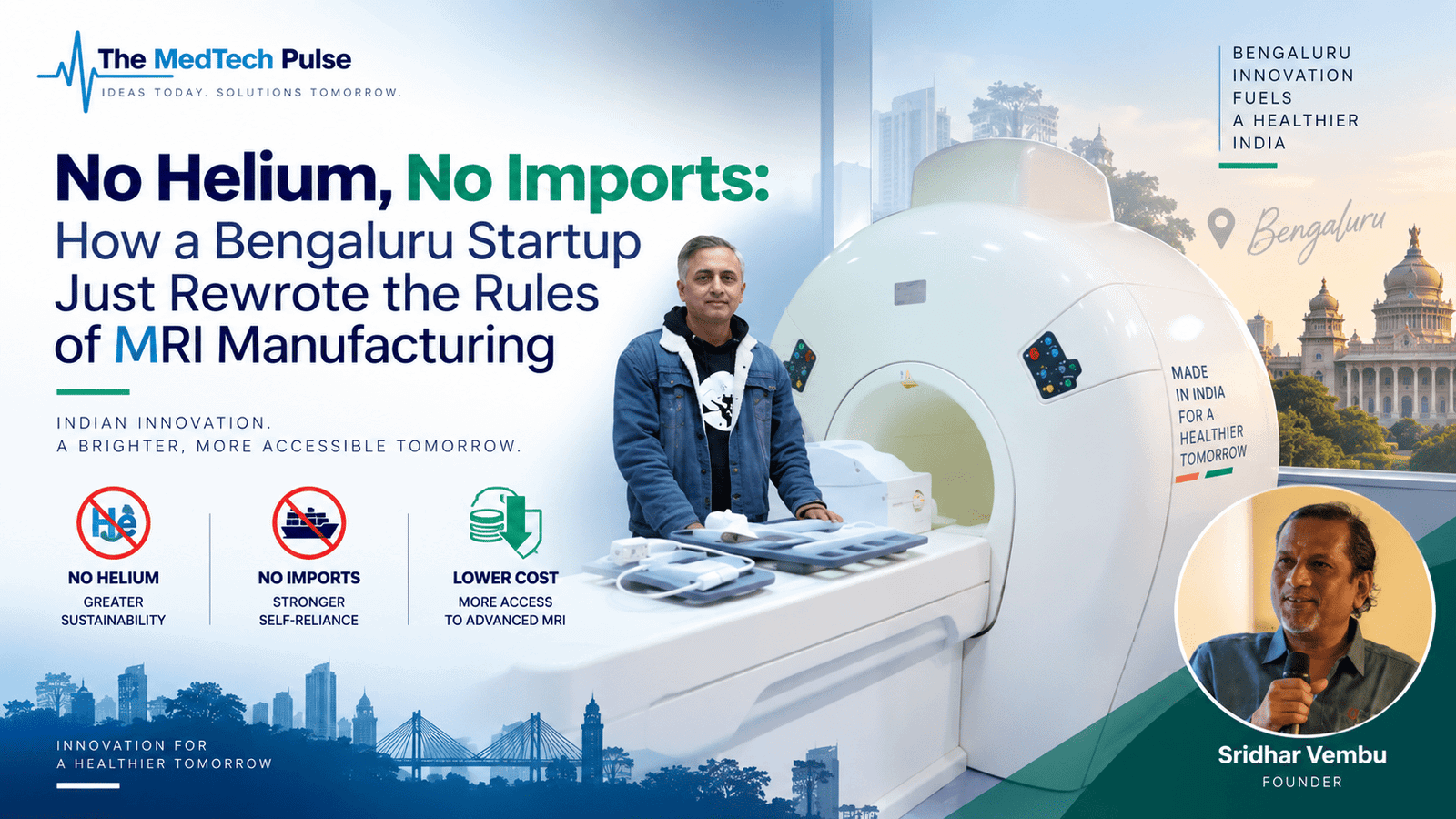
For twelve years, a small Bengaluru deep-tech team worked on a problem most of the medical device world had quietly accepted as unsolvable at scale: building an MRI scanner that doesn’t need liquid helium. On December 25, 2025, that effort produced something genuinely unprecedented for Indian MedTech, VoxelGrids Innovations unveiled and clinically deployed India’s first fully indigenous 1.5 Tesla MRI scanner, now scanning real patients at the Chandrapur Cancer Care Foundation near Nagpur, Maharashtra.
The Problem VoxelGrids Actually Solved
Every conventional high-field MRI scanner in the world relies on a superconducting magnet cooled to near-absolute-zero temperatures using liquid helium, an element that’s scarce, expensive, logistically difficult to source and transport, and requires specialised infrastructure just to keep the magnet operational. That single design choice is a major, often underappreciated driver of why MRI remains one of the most expensive diagnostic technologies available in Indian healthcare, and why it clusters almost exclusively around well-funded urban hospitals with the infrastructure to support it.
VoxelGrids built something structurally different: a “dry magnet” design that eliminates liquid helium entirely, relying instead on conduction-based cooling. Founder Dr. Arjun Arunachalam has been explicit that this isn’t a locally assembled version of a Siemens or GE Healthcare system, the machine incorporates VoxelGrids’ own technological advancements from the ground up, engineered and manufactured entirely within India.
The technical path to getting there wasn’t quick. According to the company’s own account of its engineering process, one of the biggest obstacles was the weeks-long cooldown process traditional MRI magnets require, a problem VoxelGrids’ team addressed using COMSOL Multiphysics simulation software and its Heat Transfer Module, compressing months of physical trial-and-error into days of virtual experimentation, cutting product development time by roughly 40% in the process.
What the Numbers Actually Show
The practical benefits of the helium-free design are substantial and well-documented across the scanner’s reported specifications:
Cost: Eliminating helium and its associated cooling infrastructure reduces manufacturing costs by nearly 40% compared to conventional MRI systems, a figure the company has repeated consistently across its public statements.
Weight: Traditional MRI machines typically weigh around 6 tonnes. VoxelGrids’ scanner weighs just 2 to 3 tonnes, roughly half, a difference that meaningfully changes what kind of building and floor infrastructure a hospital needs to install one.
Power consumption: The system consumes less power than conventional scanners, while maintaining a standard bore size for normal clinical use, meaning hospitals don’t need to compromise on the patient experience or scan quality to get the efficiency gains.
Deployment flexibility: The reduced weight and helium-free design make the scanner considerably easier to install in smaller hospitals and regional facilities that couldn’t previously support the infrastructure demands of an imported system, and open a genuine pathway toward mobile, containerised MRI units for rural and semi-urban outreach, an application VoxelGrids has said it’s actively exploring.
The Business Model: Pay-Per-Use
Beyond the hardware innovation itself, VoxelGrids is pairing the scanner with a deliberately different commercial model. Rather than requiring hospitals to make the full capital purchase of an MRI system upfront, historically one of the biggest barriers to MRI access for smaller hospitals and diagnostic centres, the company is planning flexible pay-per-use and usage-based payment models, directly targeting the capital burden that has kept advanced imaging out of reach for much of India’s Tier-2 and Tier-3 healthcare infrastructure.
Manufacturing capacity is currently set at 20 to 25 units annually from the company’s Bengaluru base, with a commercial launch targeted by the end of the current fiscal year, according to reporting following the unveiling.
Who’s Behind It
VoxelGrids was founded in 2017 by Dr. Arjun Arunachalam, with the explicit founding goal of making low-cost MRI procedures available to everyone, a mission that took the better part of a decade of deep-tech engineering work to reach its first clinical deployment. The company has drawn support from both private and government sources: Zoho Corporation is a key financial backer, with Zoho CEO Shailesh Kumar Davey marking the milestone directly: “We congratulate VoxelGrids on their first successful clinical installation, marking a step forward for indigenous medical tech in India. Zoho’s investment in VoxelGrids underscores our commitment to nurturing deep-tech innovation for mission-critical sectors.”
The project has also received government support, positioning it alongside other publicly and privately backed Indian deep-tech medical device efforts, a pattern increasingly familiar across Indian MedTech in 2026, from CSIR-IGIB’s gene therapy work with Serum Institute to AMTZ’s manufacturing ecosystem in Visakhapatnam.
Why This Matters for India’s Import Dependence
MRI sits squarely on the Department for Promotion of Industry and Internal Trade’s specifically flagged list of high-value device categories where India’s import dependence is most severe — alongside CT scanners, cardiac pacemakers, and continuous glucose monitors. India currently depends heavily on multinational imaging giants, principally Siemens Healthineers and GE Healthcare, for the large majority of its MRI installations.
What makes VoxelGrids’ achievement structurally significant, rather than simply a feel-good indigenous-innovation story, is that it addresses the cost problem at its actual technical root, the helium-cooling infrastructure, rather than simply assembling imported components domestically, a distinction the Indian government’s own Department of Pharmaceuticals has flagged as the difference between genuine manufacturing and “plain assembly line operations” elsewhere in the medical device sector this year. A dry-magnet design that’s cheaper to build, lighter to install, and less operationally dependent on a scarce imported resource is a genuine engineering advance with export potential, not just an import substitute.
What to Watch Next
VoxelGrids has indicated it’s exploring both mobile MRI units and export opportunities once domestic demand is met, a natural next phase for a company that has just proven clinical viability with its first installation. The real tests ahead will be regulatory: CDSCO approval status for broader commercial rollout, AERB clearance given the magnetic field safety considerations MRI systems require, and whether the company can scale from its current 20-to-25-unit annual capacity to meet the kind of demand that would genuinely move the needle on India’s MRI import dependence.
For now, though, the Chandrapur installation stands as proof of something that matters well beyond one scanner: a genuinely novel piece of Indian-engineered medical imaging technology, built over twelve years, now scanning real patients, precisely the kind of deep-tech, IP-led innovation India’s broader MedTech manufacturing ambitions have been hoping to produce.
References
- Electronics For U — India’s Step Toward Local MRI (https://www.electronicsforu.com/news/indias-step-toward-local-mri)
- COMSOL — VoxelGrids Pioneers Accessible MRI Technology Through Virtual Analysis (https://www.comsol.com/story/voxelgrids-pioneers-accessible-mri-technology-through-virtual-analysis-150151)
- Organiser — Zoho-Backed VoxelGrids Unveils First Indigenous 1.5T MRI Scanner (https://organiser.org/2025/12/27/332278/bharat/zoho-backed-voxelgrids-unveils-first-indigenous-1-5t-mri-scanner-slashes-costs-boosts-aatmanirbhar-bharat-push/)
- Digital Health News — Zoho-Backed VoxelGrids Develops India’s First Indigenous MRI Scanner (https://www.digitalhealthnews.com/zoho-backed-voxelgrids-develops-india-s-first-indigenous-mri-scanner)
- Startuppedia — Backed by Zoho and GoI, Bengaluru Startup Builds India’s First Indigenous MRI Scanner (https://startuppedia.in/trending/backed-by-zoho-and-goi-bengaluru-startup-builds-indias-first-indigenous-mri-scanner-installs-it-at-chandrapur-cancer-care-foundation-10949410)
- MedBound Times — India Gets Its First Indigenous MRI Scanner, Built by Bengaluru Startup VoxelGrids (https://www.medboundtimes.com/india/made-in-india-mri-scanner-by-voxelgrids)
- OpIndia — Backed by Zoho and Govt of India, Bengaluru Start-up VoxelGrids Builds First ‘Made In India’ MRI Scanner (https://www.opindia.com/news-updates/backed-by-zoho-govt-of-india-bengaluru-start-up-voxelgrids-builds-first-made-in-india-mri-scanner/)
- Diya TV — India Develops Locally Built MRI Machine (https://diyatvusa.com/india-made-mri-scanner/)
Note: This article reflects publicly available information as of the scanner’s December 25, 2025 unveiling and subsequent coverage through early 2026. Full CDSCO/AERB regulatory approval status for broader commercial rollout, final pricing, and export timelines had not been fully detailed publicly at the time of writing.