

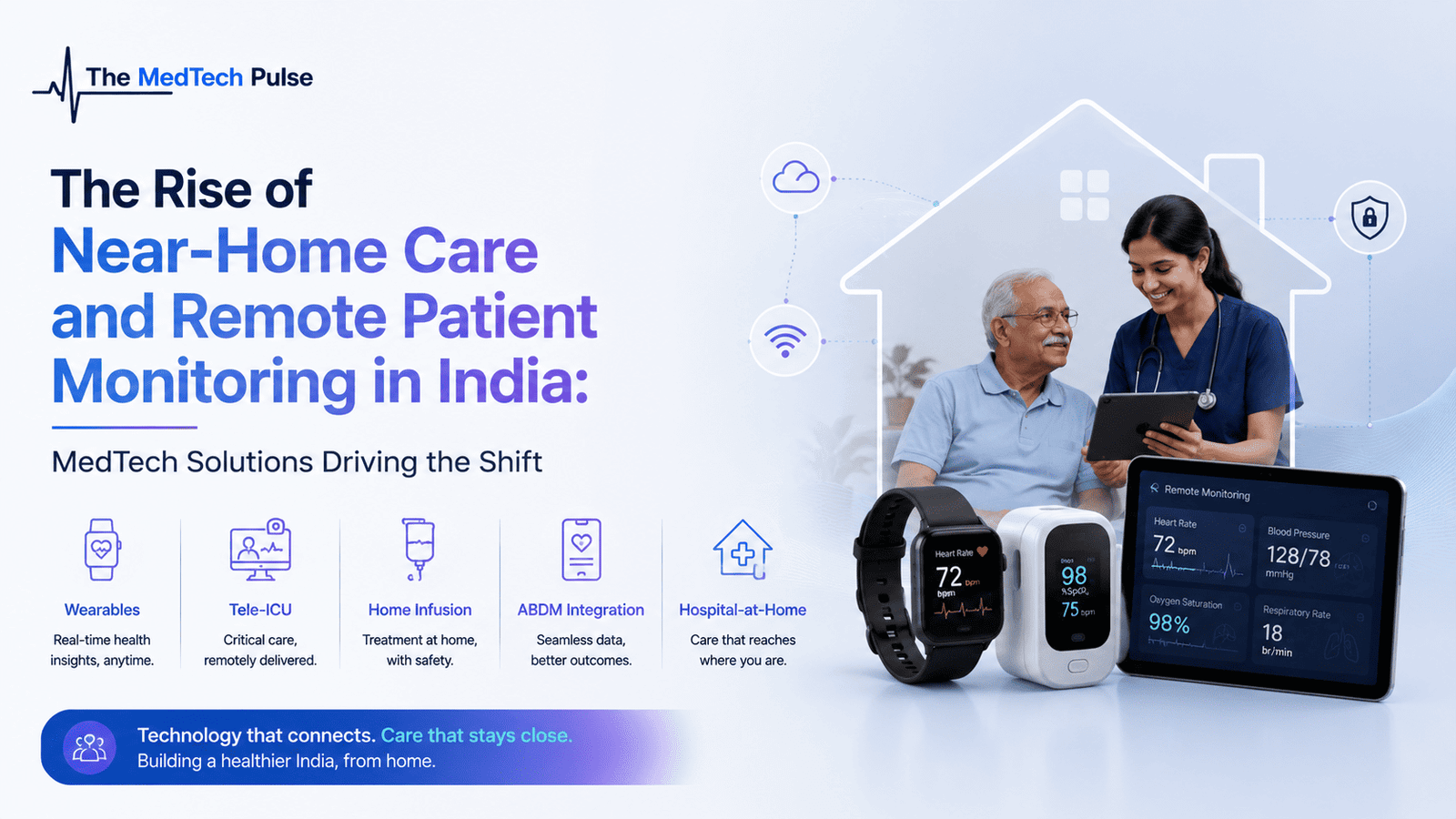
For decades, “getting treated” in India meant physically going somewhere — a clinic, a hospital, a diagnostic lab — often travelling considerable distances to do it. That default is quietly breaking down. A combination of national digital health infrastructure, a genuine chronic disease surge, and increasingly capable wearable and remote-monitoring hardware is pulling meaningful chunks of care out of hospital buildings and into homes and community settings. Here’s what’s actually driving that shift, and how far it’s really gotten.
Why Near-Home Care Is Becoming Necessary, Not Optional
The underlying pressure is demographic and epidemiological, and it’s substantial. Government-released figures citing the ICMR-INDIAB study put India’s diabetes prevalence at 10.1 crore people — a population that, by definition, needs ongoing follow-up rather than episodic hospital visits. That’s the pattern across most of India’s fastest-growing disease burden: hypertension, heart failure, chronic kidney disease, and post-surgical recovery all require continuity of monitoring that a periodic clinic visit simply can’t provide.
At the same time, India’s hospital capacity — particularly ICU-level critical care expertise — remains heavily concentrated in metro centres. As one hospital leader put it, describing exactly the gap remote monitoring is meant to close: technology now lets institutions transcend geographical barriers, providing critical care and 24×7 patient monitoring from a major city hospital to patients in far smaller towns.
The Digital Backbone: ABDM and eSanjeevani at National Scale
None of the remote-monitoring and hospital-at-home models emerging in India would function without the digital health infrastructure built over the past several years. The Ayushman Bharat Digital Mission (ABDM) is designed to support interoperable digital health records and connected care journeys, giving every citizen a unique digital health ID — the ABHA (Ayushman Bharat Health Account) — that can follow them across providers and care settings.
The scale this has reached by 2026 is genuinely remarkable by global standards. At the India AI Impact Summit 2026, Union Health Secretary Punya Salila Srivastava stated that ABDM has evolved into a holistic telemedicine ecosystem with over 859 million ABHA accounts linked to more than 878 million health records, enabling over 449 million teleconsultations to date. The workhorse platform behind much of that volume is eSanjeevani — the world’s largest government-led telemedicine platform, launched by the Ministry of Health and Family Welfare in November 2019, and now integrated directly with ABDM so that a teleconsultation automatically links into a patient’s national health record rather than existing as a disconnected, one-off interaction.
Crucially, ABDM itself doesn’t fund or procure the wearables and monitoring hardware that near-home care depends on — its role is enabling the data collected by that hardware to flow securely into clinical workflows, remote monitoring systems, and continuous care pathways. That distinction matters: ABDM is the connective tissue, not the device layer. The devices themselves are a separate, fast-growing market.
The Hardware Layer: Wearables, Patches, and Home Monitors
India’s wearable medical device market is scaling quickly on the back of this infrastructure. IMARC Group estimates the market growing from roughly ₹9,256 crore (US$1.04 billion) in 2024 to ₹37,380 crore (US$4.20 billion) by 2033 — a 15.5% compound annual growth rate. That growth is happening along two distinct tracks simultaneously: hospitals and ICUs adopting wearable monitoring to extend clinical oversight without expanding onsite staffing, and home-based remote monitoring programmes bringing continuous vitals tracking directly into patients’ daily lives.
Separately, India’s broader Medical IoT market — which includes wearables, home monitors, connected medication tools, and implantable sensors as its four core categories — generated an estimated $5.6 billion in 2023 and is projected to reach $30.6 billion by 2030, growing at 27.4% annually. Hardware specifically — wearables, home monitors, implantable sensors, connected diagnostics — is the single largest revenue-generating segment within that broader IoT category.
The clinical-grade end of this hardware spectrum is increasingly what’s powering genuine hospital-at-home programmes. Multi-vital wearables capable of tracking a range of physiological parameters with AI-driven deterioration prediction are becoming the backbone of post-acute and heart-failure monitoring programmes specifically designed to keep high-risk chronic patients safely at home rather than in a hospital bed — with fitness-tracker-grade consumer devices playing a complementary, lower-acuity role for general remote monitoring programmes rather than replacing clinical-grade equipment for higher-risk patients.
India’s broader patient monitoring market — which includes both hospital-based and remote/home monitoring equipment — is estimated at USD 2.67 billion in 2025, growing to USD 2.87 billion in 2026 and reaching USD 4.16 billion by 2031, a 7.68% CAGR. Within that market, wearable patches and contactless sensors are specifically flagged as the fastest-growing form factor, reflecting the broader convergence between consumer-grade wearable technology and genuine clinical care delivery.
Tele-ICU: Extending Critical Care Expertise Beyond Metro Hospitals
One of the more mature near-home and remote-care models in India is Tele-ICU — remote critical care monitoring that connects intensivists at major hospitals to ICU beds in smaller or more remote facilities that lack round-the-clock specialist coverage. This addresses a very specific and severe Indian healthcare gap: a shortage of trained critical-care doctors, particularly outside major cities, at exactly the hours when their expertise matters most for a deteriorating patient.
Tele-ICU’s real value isn’t glamorous — it’s operational. It reduces the need to physically transfer critical patients to better-equipped hospitals (a transfer that is itself often dangerous for unstable patients), cuts the cost burden on patients and families that comes with that transfer, and ensures expert consultation is available at the moment it’s needed rather than after a delay. For India’s rural and semi-urban healthcare landscape specifically, it has become one of the more consequential MedTech-enabled shifts in how critical care actually gets delivered.
Where This Is Genuinely Working — and Where It Isn’t Yet
It’s worth being honest about the maturity gap across different parts of this ecosystem:
Working at real scale: eSanjeevani-based teleconsultation has genuinely reached population scale, with hundreds of millions of consultations logged and integrated into a national health record system — arguably the most successful piece of India’s near-home care infrastructure to date. Tele-ICU has similarly matured into an operationally proven model for extending critical care expertise into underserved geographies.
Growing but earlier-stage: Clinical-grade remote patient monitoring for chronic disease — heart failure, post-surgical recovery, diabetes — is expanding quickly on paper (market growth figures above are strong), but genuine hospital-at-home programmes with clinical-grade multi-vital wearables remain concentrated in private, urban healthcare systems rather than being broadly available across India’s public health infrastructure.
Structurally unresolved: Reimbursement remains a real friction point. Industry commentary points to remote monitoring and telehealth services benefiting specifically from reimbursement pilots that package devices and clinician review into structured per-member payment models — meaning sustainable, scaled RPM adoption still depends heavily on insurance and payment models that are, as of 2026, still in a pilot phase rather than a fully established national standard. Interoperability is a second structural gap: bridging different device protocols with ABDM-aligned data exchanges and hospital information management systems still requires custom middleware development for many providers, rather than plug-and-play integration.
What “Hospital-at-Home” Genuinely Requires to Scale in India
Pulling these pieces together, a few things stand out as the real determinants of how far near-home care actually reaches across India over the next few years:
- Device affordability and clinical validation, so that hospital-at-home-grade monitoring isn’t limited to patients who can afford premium private healthcare packages.
- Standardised reimbursement models that make remote monitoring a billable, sustainable part of chronic disease management rather than a benefit only offered by well-resourced private hospital systems.
- Deeper ABDM interoperability so that data flowing from a wearable or home monitor integrates automatically into a patient’s health record, rather than requiring custom integration work from every individual provider.
- Extending Tele-ICU’s proven rural-reach model to the broader chronic-disease remote monitoring space, rather than keeping it siloed as a critical-care-specific solution.
The Bigger Picture
India’s near-home care shift isn’t a single product story — it’s an infrastructure story, built layer by layer: a national digital identity and health record system (ABDM/ABHA), a teleconsultation platform operating at genuinely unprecedented scale (eSanjeevani), and a fast-growing wearable and connected-device hardware market feeding data into both. What’s emerging is less a single “hospital-at-home” product than an entire care-delivery model being rebuilt around the idea that continuous monitoring, not periodic visits, is what chronic disease management in a country of 1.4 billion people actually requires. The infrastructure for that shift is genuinely in place at population scale for the first time; whether the hardware, reimbursement, and interoperability layers catch up to match it is the open question for the rest of this decade.
References
- Research and Markets — India Patient Monitoring Market Size, Competitors & Forecast (https://www.researchandmarkets.com/report/india-patient-monitoring-solution-market)
- eHealth Magazine — Making Remote Patient Monitoring Scalable, Reliable and Cost-Effective in India (https://ehealth.eletsonline.com/2026/04/making-remote-patient-monitoring-scalable-reliable-and-cost-effective-in-india/)
- IBEF — India’s Wearable Medical Device Market: Growth Potential Across Hospitals and Homes (https://www.ibef.org/blogs/india-s-wearable-medical-device-market-growth-potential-across-hospitals-and-homes)
- Doccure — Best Wearable Devices for Remote Patient Monitoring in 2026 (https://doccure.io/best-wearable-devices-for-remote-patient-monitoring-in-2026-integration-reviews-and-setup-guide/)
- India Pharma Outlook — Indian Telemedicine Apps in 2026: Enhancing Rural Health Accessibility (https://www.indiapharmaoutlook.com/in-depth/indian-telemedicine-apps-in-2026-enhancing-rural-health-accessibity-nwid-5273.html)
- Apollo Telehealth — Tele ICU: Remote Monitoring Devices for Critical Care Patients (https://www.apollotelehealth.com/tele-icu-remote-monitoring-devices-for-critical-care-patients/)
Note: Market size figures vary across research providers depending on scope definitions and should be treated as directional estimates rather than precise figures. ABDM and eSanjeevani statistics reflect the most recent official statements available as of the publish date.