

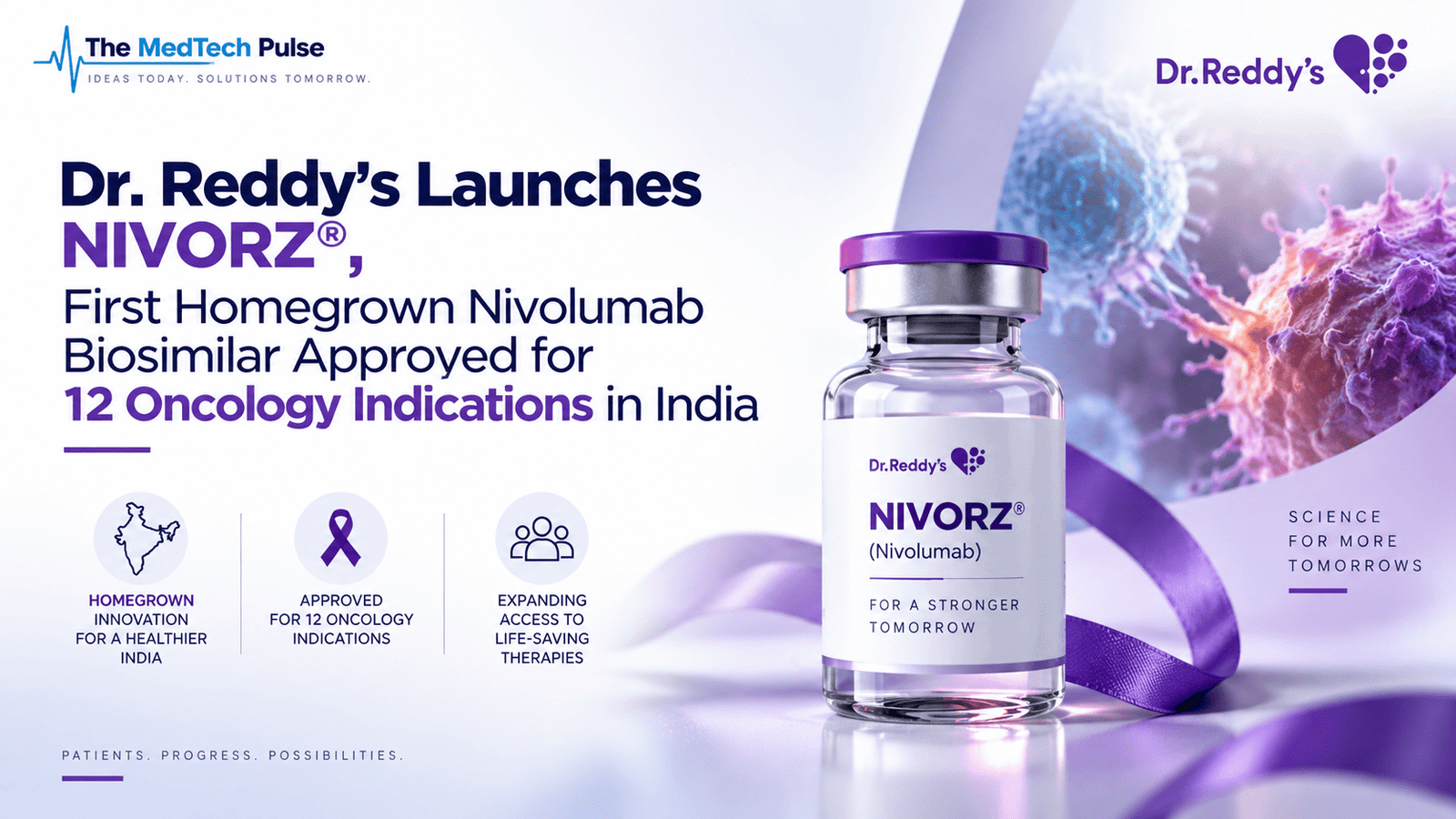
Immune checkpoint inhibitors changed cancer treatment more than almost any other drug class in the last decade, turning previously untreatable metastatic cancers into conditions some patients could live with for years. In India, though, access to that revolution has always run into the same wall: cost. Nivolumab, sold globally as Opdivo, sits firmly in the category of cancer drugs priced well beyond what most Indian patients can afford out of pocket. Dr. Reddy’s Laboratories has now put its own answer into the market, NIVORZ, described as India’s first homegrown nivolumab biosimilar, approved for 12 oncology indications.
What Nivolumab Actually Does
Nivolumab belongs to a class of drugs called PD-1 inhibitors, immune checkpoint inhibitors that work by blocking the interaction between the PD-1 receptor on immune T-cells and its ligands, PD-L1 and PD-L2. In simple terms, many cancers develop the ability to “switch off” the immune system’s T-cells, effectively hiding from the body’s own defences. Nivolumab blocks that shut-off signal, releasing the brakes on the immune response and allowing T-cells to recognise and attack tumour cells again.
Since its original approval, nivolumab has become one of the cornerstone drugs of modern oncology, with the reference product Opdivo (developed by Bristol Myers Squibb) approved globally across a wide range of cancers, melanoma, non-small cell lung cancer, renal cell carcinoma, classical Hodgkin lymphoma, head and neck squamous cell carcinoma, urothelial carcinoma, hepatocellular carcinoma, and colorectal cancer, among others, both as monotherapy and in combination with other treatments.
What a Biosimilar Actually Means for Patients
A biosimilar isn’t a generic drug in the traditional sense, biologic drugs like nivolumab are large, complex molecules manufactured using living cells, which makes them fundamentally more difficult to replicate exactly than a small-molecule chemical drug. A biosimilar is a biologic developed to be highly similar to an already-approved reference product, with no clinically meaningful differences in safety, purity, or efficacy, typically demonstrated through a “totality of evidence” approach involving analytical, non-clinical, and clinical comparability studies.
What that means practically for Indian oncology patients is significant: a properly developed and regulatory-approved biosimilar offers the same clinical benefit as the original branded drug, at a meaningfully lower price, precisely the value proposition that has made biosimilars one of the most consequential access tools in Indian oncology over the past decade.
Dr. Reddy’s Track Record in Oncology Biosimilars
NIVORZ doesn’t emerge from nowhere, it’s the latest entry in a deliberate, sustained biosimilar strategy Dr. Reddy’s has been building for close to two decades. The company entered the biosimilars space in 2008 with Reditux, a biosimilar of rituximab used for certain lymphomas and leukaemias, and has since built out a portfolio spanning Cresp (darbepoetin alfa), Grafeel (filgrastim), Hervycta (trastuzumab, for HER2-positive breast and gastric cancers), Versavo (bevacizumab, approved in India and later in the UK), and Womab (pertuzumab, for HER2-positive breast cancer) alongside its licensed immuno-oncology drug Zytorvi (toripalimab), launched through a partnership with Junshi Biosciences for nasopharyngeal carcinoma.
That track record matters for how NIVORZ should be read: this isn’t a first attempt at a complex biologic by a company still building its biologics capability, it’s a continuation of a company that has, by its own account, launched biosimilars across oncology and auto-immune disease categories, with clinical development and manufacturing infrastructure built specifically around the demands of biologics production.
The Competitive and Regulatory Backdrop
NIVORZ arrives into a nivolumab biosimilar market in India that’s already become genuinely competitive. Zydus Lifesciences moved first, receiving Delhi High Court clearance to manufacture and sell its own nivolumab biosimilar, branded Tishtha, ahead of Bristol Myers Squibb’s Indian patent on nivolumab expiring on May 2, 2026, with Zydus pricing its 40mg and 100mg presentations to specifically improve affordability and reduce dosing wastage for oncologists. Zydus has estimated its biosimilar could benefit more than 500,000 Indian patients through improved affordability and access to immuno-oncology therapy.
Dr. Reddy’s entry with NIVORZ signals that India’s nivolumab market is following a now-familiar pattern in Indian oncology biosimilars: once patent protection lifts (or is successfully challenged) on a high-value cancer immunotherapy, multiple Indian manufacturers move quickly to bring biosimilar versions to market, driving real price competition in a therapy category where the originator brand has historically had no meaningful domestic competition. For patients and oncologists, that competition is unambiguously positive, more suppliers generally means better pricing and more secure supply than a single-manufacturer market.
Why 12 Indications Matters
A biosimilar’s regulatory approval doesn’t automatically extend to every indication the reference product holds, regulators evaluate whether extrapolation across indications is scientifically justified based on the mechanism of action and available clinical evidence. An approval spanning 12 oncology indications for NIVORZ, if it matches or approaches the breadth of nivolumab’s global label, would represent a meaningfully comprehensive biosimilar approval, giving Indian oncologists broad flexibility to prescribe the more affordable biosimilar across the same range of cancers where the reference product would otherwise be used, rather than a narrower approval that would leave prescribers to make an unfavourable trade-off between cost and label breadth in certain cancers.
What This Means for Indian Oncology Access
India’s cancer burden continues to grow substantially, the country faces close to 2 million new cancer cases annually, with incidence projected to rise significantly in the coming decades. Against that backdrop, the affordability of modern immunotherapy isn’t a marginal concern; it’s central to whether India’s oncology system can actually deliver on the promise checkpoint inhibitors represent, rather than reserving them for a small fraction of patients who can afford originator pricing.
NIVORZ’s entry, alongside Zydus’s Tishtha, is part of the same broader pattern running through Indian biotech and pharma in 2026: domestically developed alternatives to expensive global therapies, built specifically to close India’s affordability gap in cancer care, echoing the same underlying logic behind ImmunoACT’s low-cost CAR-T therapy NexCAR19 and the broader push toward indigenous, affordable advanced medicine covered elsewhere in Indian MedTech and pharma coverage this year.
What to Watch Next
For a launch of this significance, the details that will matter most to oncologists and patients over the coming months are the ones that determine real-world impact: NIVORZ’s actual price point relative to both the originator Opdivo/Opdyta and its direct competitor Tishtha, real-world clinical uptake data, and how quickly hospitals and treatment protocols across India’s Tier-2 and Tier-3 oncology centres, not just major metro cancer institutes, begin incorporating the biosimilar into standard treatment pathways.
References
- Business Standard — Zydus Life Launches Nivolumab Biosimilar in India After Delhi HC Nod (https://www.business-standard.com/companies/news/zydus-life-launches-nivolumab-biosimilar-in-india-after-delhi-hc-nod-126012201230_1.html)
- Frontiers in Oncology — Past, Present and Future of Nivolumab: New Horizons in Immuno-Oncology (https://www.frontiersin.org/journals/oncology/articles/10.3389/fonc.2026.1801874/full)
- Dr. Reddy’s Biologics — Biosimilar Products Portfolio (https://www.drreddysbiologics.com/biosimilars)
- Zacks — RDY Launches Loqtorzi Biosimilar in India for Nasopharyngeal Carcinoma (https://www.zacks.com/stock/news/2377101/rdy-launches-loqtorzi-biosimilar-in-india-for-nasopharyngeal-carcinoma)
- GaBI Online — Dr Reddy’s Looks to Biosimilars for Growth (https://gabionline.net/biosimilars/news/Dr-Reddy-s-looks-to-biosimilars-for-growth)
Note: This article reflects Dr. Reddy’s public announcement of the NIVORZ launch. Specific details regarding the complete list of the 12 approved indications, exact pricing, and formal launch date were not independently verified through a primary company press release at the time of writing; readers should confirm current prescribing information and pricing directly through Dr. Reddy’s Laboratories or a treating oncologist.