

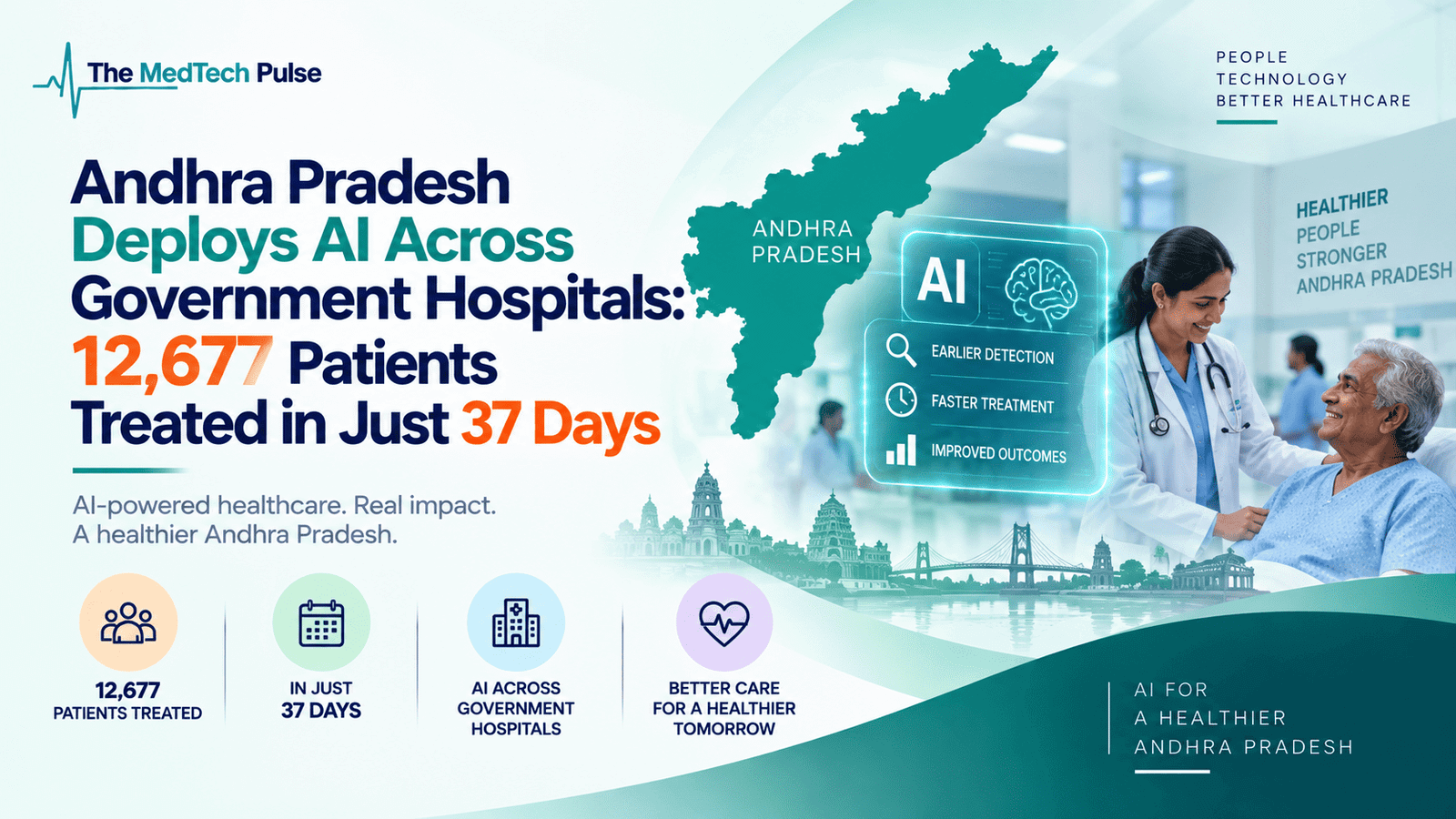
Public health systems in India rarely get described as fast-moving testbeds for new technology. Andhra Pradesh’s recent AI healthcare pilot is a genuine exception — a coordinated, multi-startup deployment across government hospitals that ran for just over a month and generated results at a scale rarely seen in Indian public-sector pilots of any kind.
What the Pilot Actually Was
The programme sits under the AP MedTech Innovation Challenge, a state government initiative that drew close to 300 applications from startups across the country. From that pool, 18 startups were selected and deployed directly into government hospitals across Andhra Pradesh — not as isolated demos, but as tools used under clinical supervision on real patients.
The selection process itself was structured rather than informal. A body called the Committee for Applied Technologies in Health (CATH), featuring experts from IISc Bengaluru and ICMR, spent months vetting submitted technologies before the final 18 were cleared for hospital deployment. The intent, according to state health officials, was to ensure patients were receiving validated tools rather than unproven experiments — a distinction that matters when the deployment touches thousands of real patients rather than a controlled trial cohort.
The Scale, in Numbers
Over 37 days, the deployed technologies were used to serve 12,677 patients across the participating hospitals. Andhra Pradesh Health Minister Y Satya Kumar Yadav described it as the first time in India that multiple startups had simultaneously piloted AI-driven healthcare tools inside government hospitals at this scale — a claim that, based on available reporting, appears to hold up; most prior AI-health pilots in India have involved a single technology or a single hospital system, not an 18-startup, statewide rollout.
What the Technologies Actually Did
The deployed tools spanned a genuinely wide range of clinical use cases rather than clustering around one specialty. Diagnostic tools covered early detection of tuberculosis — including AI systems analysing the acoustic signature of a patient’s cough in real time — alongside identification of eye conditions, cervical and other cancer risk assessment, detection of neonatal respiratory complications, and identification of cardiac irregularities. Portable point-of-care devices and smart monitoring wearables extended diagnostic reach into primary health centres that would not otherwise have specialist-level screening capacity. Remote telemedicine platforms filled gaps where specialist availability remained limited. AI-powered medical scribing systems were also deployed, with reported reductions in consultation documentation time of around 70% — a meaningful efficiency gain in settings where physician time is often the binding constraint on how many patients can be seen in a day.
One detail worth underlining for anyone thinking about deployment mechanics rather than just headline numbers: the pilot integrated AI-generated diagnostic outputs directly into each patient’s ABHA ID (Ayushman Bharat Health Account). That means a patient’s AI-generated report doesn’t stay siloed inside a single pilot programme — it becomes part of their portable digital health history, accessible wherever they next seek care within India’s digital health ecosystem.
Recognition and Incentives
The programme culminated in an evaluation and awards event, with the state government offering a top prize of ₹1 crore to the best-performing startup, alongside additional incentives totalling ₹40 lakh distributed across four categories — first, second, and third place startups in each receiving ₹5 lakh, ₹3 lakh, and ₹2 lakh respectively, covering 12 winning startups in total. The evaluation and closing event was held at the Ratan Tata Innovation Hub in Mangalagiri, alongside a broader “AI-Based Healthcare System Stakeholders’ Conference” that brought in participants including National Health Authority Joint Secretary Kiran Gopal Vaska, along with representation from the India AI Mission, IIT Kanpur, and e-Health Startup India — signalling that the state intends the pilot’s findings to feed into national-level AI health policy discussions, not remain a purely state-level exercise.
The Bigger Political and Policy Context
The pilot sits inside a more ambitious stated vision from Andhra Pradesh Chief Minister N Chandrababu Naidu, who has publicly floated a “one AI doctor per person” model as a longer-term goal for the state’s healthcare monitoring and delivery system. Whatever one makes of that framing, the 37-day pilot functions as an early, real-world data point for whether AI tools can meaningfully extend clinical capacity inside resource-constrained government hospital settings — which is a considerably more grounded question than the “AI doctor” framing might suggest.
Why This Matters Beyond Andhra Pradesh
For hospitals, this is a rare instance of AI healthcare tools being validated at meaningful patient volume inside a public-sector setting rather than a private, urban, tertiary-care hospital — the environment most AI-health pilots in India actually happen in. For startups, the pilot demonstrates that a structured state-level channel — apply, get vetted by a credible technical committee, deploy under clinical supervision, get evaluated against real outcomes — can function as a genuine go-to-market pathway into public healthcare, rather than public health remaining accessible only through slow-moving central tenders. For policymakers in other states, the ABHA integration detail is arguably the most exportable part of the model: it demonstrates a workable pattern for how state-level AI pilots can plug into India’s existing national digital health infrastructure rather than creating disconnected, one-off data silos.
What to Watch Next
The open questions worth tracking are whether Andhra Pradesh moves from pilot to sustained deployment across a larger set of hospitals, whether other states adopt a similar CATH-style vetting-and-deployment model, how the 12 winning startups scale beyond their pilot deployments, and whether the promised evaluation findings — expected to be shared with medical officers, students, and national health agencies — result in any formal national guidance on state-level AI health pilots. For a sector that has generated plenty of pilot announcements and comparatively few reported outcome numbers, Andhra Pradesh’s willingness to publish a specific patient count is itself notable.
References
- Digital Health News, “Andhra Pilots AI Healthcare in Public Hospitals with 12,000+ patients served in 37-day trial,” April 2026
- Digital Health News, “Andhra Pradesh Sets Benchmark in AI-Driven Healthcare, Says Health Minister,” May 2026
- Deccan Chronicle, “AI-Driven Healthcare Summit, MedTech Grand Finale To Be Held Today,” May 2026
- The Indian Practitioner, “Andhra Pradesh Launches AI Pilot in 18 Government Hospitals to Improve Diagnosis and Care,” March 2026
- Medical Buyer, “Andhra start-ups pilot AI-driven healthcare in government hospitals,” April 2026
- AI Infozone, “We went inside Andhra’s 18 pilot hospitals,” March 2026
Note: One source reported the patient count as “nearly 15,000”; this article uses 12,677, the figure most consistently cited across state government and health-ministry-adjacent reporting.