

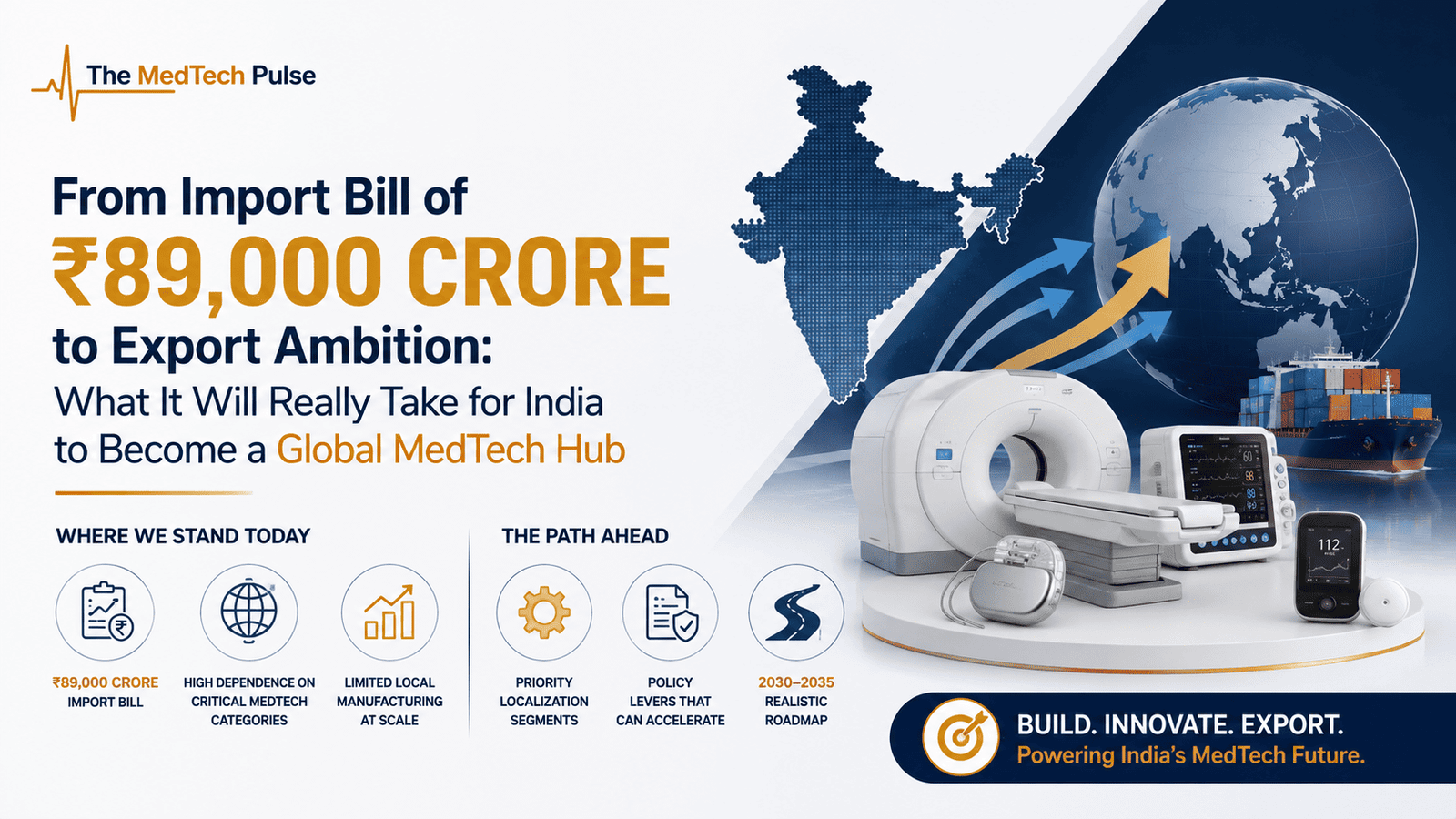
India imports roughly 70% of the medical devices it uses — a dependency that, for the country’s more advanced diagnostic and therapeutic equipment specifically, has actually gotten worse in recent years, not better. The country’s medical device import bill surged 17% in a single year to reach ₹89,000 crore, and more recent government figures put the total even higher, at ₹1.37 lakh crore. That’s the uncomfortable backdrop against which every other article in this series — the PLI scheme, CDSCO reforms, AMTZ, indigenous devices from BIRSA 101 to Supernova — has to be read. India has real, genuine MedTech manufacturing momentum. It also, by its own government’s admission, still has a very long way to go before “Make in India” medical devices meaningfully dent that import bill, let alone flip the country into a genuine export hub.
Here’s what the numbers actually show, and what it will realistically take to close the gap.
The Scale of the Problem: Where the Money Actually Goes
Import concentration in Indian MedTech is sharper than most people assume. Currently, just 40 product categories account for nearly 85% of India’s total medical device imports — meaning the country’s dependency isn’t spread evenly across thousands of device types, it’s concentrated in a relatively small, identifiable list of high-technology categories that India has historically never built serious domestic manufacturing capacity for.
The Department for Promotion of Industry and Internal Trade (DPIIT) has been consulting industry leaders on a specific ten-item priority list of high-value devices targeted for accelerated domestic production: MRI systems and their components, cardiac pacemakers, continuous glucose monitoring (CGM) systems, advanced ultrasound machines, high-end IVD analysers, X-ray tubes, X-ray imaging detectors, ultrasound probes, CT scanner components, and high-value mammography systems. Officials have also flagged critical sub-components — X-ray tubes and imaging detectors specifically — as areas needing dedicated attention, since these are the kind of upstream parts that sit inside multiple finished-device categories simultaneously, making them a particularly high-leverage place to build domestic capacity.
It’s worth being precise about why this list looks the way it does: these are almost all devices with genuine, decades-deep engineering barriers to entry — precision imaging physics, semiconductor-grade detector manufacturing, biocompatible implant materials science — not devices India lacks manufacturing capacity for out of neglect. As one industry analysis put it bluntly: India’s rising medical device import bill is precisely the kind of problem where it’s not money, market size, or political will that’s missing, but technology that took other countries three decades and enormous institutional investment to build.
Some Real Progress — But the Bill Is Still Growing
It would be inaccurate to say nothing has changed. The Production Linked Incentive scheme for medical devices, covered in detail elsewhere in this series, has genuinely brought domestic manufacturing online for MRI and CT equipment, linear accelerators, mammography systems, C-arms, ultrasound equipment, heart valves, stents, and dialysis products — production lines that simply didn’t exist in India five years ago. Export figures back up genuine, if modest, progress on the other side of the ledger too: medical device exports rose from $2.9 billion in FY2021-22 to $4.1 billion in FY2024-25, according to government data — roughly 41% growth over three years.
But that progress is being outpaced by import growth. The import bill’s 17% single-year jump to ₹89,000 crore — and the more recent figure putting total MedTech imports at ₹1.37 lakh crore — makes clear that domestic manufacturing capacity, real as it is, hasn’t yet come close to catching up with the sheer growth in India’s underlying demand for advanced medical technology. India’s hospital infrastructure is expanding fast, non-communicable disease burden is rising, and insurance penetration is deepening — all genuine, positive healthcare trends that happen to also be driving import volumes up faster than domestic substitution can currently offset.
Department of Pharmaceuticals Secretary Manoj Joshi captured this tension directly at the ninth India Medical Device conference in 2026: India has made real progress in local manufacturing of consumables and disposables, and in the assembly of higher-end diagnostic and imaging systems — but he explicitly called for greater domestic value addition, stronger component manufacturing, and continued investment in advanced medical technologies, arguing that India’s strategy needs to extend beyond import substitution and toward building a genuinely export-oriented device industry. That’s a notably candid framing from the government official overseeing the sector: assembly-stage progress is real, but it isn’t the same thing as the deep manufacturing capability the country actually needs.
The Scale Gap: India vs the Global Market
Context matters here, and it’s sobering. According to Joshi, India’s medical device market is valued at around $16 billion, compared with a global market exceeding $600 billion — meaning India currently represents well under 3% of the world’s medical device market by value, despite having roughly 17% of the world’s population. That gap is itself the clearest illustration of how much runway exists, in both directions: enormous unmet domestic demand still being met through imports, and an enormous global market India has barely begun to compete in as an exporter.
What Genuine Localization Would Require, Category by Category
MRI and CT systems. These represent perhaps the hardest category on the government’s priority list, because the core technology — superconducting magnets for MRI, precision X-ray detector arrays for CT — sits at the intersection of materials science, cryogenics, and semiconductor-grade manufacturing that only a handful of companies globally (Siemens Healthineers, GE Healthcare, Philips, Canon Medical) have mastered end-to-end. India’s progress so far has been meaningful at the assembly and mid-range system level; the genuinely hard technology — high-field superconducting magnets, advanced detector arrays — remains a multi-year, capital-intensive undertaking even with sustained policy support.
Cardiac pacemakers. Miniaturised, implantable electronics with multi-decade reliability requirements and an extraordinarily high regulatory bar, given the life-or-death consequences of device failure. This is a category where India’s existing electronics manufacturing base — strong in consumer electronics assembly — doesn’t automatically translate, because implantable-grade reliability engineering is a fundamentally different discipline from consumer product manufacturing.
CGM systems. As covered elsewhere in this series, India’s CGM story so far is mostly a software and consumer-brand success story (Ultrahuman) built on top of imported sensor hardware (Abbott, Dexcom, and similar global players), rather than genuine domestic sensor chemistry manufacturing — illustrating precisely the assembly-versus-deep-manufacturing gap that runs through this entire import-substitution challenge.
X-ray tubes, detectors, and imaging components. Arguably the most promising near-term opportunity on the list, precisely because these are components rather than complete systems — meaning a domestic manufacturer doesn’t need to master an entire MRI or CT system to make meaningful progress, just the specific sub-component. This is also exactly the kind of upstream, component-level manufacturing gap that Department of Pharmaceuticals officials have flagged as the sector’s most urgent priority, separate from and more foundational than finished-device assembly.
Policy Levers Already in Motion
A few concrete policy developments are worth tracking as signals of how seriously this priority list is being pursued:
- PLI 2.0 for high-end MedTech. The current PLI scheme runs through FY2026-27 and, as covered elsewhere in this series, has drawn government acknowledgment that a meaningful share of its output remains assembly rather than deep value-addition. A follow-on PLI 2.0 specifically targeting high-end MedTech is reportedly under active consideration — a signal that the government sees the current scheme’s structure as insufficient on its own to close the gap on the hardest device categories.
- Global Tender Enquiry (GTE) exemption list review. In June 2026, the Department of Pharmaceuticals invited stakeholder comments on proposed amendments to the GTE exemption list for medical devices, with submissions due by mid-July 2026 — a procurement-policy lever that determines how public healthcare buyers can source imported versus domestic devices, and one that directly shapes how much guaranteed domestic demand local manufacturers can count on as they scale.
- National Medical Devices Policy 2023. This broader policy framework — promoting regulatory reform, infrastructure development, and skill enhancement alongside CDSCO’s harmonisation with global standards — sits as the umbrella strategy underneath the more specific PLI and priority-device-list initiatives.
- An unresolved tension over used-device imports. Domestic manufacturer associations have pushed back on a separate government order permitting import of pre-owned high-value medical devices for reuse in India, arguing it directly contradicts the self-reliance goals of the National Medical Device Policy — a reminder that India’s import-substitution push isn’t a fully unified government position, but one still being actively negotiated between different policy objectives and stakeholder interests.
The Honest Roadmap: 2026–2035
Pulling together the government’s own stated targets, industry commentary, and the structural realities of each device category, a realistic roadmap for India’s medical device self-reliance ambitions looks something like this:
Near-term (2026–2028): Continued PLI-driven assembly and mid-range system manufacturing scale-up for MRI, CT, ultrasound, and mammography systems already underway; component-level progress on X-ray tubes and imaging detectors, given their comparatively lower technical barrier relative to complete high-field imaging systems; a likely PLI 2.0 launch specifically targeting the ten priority high-value categories; continued export growth in the mid-single-digit-billion-dollar range, following the FY2021-22 to FY2024-25 trajectory.
Medium-term (2028–2032): The genuine test of whether India can move from assembly to deep manufacturing in at least a few of the hardest categories — most plausibly CGM sensor chemistry and mid-field MRI systems, given existing domestic momentum in both areas, rather than the very highest-end imaging and implantable device categories, which will likely remain import-dependent considerably longer.
Long-term (2032–2035): A realistic best-case scenario would see India meaningfully narrow, though not eliminate, its import dependence in the ten priority categories, while genuinely establishing itself as a credible exporter in at least a handful of device categories where Indian companies have already shown export traction — cell and gene therapy platforms (following ImmunoACT and BIRSA 101’s model), surgical robotics (following SS Innovations’ already-active 12-country footprint), and mid-range diagnostic imaging equipment.
What Would Actually Determine Success or Failure
Three factors, more than any single policy announcement, will determine whether India closes this gap or simply keeps growing both its import bill and its domestic manufacturing base in parallel without meaningfully shifting the ratio between them:
- Whether component-level manufacturing genuinely scales, rather than remaining concentrated in finished-device assembly — the specific distinction Department of Pharmaceuticals officials have themselves flagged as the sector’s central unresolved weakness.
- Whether India’s healthcare demand growth outpaces its manufacturing scale-up, as it has for the past several years — meaning the import bill could plausibly keep growing in absolute terms even while the percentage of demand met domestically genuinely improves, a nuance easy to miss in headline import-bill figures.
- Whether Indian companies that have already proven export competitiveness — SS Innovations in surgical robotics, ImmunoACT in cell therapy — represent the start of a broader pattern, or remain isolated success stories in a sector where most other categories still struggle to clear even the domestic-substitution bar, let alone compete internationally.
The Bottom Line
India’s medical device import bill crossing ₹89,000 crore, and by some measures ₹1.37 lakh crore, isn’t a policy failure story — it’s a genuine reflection of how fast Indian healthcare demand is growing, running ahead of a domestic manufacturing base that is real, improving, but still fundamentally young relative to the multi-decade technology moats built by global incumbents in the hardest device categories. The government’s own senior officials have been unusually candid that assembly-stage progress, while genuine, isn’t the same as the deep component manufacturing capability the country actually needs. What India has clearly proven, through BIRSA 101, NexCAR19, Supernova, and SS Innovations’ international expansion, is that it can build genuinely world-class, cost-competitive medical technology when the right combination of public research infrastructure and private manufacturing partnership comes together. The 2026–2035 question isn’t whether India can innovate — it’s whether that innovation model can be replicated across enough of the ten priority high-value device categories, fast enough, to actually bend the import curve before India’s healthcare demand growth outpaces it again.
References
- Medical Buyer — High-Value Medical Devices: India Pushes Local Production (https://www.ocacademy.in/blogs/india-high-value-medical-devices-manufacturing/)
- BioVoice News — India Medical Device 2026 Opens with Focus on Exports, Manufacturing (https://biovoicenews.com/india-medical-device-2026-exports-local-manufacturing-medtech/)
- India Briefing — India MedTech Localization: Manufacturing and Investment Opportunities (https://www.india-briefing.com/news/india-medtech-localization-manufacturing-investment-opportunities-45813.html)
- NIIR Project Consultancy — Medical Device Manufacturing Business in India: 5 Business Ideas (https://www.niir.org/blog/medical-device-manufacturing-business/)
- Medical Buyer — India’s High-Value Medical Device Push: Right Diagnosis, Harder Cure (https://medicalbuyer.co.in/indias-high-value-medical-device-push-right-diagnosis-harder-cure/)
- Medical Buyer — India Calls for Manufacturing Push as MedTech Import Bill Hits ₹1.37L Crore (https://medicalbuyer.co.in/india-calls-for-manufacturing-push-as-medtech-import-bill-hits-%E2%82%B91-37l-crore/)
- International Trade Administration (US Department of Commerce) — India Medical Devices Market Intelligence (https://www.trade.gov/market-intelligence/india-medical-devices)
- Deccan Herald — Domestic Medical Device Makers Seek Withdrawal of New Drugs, Medical Device and Cosmetics Bill 2023 (https://www.deccanherald.com/india/domestic-medical-device-makers-seek-withdrawal-of-new-drugs-medical-device-and-cosmetics-bill-2023-2653223)
Note: Import bill and export figures are drawn from government data and industry reporting current as of mid-to-late 2026 and are subject to revision as official annual trade data is finalised. The 2026–2035 roadmap presented here is an editorial projection based on stated government priorities and current sector trajectory, not an official government timeline.