

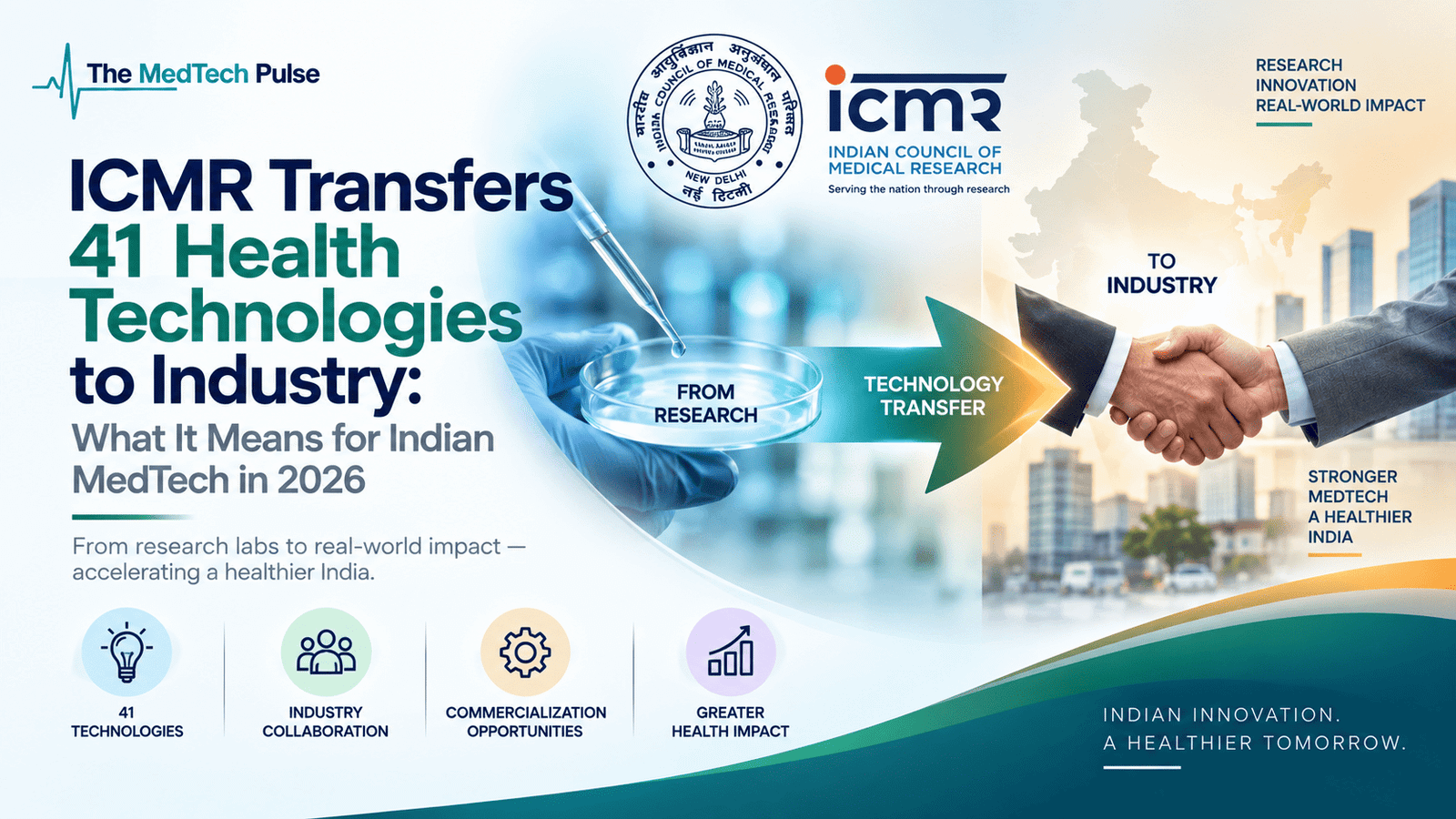
For years, one of the quiet frustrations in Indian biomedical research has been the gap between what gets discovered in a government lab and what actually reaches a patient. India funds a large public research apparatus through the Indian Council of Medical Research (ICMR), yet a meaningful share of that research has historically stalled somewhere between publication and product. In May 2026, ICMR took a visible step toward closing that gap — and the scale of the move is worth understanding if you build, fund, or manufacture in Indian MedTech.
What Happened
On May 25, 2026, ICMR — under the Department of Health Research, Ministry of Health and Family Welfare — hosted what it described as India’s largest biomedical innovation and technology transfer facilitation event, held in New Delhi under the banner “Medical Innovations Patent Mitra: Innovators-to-Industry (I2I) Connect.”
The headline number: 41 public health technologies were formally transferred from ICMR institutes and independent innovators to industry partners for further development, manufacturing, and commercialisation. More than 100 additional technologies across diagnostics, therapeutics, and medical devices were showcased at the event, giving industry stakeholders direct access to ICMR’s research pipeline rather than having to discover it through scattered publications or informal networks.
Inside the Transfer: What Kind of Technologies Moved
The 41 transferred technologies span several categories that matter to MedTech and pharma manufacturers alike: advanced diagnostics, vaccine candidates, medical devices, and other biomedical solutions targeting priority public health problems. The event also marked the release of two reference documents — the Indian Biomedical Patent Landscape Report and a Technology Compendium — intended to give industry a structured map of what IP already exists inside India’s public research system and where the commercialisation-ready assets sit.
This isn’t an isolated event, either. In July 2026, ICMR licensed three further biomedical technologies through the same Patent Mitra mechanism to established manufacturers, including Emcure Pharmaceuticals and Biological E. Those transfers covered glycoconjugate and recombinant vaccine candidates for typhoid and paratyphoid, alongside diagnostic technologies for Japanese Encephalitis, tuberculosis, and Mpox. Read together, the May event and the July follow-on suggest ICMR intends Patent Mitra to function as a standing pipeline rather than a one-time showcase.
The Medical Innovation Patent Mitra Initiative
Patent Mitra is the structural mechanism behind all of this — one of the first platforms of its kind dedicated specifically to biomedical innovation showcasing and technology transfer in India. Its stated purpose is to translate publicly funded biomedical research into real-world healthcare solutions through structured industry partnerships, while also protecting the underlying intellectual property so that innovators and institutions retain appropriate value from what they’ve developed.
Officials speaking at the event framed the initiative in fairly direct terms: India, they said, is moving from being primarily a consumer of health technologies toward becoming a source of affordable, innovative healthcare solutions — a shift enabled by institutions like ICMR working in closer partnership with industry. A NITI Aayog representative present at the event argued India already has the scientific capability and innovation ecosystem needed to lead globally in health technologies, and that Patent Mitra’s role is specifically to protect IP, formalise technology transfer, and accelerate the journey from laboratory to society. ICMR’s Director General framed the initiative as central to ensuring that cutting-edge public research actually reaches people, rather than remaining confined to academic output. The initiative has also been positioned as supporting the broader Viksit Bharat 2047 vision through stronger public-private partnership in the biomedical sector.
Why This Matters for Indian MedTech Founders and Investors
If you’re building a diagnostics, devices, or biologics company in India, this is worth tracking for a few concrete reasons.
First, it’s a licensing opportunity, not just a policy headline. Technologies transferred under Patent Mitra are explicitly available for further development, manufacturing, and commercialisation by industry partners — which means smaller device and diagnostics companies, not only large pharma names, are plausible licensees if they can demonstrate manufacturing and regulatory capability.
Second, it signals where public research priorities sit. The technology mix — diagnostics, vaccines, devices addressing “critical public health priorities” — gives a reasonably clear signal of where government-backed IP is concentrated, which is useful information for companies deciding where to position their own R&D pipelines relative to what’s already been de-risked at the research stage.
Third, it reinforces a direction of travel that’s been building across several policy threads this year: India’s regulatory and research institutions are actively trying to shorten the lab-to-market runway, rather than leaving that translation entirely to the private sector or to chance.
The Commercialisation Pathway From Here
The practical mechanics of the pathway are: ICMR institutes and innovators develop and patent technologies; Patent Mitra provides the structured licensing and IP-protection layer; industry partners take on further development, scale-up manufacturing, and commercialisation, typically under negotiated licensing terms. The Technology Compendium released at the May event is meant to make this process more discoverable — effectively a catalogue that industry can browse rather than a process that depends on informal introductions.
What to Watch Through 2026–27
A few things are worth tracking as this initiative matures. Whether the July-style follow-on licensing deals continue at a steady cadence will indicate whether Patent Mitra is a genuine pipeline or a periodic showcase. Which categories of technology attract the fastest uptake — diagnostics and vaccines look like early movers — will tell manufacturers where competitive licensing activity is likely to intensify. And whether facilitation extends meaningfully to smaller device-focused startups, rather than concentrating in the hands of large vaccine and pharma manufacturers, will determine how broadly this initiative actually reshapes India’s MedTech commercialisation landscape.
For a sector that has often struggled to move research out of institutional silos, a structured, repeatable transfer mechanism — even an imperfect one — is a meaningful shift in direction.
References
- Medical Dialogues, “ICMR transfers 41 technologies at India’s largest biomedical innovation, tech transfer event,” May 2026
- BioSpectrum India, “ICMR transfers 41 public health technologies to Industry,” May 2026
- Manorama Yearbook, “ICMR transfers 41 public health technologies for development,” May 2026
- The Hans India, “ICMR transfers 41 technologies at India’s largest biomedical innovation, tech transfer event,” May 2026
- GKToday, “ICMR Transfers Indigenous Medical Technologies for Commercialisation,” July 2026
- DD News, “ICMR launches India’s largest biomedical innovation platform, transfers 41 health technologies to industry,” May 2026
Note: Some source reports carried slightly different event dates (May 25 vs. May 27, 2026) in their bylines; this article uses May 25, 2026 (the Monday referenced consistently across wire copy) as the event date.