

Regulatory delay has long been one of the most-cited frustrations among Indian device manufacturers and startups — approvals that take months longer than comparable pathways in other markets, paperwork that moves between central and state authorities without a single source of truth, and limited visibility into where an application actually sits in the queue. In late July 2026, India’s drug regulator signalled the clearest commitment yet to fixing that experience through technology rather than incremental process tweaks.
What Was Announced
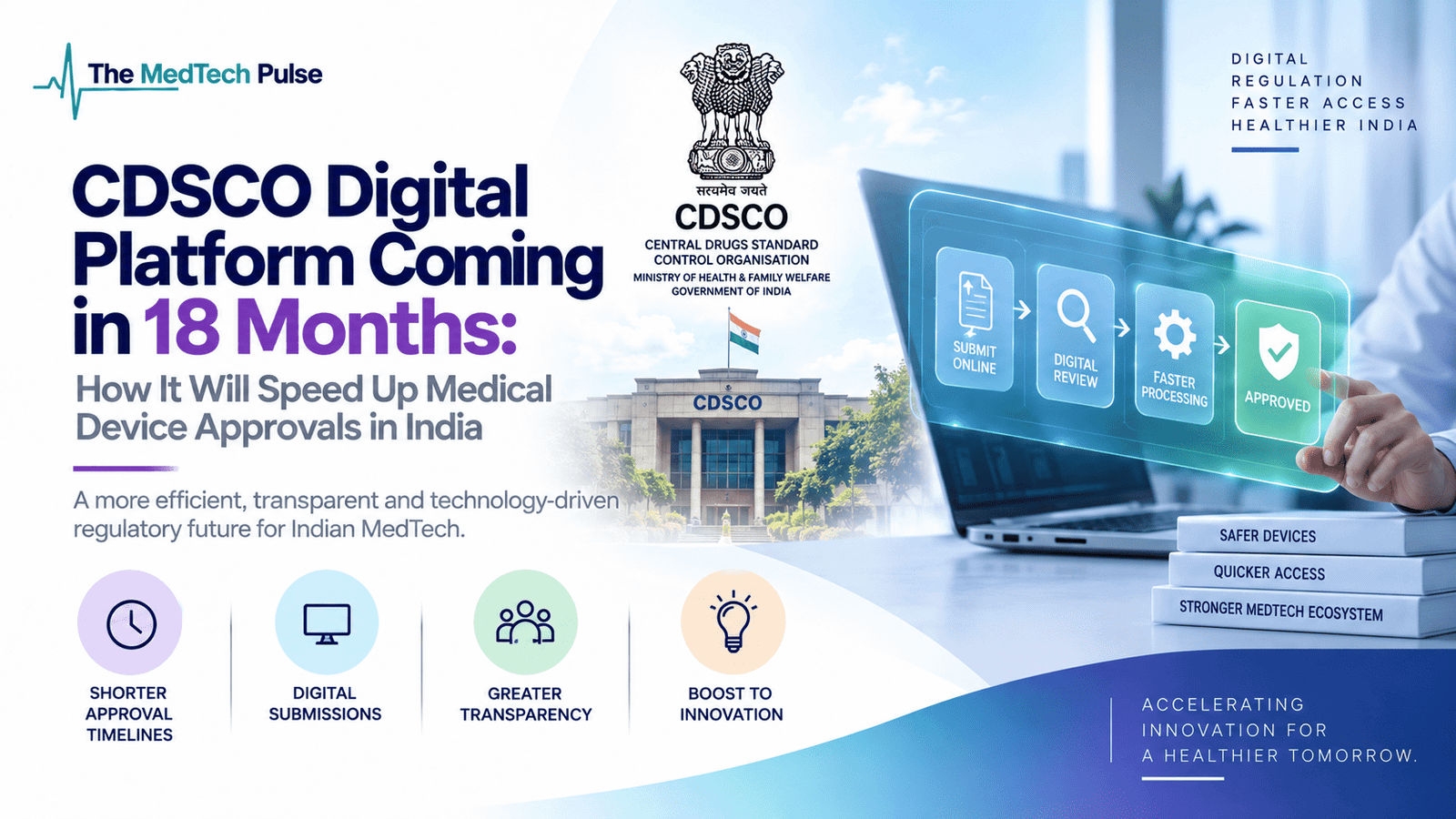
At the inaugural Global Drug Regulatory Conclave (GDRC) 2026, organised by the Pharmaceuticals Export Promotion Council of India (Pharmexcil) in association with the Central Drugs Standard Control Organisation (CDSCO), Drugs Controller General of India (DCGI) Dr Rajeev Singh Raghuvanshi announced that CDSCO will roll out the first phase of a comprehensive, end-to-end digital drug regulatory platform within the next 18 months.
The conclave itself was a signal of intent — it brought together regulatory authorities from more than 40 countries, including the US, UK, and Japan, to discuss harmonisation, digital transformation, and expanding global acceptance of the Indian Pharmacopoeia. Union Health and Family Welfare Minister J.P. Nadda addressed the event virtually, describing India’s goal as building a future-ready regulatory framework that supports healthcare innovation while holding the line on patient safety, quality, and efficacy standards.
What the Platform Will Actually Do
The proposed platform is designed as a single-window interface for the pharmaceutical and device industry, integrating the entire regulatory value chain into one connected digital ecosystem. According to Dr Raghuvanshi, that means linking research and clinical development, manufacturing, approvals, distribution, and post-market surveillance — and connecting central regulators, state regulators, and manufacturers on the same system, rather than the current arrangement where information often sits in separate silos.
This builds on work already underway. CDSCO says more than 99% of its regulatory processes have already been digitised in some form, which the DCGI credits with meaningfully improving transparency and approval timelines to date. The new platform is being framed less as a first step into digitisation and more as the integration layer that finally connects those separately digitised processes into a coherent, trackable system.
AI Enters the Regulatory Process
Alongside the platform announcement, Dr Raghuvanshi confirmed that CDSCO is now piloting artificial intelligence across its regulatory processes, with the explicit goal of building a faster, more agile, and data-driven regulatory system. This isn’t happening in isolation — a Parliamentary Standing Committee on Health and Family Welfare report from December 2025 had already recommended that CDSCO adopt AI-driven analytics specifically to identify procedural bottlenecks, cut down on manual intervention, and make approval timelines more predictable, citing persistent delays in the medical device approval process as a competitiveness concern.
Two other regulatory moves from the same period reinforce the direction of travel. CDSCO has already implemented a fully digitised Export No Objection Certificate (NOC) system, adopted globally aligned regulatory reliance pathways that let India lean on trusted foreign regulatory decisions where appropriate, and introduced accelerated approval mechanisms aimed at getting innovative therapies to patients faster. Regulators are also reportedly considering waiving clinical trial requirements for roughly 25–30% of eligible innovative products, depending on individual regulatory eligibility — a change that, if implemented, would materially shorten timelines for some device and drug categories.
What This Means for MedTech Startups Specifically
For SaMD (Software as a Medical Device) and device manufacturers, two threads matter beyond the headline platform announcement.
First, CDSCO released its final guidance document on Medical Device Software in 2026, following a draft published in October 2025. The final guidance sets out classification, technical documentation, and quality management expectations for software-based medical devices — including alignment with ISO 13485 for quality management, IEC 62304 for software lifecycle processes, and ISO 14971 for risk management, alongside cybersecurity and clinical evaluation requirements. For AI-diagnostics and connected-device companies, this is the clearest regulatory reference point currently available and is likely to shape how new SaMD submissions are structured going forward.
Second, the MedTech Mitra facilitation initiative — which exists specifically to help startups navigate CDSCO’s regulatory requirements — has already assisted more than 800 startups, according to figures shared at the conclave. Similar facilitation programmes are reportedly being planned for biologics and other emerging healthcare technology categories, which suggests the government sees structured hand-holding, not just faster software, as part of closing the regulatory-speed gap.
The Honest Caveats
It’s worth being direct about what hasn’t happened yet. The platform is a phased rollout over an 18-month horizon, not a system that exists today — the first phase alone represents a significant integration undertaking across central and state regulatory bodies with genuinely different systems and workflows. AI adoption in regulatory decision-making is explicitly described as being in a piloting stage, not a deployed capability, and regulators have not detailed exactly which approval categories AI will touch first or how much of the process will remain human-reviewed. The clinical trial waiver range (25–30%) was described as under consideration rather than finalised policy.
None of that diminishes the significance of the announcement — a stated 18-month commitment from the DCGI, made publicly at an international regulatory conclave, is a meaningfully firmer signal than the periodic modernisation promises the sector has heard before. But manufacturers and startups planning submission timelines over the next year should treat this as a direction of travel to plan around, not yet a system to rely on.
What to Watch
Over the next several quarters, the details worth tracking include which regulatory functions the digital platform integrates first (approvals versus post-market surveillance versus manufacturing licensing), how state-level regulators are brought onto a single system given India’s federal drug-regulation structure, whether the clinical trial waiver framework for innovative products gets formalised, and how far AI actually moves from pilot to production within CDSCO’s approval workflow. For a sector where predictable timelines are often as valuable as fast ones, the platform’s real test will be whether it makes the process more legible — not just faster.
References
- Medical Dialogues, “Digital Drug Regulation: CDSCO to Introduce Integrated Compliance Platform in 18 Months,” July 2026
- BioSpectrum India, “CDSCO is piloting AI across regulatory processes to create data-driven regulatory system: DCGI,” July 2026
- Indian Pharma Post, “India to launch end-to-end digital drug regulatory platform within 18 months: DCGI,” July 2026
- Digital Health News, “CDSCO Pilots AI Across Regulatory Processes, Digital Platform Planned Within 18 Months,” August 2026
- World Pharma Today, “CDSCO Advances Digital Drug Regulation Platform in India,” August 2026
- Digital Health News, “Parliamentary Panel recommends digitized, time-bound CDSCO approvals for medical devices,” December 2025
- Operon Strategist, “CDSCO Final Guidance for Medical Device Software (MDSW) 2026,” July 2026