

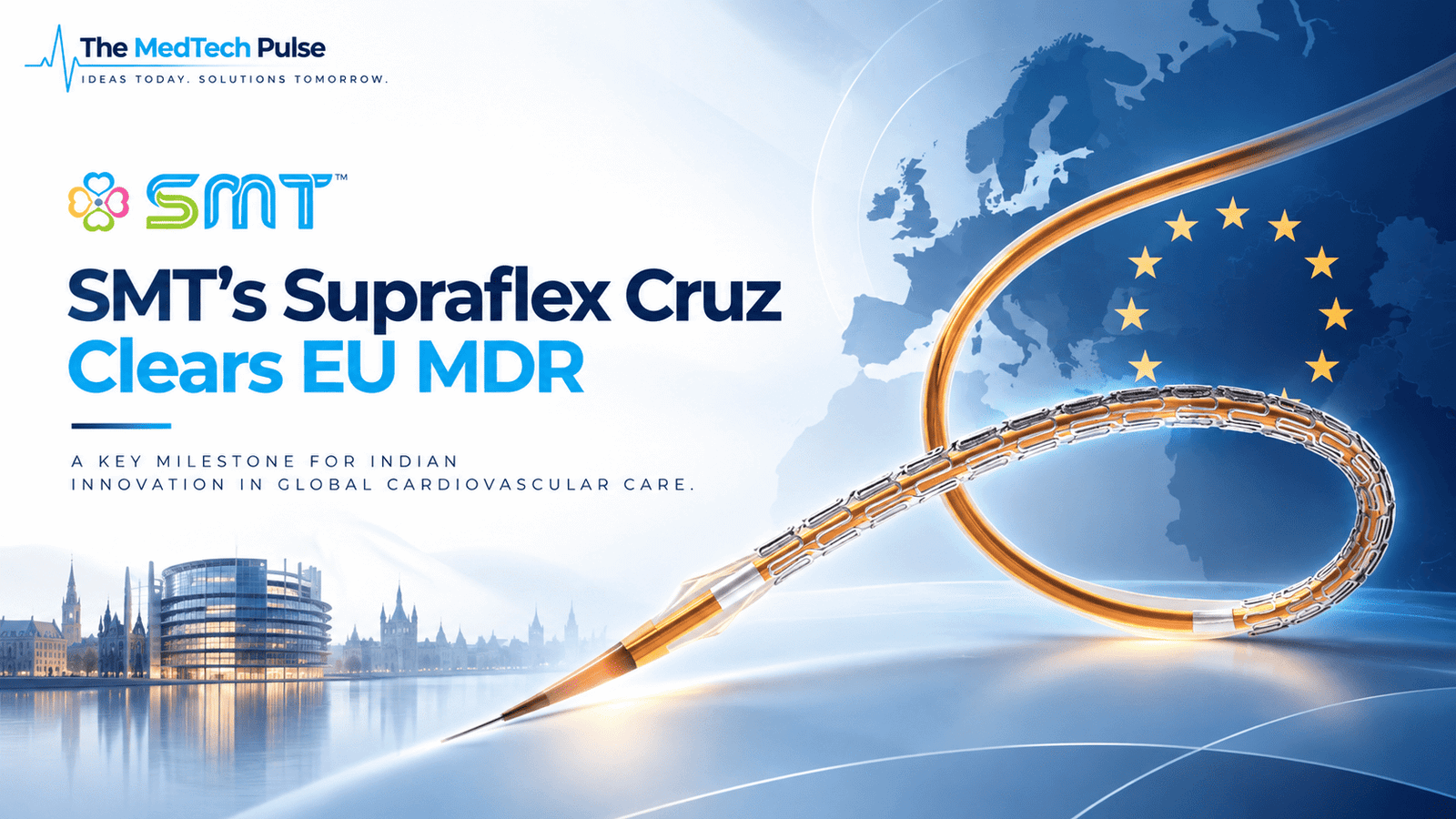
Three continents, three major regulatory clearances, one calendar year. Sahajanand Medical Technologies (SMT) has announced that its Supraflex Cruz coronary stent and its broader product family have received certification under the European Union Medical Device Regulation (EU MDR 2017/745) — arguably the most demanding medical device regulatory framework in the world, and the third significant international approval the Gujarat-based company has secured in 2026 alone, following clearances in Canada and Egypt earlier this year.
What Was Actually Certified
SMT confirmed the EU MDR certification on September 24, 2026, describing it as covering Supraflex Cruz and its broader product family — meaning the certification extends across the stent platform’s variants, not a single isolated product configuration. The certification followed the full conformity assessment process EU MDR 2017/745 requires: a comprehensive review of SMT’s technical documentation, clinical evaluation data, and quality management system by an accredited notified body.
Combined with SMT’s existing ISO 13485 quality management certification and Medical Device Single Audit Program (MDSAP) status, the company said the EU MDR certification confirms Supraflex Cruz has successfully undergone assessment against the regulation’s requirements for safety, performance, and clinical evidence — the three pillars EU MDR is specifically designed to scrutinise more rigorously than its predecessor framework.
Why EU MDR Specifically Matters
To understand why this particular certification is significant, it helps to understand what EU MDR actually is and why it exists. Regulation (EU) 2017/745 replaced the EU’s earlier Medical Devices Directive framework following a major scandal: the 2010 discovery that French manufacturer Poly Implant Prothèse (PIP) had been using industrial-grade, non-medical silicone in breast implants sold across Europe, deceiving regulators and endangering hundreds of thousands of patients. That scandal exposed serious weaknesses in the EU’s previous device oversight system, and EU MDR was built specifically to close those gaps — with substantially stricter requirements for clinical evidence, more rigorous technical documentation, and continuous post-market surveillance obligations that persist long after a device reaches the market, not just at the point of initial approval.
Abhijeet Singhvi, Chief Technology Officer at SMT, was direct about what clearing that bar actually required: “EU MDR significantly raised expectations for clinical evidence, technical documentation and post-market surveillance. Achieving this certification reflects a strong cross-functional effort across our R&D, clinical, quality and regulatory teams.” That’s a meaningful acknowledgment from the company’s own technical leadership — EU MDR isn’t a formality companies clear by submitting existing paperwork; it demands a genuinely higher evidentiary standard than what came before it, and a considerable number of device manufacturers globally have struggled to keep products on the European market as the regulation has phased in over recent years.
The Scale Behind the Certification
SMT paired the announcement with figures that underline just how established Supraflex Cruz already is as a clinical product, not a new or unproven device seeking its first major market. The company states Supraflex Cruz has supported the treatment of more than 2.5 million patients across over 75 countries, with clinical evidence built on four randomised controlled trials involving more than 5,000 patients and seven real-world registries covering more than 13,000 patients. That’s a substantial evidentiary base — precisely the kind of depth that made clearing EU MDR’s heightened clinical-evidence bar achievable, rather than a stretch.
SMT also described its existing standing in Europe specifically: the company says it already ranks among the top five drug-eluting stent manufacturers in key European markets, including Germany, Spain, and Poland — meaning this certification is best understood as protecting and extending an already meaningful European commercial presence, not a first attempt to enter the market.
The Third Approval of 2026: A Pattern, Not a Coincidence
What makes this announcement particularly notable is where it sits in SMT’s broader 2026 trajectory. Earlier this year, Supraflex Cruz cleared Health Canada’s Class IV medical device licence — the highest-risk device tier Health Canada regulates, reserved for implantable cardiovascular devices — marking the company’s entry into the Canadian and broader North American market. Shortly after, the stent secured approval from Egypt’s Drug Authority, extending SMT’s regulatory footprint into Africa.
Within a single year, then, SMT has cleared high-scrutiny regulatory bars across North America, Africa, and now — with EU MDR — Europe’s most demanding device framework. That’s not a coincidental cluster of unrelated wins; it reflects a company deliberately building simultaneous regulatory submissions across multiple major jurisdictions, backed by a clinical evidence base substantial enough to support parallel review processes in different regulatory systems at the same time.
SMT’s own framing of the EU MDR milestone captures this ambition directly: “It is another step in SMT’s journey toward becoming a truly global leader in cardiovascular care.” Given the pace of the company’s 2026 approvals, that framing reads less as aspirational marketing language and more as a fairly literal description of what’s actually happening.
Why This Matters for Indian MedTech
SMT’s pattern this year is worth reading alongside the broader story running through Indian MedTech in 2026 — a sector working hard to shift from being judged primarily on cost competitiveness to being judged on genuine technical and clinical credibility in the world’s most demanding markets. SMT’s own history supports that shift: the company was the first in the world to receive CE certification for a drug-eluting stent with a biodegradable polymer, a foundational technical achievement that has underpinned its international expansion ever since.
Clearing EU MDR specifically sends a particular kind of signal that Health Canada or Egyptian Drug Authority approval, while genuinely significant in their own right, don’t quite carry on their own: EU MDR is widely regarded within the global MedTech industry as one of the hardest device frameworks to satisfy anywhere in the world, precisely because of the post-PIP-scandal reforms built into it. An Indian-manufactured coronary stent clearing that bar — alongside an already-established top-five market position across Germany, Spain, and Poland — is a concrete answer to any lingering perception that Indian-manufactured devices compete only on price rather than on the underlying engineering and clinical rigour that regulators like the EU’s actually scrutinise.
What to Watch Next
With continuity of supply and patient access across Europe now secured under the new regulatory regime, the practical next phase for SMT will be maintaining EU MDR’s ongoing post-market surveillance obligations — a continuous compliance requirement, not a one-time achievement — while continuing to build out the international regulatory footprint that’s defined its 2026. Given the company’s stated ambition to become “a truly global leader in cardiovascular care,” and a track record of three major approvals across three continents within a single year, further international regulatory announcements from SMT look like less a possibility than an expectation.
References
- The Tribune — Sahajanand Medical Technologies Receives EU MDR Certification for Supraflex Cruz and Product Family, Reinforcing Global Compliance and Patient Safety (https://www.tribuneindia.com/news/business/sahajanand-medical-technologies-receives-eu-mdr-certification-for-supraflex-cruz-and-product-family-reinforcing-global-compliance-and-patient-safety)
- BioSpace — Sahajanand Medical Technologies Receives EU MDR Certification for Supraflex Cruz and Product Family (https://www.biospace.com/press-releases/sahajanand-medical-technologies-receives-eu-mdr-certification-for-supraflex-cruz-and-product-family-reinforcing-global-compliance-and-patient-safety)
- ANI News — Sahajanand Medical Technologies Receives EU MDR Certification for Supraflex Cruz and Product Family (https://aninews.in/news/business/sahajanand-medical-technologies-receives-eu-mdr-certification-for-supraflex-cruz-and-product-family-reinforcing-global-compliance-and-patient-safety20260924171124/)
- LatestLY — Sahajanand Medical Technologies Receives EU MDR Certification for Supraflex Cruz and Product Family (https://www.latestly.com/agency-news/business-news-sahajanand-medical-technologies-receives-eu-mdr-certification-for-supraflex-cruz-and-product-family-reinforcing-global-compliance-and-patient-safety-7618916.html)
- ThePrint (ANI Press Releases) — Sahajanand Medical Technologies Receives EU MDR Certification for Supraflex Cruz and Product Family (https://theprint.in/ani-press-releases/sahajanand-medical-technologies-receives-eu-mdr-certification-for-supraflex-cruz-and-product-family-reinforcing-global-compliance-and-patient-safety/3052359/)
- Wikipedia — Regulation (EU) 2017/745 (Medical Device Regulation) (https://en.wikipedia.org/wiki/Regulation_(EU)_2017/745)
- Business Standard — Sahajanand Medical Technologies Secures Regulatory Approval in Egypt for Supraflex Cruz Coronary Stent (https://www.business-standard.com/content/press-releases-ani/sahajanand-medical-technologies-secures-regulatory-approval-in-egypt-for-supraflex-cruz-coronary-stent-126091600554_1.html)
Note: This article reflects SMT’s official announcement dated September 24, 2026, and publicly available information as of the same date. This article references SMT’s proposed IPO process, which remained subject to SEBI approval and market conditions at the time of writing.