

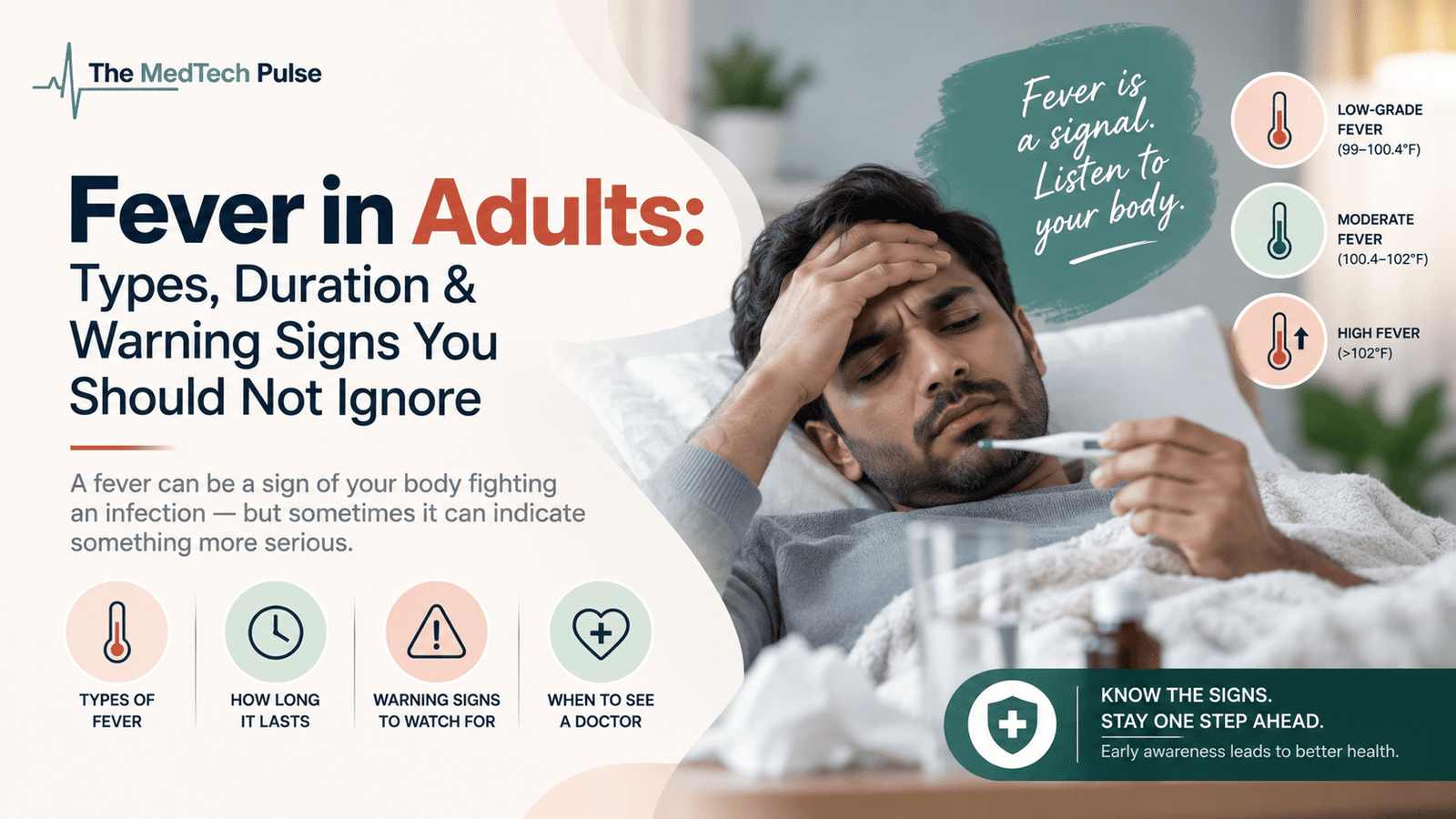
Fever is one of the most common reasons Indian adults visit a doctor — and also one of the most commonly misunderstood. Some people panic at the first sign of a slightly warm forehead. Others push through a 102°F fever for days, assuming it’s “just weather change” or “just weakness,” until it turns out to be dengue, typhoid, or something else that needed attention days earlier. India’s tropical climate, dense population, and monsoon-linked disease burden make fever a genuinely more complicated symptom here than in many other parts of the world — the same fever that might simply be a cold in a temperate country could, in India, be one of several distinct illnesses requiring very different treatment.
This guide walks through what fever actually is, the different types and what they typically mean, the major causes specific to India, how to measure your temperature correctly, and — most importantly — the warning signs that tell you it’s time to stop waiting it out and see a doctor.
What Counts as Fever, and What Doesn’t
Normal body temperature isn’t a single fixed number — it varies slightly by individual, time of day, and measurement method, but generally sits around 98.6°F (37°C), with normal variation typically between 97°F and 99°F depending on the time of day (body temperature is usually lowest in early morning and highest in late afternoon/evening).
Medically, fever is generally defined as:
- Oral temperature of 100.4°F (38°C) or above
- A temperature reading that’s meaningfully elevated compared to your own personal baseline, particularly if accompanied by other symptoms
A temperature of 99°F to 100.3°F is often considered a mild elevation rather than a true fever in adults, though it’s still worth monitoring, especially if it persists or is accompanied by other symptoms.
Types of Fever
Understanding the pattern of your fever — not just the peak number — genuinely helps doctors narrow down the cause, and it’s useful for you to track and describe accurately when you do see a doctor.
Low-Grade Fever
A low-grade fever generally refers to a temperature between 99°F and 100.9°F. It’s often associated with:
- Early-stage viral infections
- Mild inflammatory conditions
- The body’s general immune response to minor infections
- Sometimes, non-infectious causes like stress or, in women, the normal luteal phase of the menstrual cycle
Low-grade fevers are usually manageable at home unless they persist for several days or come with other concerning symptoms.
High-Grade Fever
A high-grade fever refers to a temperature of 103°F (39.4°C) or above. This level of fever is more likely to indicate a significant infection and deserves closer attention, particularly if it develops suddenly or is accompanied by other symptoms like severe body ache, rash, or altered mental state. High fevers are a hallmark of several of the infections discussed below, including dengue and malaria.
Intermittent Fever
An intermittent fever is one that rises and falls, sometimes returning to completely normal temperature between episodes, following a repeating pattern. This pattern is medically significant and is a classic sign of certain specific infections:
- Malaria classically causes fever that cycles in waves — often with a specific timing pattern (for instance, every 48 or 72 hours depending on the malaria parasite species involved) — with the fever alternating between high spikes, sweating, and periods of feeling relatively normal in between.
- Intermittent fever patterns can also occur with certain bacterial infections and some non-infectious causes.
Continuous or Remittent Fever
Unlike intermittent fever, a continuous fever stays persistently elevated without returning to normal, while a remittent fever fluctuates but doesn’t fully return to baseline temperature. Typhoid fever classically follows a distinctive pattern: a low fever that gradually increases day by day over the first week, often reaching as high as 104–105°F (40–40.5°C) if untreated, and tends to remain persistently elevated rather than cycling the way malaria does.
Common Causes of Fever in India
Viral Fever
The most common cause of fever in India by far, viral fever typically presents with a moderate temperature, body ache, fatigue, and sometimes cold-like symptoms (runny nose, cough, sore throat). It’s generally self-limiting, meaning it resolves on its own within about 3 to 7 days with supportive care, and doesn’t require antibiotics since it isn’t caused by bacteria.
Dengue Fever
Dengue is transmitted by the Aedes mosquito and remains one of India’s most significant public health concerns — the country contributes roughly a third of the world’s dengue cases. Symptoms typically appear 4 to 10 days after a mosquito bite and include:
- Sudden, high-grade fever
- Severe headache, particularly behind the eyes
- Intense muscle and joint pain, which has earned dengue the nickname “breakbone fever”
- Skin rash
- Nausea and vomiting
Dengue follows three distinct phases: an initial febrile phase, a critical phase (typically days 3 to 7 of illness, often right as the fever starts to subside — this is when complications like bleeding and dangerously low blood pressure can develop, even as the patient may appear to be improving), and a recovery phase. Diagnosis relies on blood tests — an NS1 antigen test in the early days of illness, or antibody tests slightly later — combined with a complete blood count (CBC) to monitor platelet levels, which characteristically drop in dengue and need close monitoring even after the fever itself settles.
Typhoid Fever
Caused by Salmonella Typhi bacteria and spread through contaminated food and water, typhoid remains common in India due to variable water and sanitation quality in many areas. Typhoid classically presents with:
- Fever that starts low and climbs progressively day by day, potentially reaching 104–105°F
- Headache, weakness, and fatigue
- Loss of appetite
- Abdominal pain and either diarrhoea or constipation
- Sometimes a rash and an enlarged liver or spleen
Diagnosis typically involves blood culture (the most reliable method, especially in the first week of illness) or the Widal test, alongside clinical evaluation. Typhoid requires antibiotic treatment, and — unlike viral fever — will generally not resolve on its own; delayed treatment increases the risk of serious complications.
Malaria
Caused by Plasmodium parasites transmitted through the female Anopheles mosquito, malaria remains endemic in many parts of India, with the country accounting for a meaningful share of global malaria cases. Key features include:
- The characteristic cyclic fever pattern described above, often with associated chills and profuse sweating
- Headache, muscle aches, and fatigue
- As the disease progresses without treatment, malaria can cause anaemia, jaundice, and an enlarged spleen
- In severe cases, particularly with Plasmodium falciparum, malaria can progress to cerebral malaria, kidney failure, and multi-organ failure
Diagnosis is through a blood smear examination or a rapid diagnostic test, both widely available across India. Malaria requires specific antimalarial treatment, and species identification matters for choosing the right medication.
Other Bacterial Infections
Beyond typhoid, various bacterial infections — urinary tract infections, pneumonia, skin and soft tissue infections, and others — can present with fever, usually alongside symptoms specific to the site of infection (burning urination for UTIs, cough and chest pain for pneumonia, localised redness and swelling for skin infections). These generally require antibiotics once properly diagnosed.
The Overlap Problem
It’s worth being honest about a genuine clinical challenge: dengue, typhoid, malaria, and viral fever often present with substantially overlapping symptoms in their early days — fever, headache, body ache, and fatigue can look nearly identical across all of them. Co-infections (having more than one of these simultaneously) have also been documented in Indian case reports, particularly during peak monsoon season, adding further complexity. This overlap is precisely why self-diagnosis based on symptoms alone is unreliable, and why doctors generally recommend proper blood testing — rather than guessing — for any fever that doesn’t resolve quickly or comes with any concerning features.
How Long Is Normal, and When Does Fever Become Concerning?
What’s Generally Normal
A fever linked to a straightforward viral infection typically:
- Peaks within the first 2–3 days
- Gradually improves and resolves within 5–7 days total
- Responds reasonably well to rest, fluids, and standard fever-reducing medication
- Doesn’t come with severe or progressively worsening symptoms
When Duration Itself Becomes a Warning Sign
- Fever persisting beyond 3 days without improvement is generally the point at which proper testing is recommended in India, given the range of serious causes — dengue, typhoid, malaria — that need to be ruled out specifically.
- Fever lasting more than 7 days regardless of severity should be medically evaluated if it hasn’t already been.
- Fever that resolves and then returns after a fever-free period is a pattern worth flagging to a doctor, since it can occur with certain infections and doesn’t always mean the illness is over.
Red Flag Symptoms That Need Urgent Care
While most fevers in India are due to manageable viral illness, certain accompanying symptoms mean you should seek medical attention urgently — not wait it out at home.
Seek Prompt Medical Attention If:
- Fever above 103°F (39.4°C) that doesn’t respond to fever-reducing medication
- Fever lasting more than 3 days, especially during dengue, malaria, or typhoid season in your region
- Severe headache, particularly behind the eyes (a classic dengue warning sign)
- Persistent vomiting, preventing you from keeping fluids down
- Severe abdominal pain
- Rash appearing alongside fever
- Unusual bleeding — bleeding gums, nosebleeds, blood in urine or stool, or easy bruising
- Significant weakness or restlessness, particularly if it develops as the fever starts to come down (this specific pattern is an important dengue warning sign, since the critical phase of dengue often begins just as the fever appears to be improving)
- Difficulty breathing or rapid breathing
- Cold, clammy skin or feeling faint
- Reduced urination
Seek Emergency Care Immediately If:
- Confusion, disorientation, or difficulty staying awake
- Seizures
- Signs of shock — very low blood pressure, rapid weak pulse, cold extremities, extreme lethargy
- Significant bleeding from any site
- Severe, unrelenting abdominal pain with vomiting
- Difficulty breathing or bluish discolouration of lips
The Correct Way to Measure Temperature
Accurate temperature measurement matters — both for deciding whether you actually have a fever, and for tracking whether treatment is working.
Types of Thermometers
- Digital thermometers (oral, underarm, or rectal use) are widely available, affordable, and generally accurate when used correctly. Oral readings are typically most reliable for adults.
- Infrared/non-contact thermometers became common during the COVID-19 pandemic. They’re convenient and fast but are generally somewhat less precise than digital contact thermometers, and readings can be affected by room temperature, sweat, or improper distance from the forehead — useful for quick screening, but a digital thermometer is more reliable for actually tracking fever at home.
- Mercury thermometers, once standard in Indian households, are no longer recommended due to the health and environmental risks of mercury exposure if broken; digital thermometers have largely and appropriately replaced them.
Tips for an Accurate Reading
- Wait at least 20–30 minutes after eating, drinking hot or cold liquids, or exercising before taking an oral temperature
- For underarm (axillary) readings, place the thermometer directly against dry skin, not over clothing, and hold the arm firmly against the body for the full measurement time
- Take your temperature at a similar time of day for consistent tracking, since body temperature naturally varies through the day
- If using a digital oral thermometer, keep it under the tongue with lips closed until it beeps
- Keep a simple written record of your readings and the time taken — this is genuinely useful information for a doctor if the fever persists
Home Care Guidelines and When to Visit a Doctor
Home Care for Uncomplicated Fever
For a fever without red-flag symptoms, in the early days of illness:
- Rest adequately — your body needs energy to fight the underlying infection
- Stay well-hydrated — water, ORS (oral rehydration solution), coconut water, and clear soups all help; fluid loss through sweating during fever is significant and easy to underestimate
- Use fever-reducing medication as needed — paracetamol is generally the preferred first-line option in India for fever, following the dosing guidance on the package or from a pharmacist; avoid combining multiple fever medications without medical advice
- Dress in light, breathable clothing and keep the room comfortably cool rather than heavily bundling up
- Eat light, easily digestible food — khichdi, dal, boiled vegetables, and fruit are commonly recommended during fever in Indian households, and for good reason
- Monitor your temperature at regular intervals and keep track of any new or worsening symptoms
When to Visit a Doctor
- Fever persists beyond 3 days without clear improvement
- Fever is high-grade (103°F or above) or not responding to standard fever medication
- Any of the red-flag symptoms described above appear
- You live in, or have recently visited, an area with known dengue, malaria, or typhoid activity, and develop fever with body ache, headache, or rash
- You have an underlying health condition — diabetes, heart disease, a compromised immune system, or are pregnant — since fever can progress differently and more seriously in these situations
- You’re simply unsure and increasingly worried — that instinct is worth trusting rather than second-guessing
A doctor will typically take a detailed history (including recent travel, mosquito exposure, food and water sources, and symptom timeline) and may order blood tests — a CBC, dengue NS1/antibody test, malaria smear or rapid test, and/or typhoid blood culture or Widal test — depending on what the clinical picture suggests, rather than testing for everything at once without reason.
Frequently Asked Questions
Q: Is it normal to have a fever without any other symptoms? Yes, especially in the early stages of a viral illness — other symptoms sometimes develop over the following day or two. If fever alone persists beyond 2–3 days without any other symptoms emerging, it’s still worth getting evaluated.
Q: How can I tell if my fever is dengue, typhoid, or just viral, based on symptoms alone? Honestly, you often can’t reliably tell in the early days — the symptoms overlap significantly. Dengue tends to cause severe body ache and pain behind the eyes; typhoid tends to cause a gradually climbing fever with abdominal symptoms; malaria classically cycles in waves. But definitive diagnosis requires blood testing, not symptom-guessing alone, especially since delayed or incorrect treatment for typhoid or malaria specifically can lead to complications.
Q: Should I take antibiotics for a fever right away? No. Most fevers in India are viral and don’t respond to antibiotics at all. Antibiotics are only appropriate for confirmed bacterial infections like typhoid, and should be prescribed by a doctor based on proper diagnosis — not taken preventively or based on self-diagnosis.
Q: My fever came down but I still feel unwell — is that normal? It can be, but it also deserves attention, particularly with dengue, where the period right after fever subsides (the “critical phase”) is actually when serious complications can develop. Don’t assume you’re in the clear just because the fever itself has dropped — continue monitoring for the warning signs listed above.
Q: What temperature is considered a medical emergency? Very high fever (above 104°F/40°C) that doesn’t respond to medication, or any fever accompanied by confusion, seizures, difficulty breathing, or signs of shock, should be treated as a medical emergency requiring immediate care.
Q: Can stress or hot weather cause fever without an infection? True fever (100.4°F or above) is almost always linked to an underlying infection or inflammatory process, not stress or heat alone — though heat exhaustion and heatstroke can raise body temperature dangerously and require urgent care in their own right, especially during India’s hot summer months. If you’re unsure whether your elevated temperature is heat-related or infection-related, it’s safest to seek medical evaluation rather than assume.
This article is for general educational purposes and does not replace professional medical advice, diagnosis, or treatment. If you or someone you’re caring for is experiencing any of the red-flag symptoms described above, please seek medical attention promptly. This article is not a substitute for proper diagnostic testing when fever persists or is accompanied by concerning symptoms.
References
- Wikipedia — Dengue Fever (https://en.wikipedia.org/wiki/Dengue_fever)
- Wikipedia — Typhoid Fever (https://en.wikipedia.org/wiki/Typhoid_fever)
- Max Hospital — What is Dengue Fever: Causes, Symptoms & Prevention (https://www.maxhealthcare.in/blogs/dengue-fever-symptoms-diagnosis-and-prevention)
- Metropolis Healthcare — Malaria vs Dengue: Key Differences, Symptoms & Treatment (https://www.metropolisindia.com/blog/health-wellness/malaria-vs-dengue-how-to-know-whats-causing-the-fever)
- KIMS Sunshine Hospitals — Monsoon Fevers: Differentiating Between Dengue, Malaria, and Typhoid (https://www.kimssunshine.co.in/blog/monsoon-fevers-differentiating-between-dengue-malaria-and-typhoid/)
- Sparsh Diagnostic Centre — Differences Between Dengue, Malaria, and Typhoid (https://www.sparshdiagnostica.com/differences-between-dengue-malaria-and-typhoid/)
- Journal of Tropical Medicine — Clinical Profile of Dengue Fever in a Tertiary Care Hospital, New Delhi (https://doaj.org/article/c9bcb0f89ea54aa5a0677f4c7fcd28cc)
- International Journal of Case Reports and Images — Dengue and Typhoid Co-Infection: A Case Report from a Tertiary Care Hospital in South India (https://www.ijcasereportsandimages.com/archive/2016/009-2016-ijcri/CS-10076-09-2016-seshan/ijcri-1007609201676-seshan-full-text.php)
Note: This article reflects general clinical guidance and India-specific disease patterns current at the time of writing. Individual symptoms, appropriate testing, and treatment vary by case; always consult a qualified physician for persistent or concerning fever, particularly during dengue, malaria, or typhoid season in your area.