

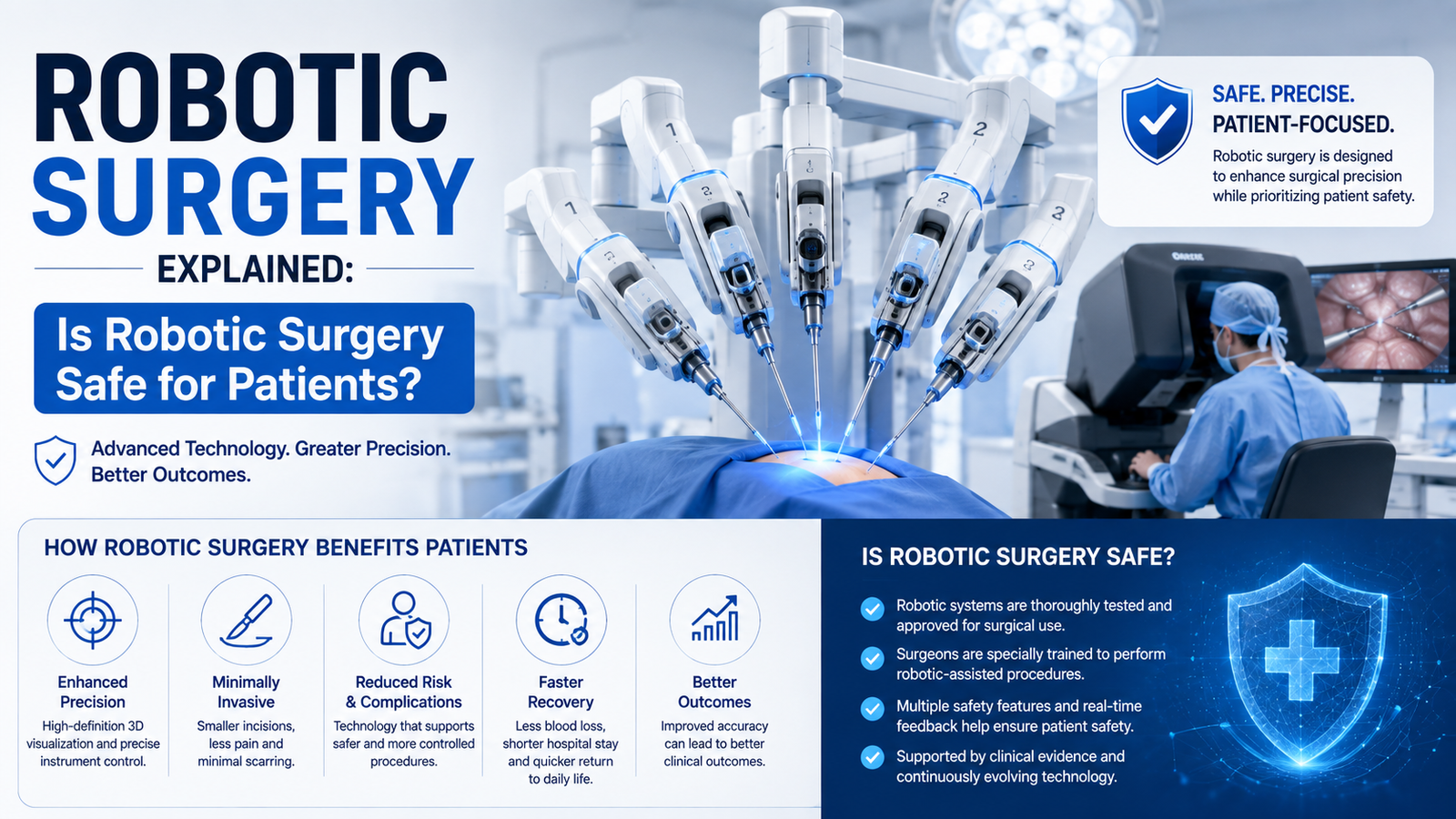
Robotic surgery has moved from science fiction to standard practice in operating rooms around the world. From prostatectomies to hernia repairs, robotic-assisted procedures are now performed millions of times each year across specialties like urology, gynecology, cardiothoracic surgery, and general surgery. Yet many patients still wonder: is robotic surgery actually safe? This guide breaks down how robotic surgery works, its proven benefits, the risks involved, and how it compares to traditional open and laparoscopic techniques—so patients and caregivers can make informed decisions.
What Is Robotic Surgery?
Robotic surgery, also called robotic-assisted surgery, is a minimally invasive technique where a surgeon controls robotic arms fitted with surgical instruments and a high-definition camera. Contrary to a common misconception, the robot does not operate independently—every movement is directed in real time by a trained surgeon seated at a console a few feet from the patient.
The most widely used system is the da Vinci Surgical System, though newer platforms continue to enter the market. These systems translate the surgeon’s hand movements into precise, scaled-down motions of miniaturized instruments inserted through small incisions, typically less than 2 centimeters wide.
How Does Robotic Surgery Work?
- Small incisions: The surgeon makes several small incisions rather than one large opening.
- 3D visualization: A high-definition camera provides magnified, three-dimensional views of the surgical site.
- Instrument control: Robotic arms mimic the surgeon’s hand and wrist movements, but with greater range of motion than the human hand allows and with tremor filtration that removes natural hand shake.
- Real-time surgeon control: The surgeon remains in complete control throughout the procedure, with the system unable to make autonomous decisions or move without direct input.
This combination allows for greater precision in tight anatomical spaces, which is particularly valuable in procedures involving delicate structures like nerves, blood vessels, and organs.
Common Procedures That Use Robotic Surgery
Robotic-assisted techniques are now used in a wide range of procedures, including:
- Prostatectomy (prostate removal)
- Hysterectomy and other gynecologic surgeries
- Hernia repair
- Colorectal surgery
- Cardiac valve repair
- Kidney surgery (partial or full nephrectomy)
- Bariatric surgery
Is Robotic Surgery Safe? What the Evidence Shows
Safety is the top concern for most patients considering robotic surgery, and the data is generally reassuring—with important caveats.
Benefits Supported by Clinical Evidence
- Smaller incisions, less scarring: Reduced tissue trauma compared to open surgery.
- Lower blood loss: Precision instrumentation often means less bleeding during the procedure.
- Reduced infection risk: Smaller wounds generally correlate with lower rates of surgical site infection.
- Shorter hospital stays: Many robotic procedures allow for faster discharge compared to open surgery.
- Faster recovery and less postoperative pain: Patients often return to normal activities sooner.
- Enhanced surgical precision: Particularly valuable for procedures requiring fine dissection in confined spaces.
Risks and Limitations to Understand
No surgical approach—robotic, laparoscopic, or open—is without risk. Potential complications associated with robotic surgery include:
- Longer operative times, especially during a surgical team’s learning curve with the technology
- Equipment malfunction, though rare, which may require conversion to open surgery
- Surgeon experience variability—outcomes are closely tied to how many robotic procedures a surgeon has performed
- Higher upfront procedural cost, which may affect insurance coverage or out-of-pocket expenses
- Not suitable for every patient or condition, particularly in cases of extensive scar tissue, certain tumor sizes, or specific anatomical considerations
Importantly, most large-scale studies find that robotic surgery has complication rates comparable to traditional laparoscopic surgery when performed by experienced surgical teams. The key safety factor isn’t the robot itself—it’s the training, experience, and judgment of the surgeon and surgical team using it.
Robotic Surgery vs. Traditional Surgery: A Quick Comparison
| Factor | Open Surgery | Robotic Surgery |
|---|---|---|
| Incision size | Large | Small |
| Blood loss | Higher | Lower |
| Recovery time | Longer | Shorter |
| Scarring | More visible | Minimal |
| Precision in tight spaces | Limited | Enhanced |
| Cost | Generally lower | Generally higher |
The Role of Wound Closure in Robotic Surgery Outcomes
While much attention goes to the robotic instruments themselves, the way incisions are closed also plays a meaningful role in patient recovery and infection prevention. Even with smaller robotic-assisted incisions, proper wound closure technique—whether through sutures or surgical staples—directly influences healing time, scarring, and complication rates. Surgeons weigh factors like tissue type, incision location, and patient risk profile when choosing the right closure method, underscoring that safety in robotic surgery depends on the entire surgical process, not just the robotic platform.
Questions Patients Should Ask Their Surgeon
Before undergoing a robotic-assisted procedure, patients should feel empowered to ask:
- How many robotic procedures have you personally performed for this specific surgery?
- What are the specific risks for my case?
- What happens if the procedure needs to be converted to open surgery?
- What does recovery typically look like for patients my age and health status?
- What wound closure method will you use, and why?
Frequently Asked Questions
Does the robot perform the surgery on its own?
No. The surgeon controls every movement of the robotic instruments in real time. The system cannot act independently.
Is robotic surgery more painful than traditional surgery?
Generally, robotic surgery results in less postoperative pain due to smaller incisions and reduced tissue trauma.
How long does it take to recover from robotic surgery?
Recovery time varies by procedure, but many patients return to normal activities faster than with open surgery—often within one to two weeks for minor procedures.
Is robotic surgery covered by insurance?
Coverage varies by insurer and procedure. Patients should confirm coverage details with their insurance provider before scheduling.
The Bottom Line
Robotic surgery represents a significant advancement in minimally invasive care, offering patients smaller incisions, reduced pain, and faster recovery for many procedures. Safety outcomes are strong when performed by experienced surgical teams, though patient-specific factors and surgeon expertise remain critical variables. As with any surgical decision, patients should discuss their individual risk factors, ask detailed questions, and understand the full scope of their procedure—including wound closure and recovery planning—before moving forward.