

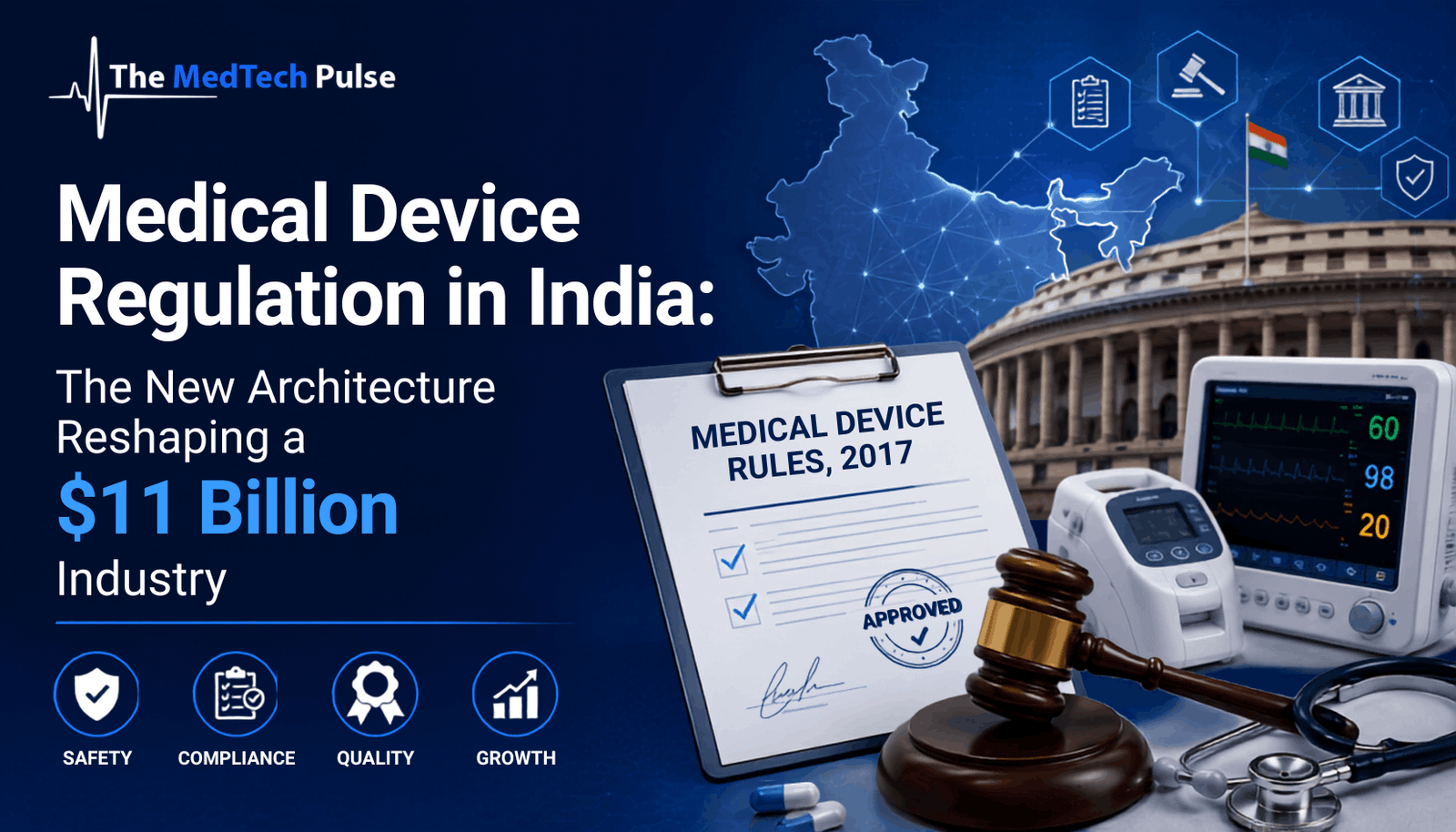
India’s medical device regulatory landscape is undergoing its most significant transformation in over eight decades. With the government moving to replace the Drugs and Cosmetics Act, 1940, and simultaneously rolling out amendments to the Medical Devices Rules, 2017, manufacturers, importers, hospitals, and clinicians across the country are watching closely. For an industry now valued at roughly USD 11 billion and growing at nearly 15% annually, the stakes attached to this regulatory overhaul could not be higher.
From the Drugs and Cosmetics Act to a Unified Modern Law
For decades, medical devices in India were regulated as an afterthought to pharmaceuticals — folded into the Drugs and Cosmetics Act, 1940, and formally notified as “drugs” only through a 2020 notification. That is now set to change. The government has released the Draft Drugs, Medical Devices and Cosmetics Bill, 2026, a sweeping 190-section law spread across eight chapters designed to consolidate and modernize regulation of drugs, medical devices, and cosmetics under a single, unified statute.
Central to this new architecture is, for the first time, a dedicated statutory framework specifically for medical devices — separate provisions covering risk-based classification, licensing, clinical investigations, performance evaluation of diagnostics, a Medical Devices Technical Advisory Board, and a central testing laboratory. The Bill also proposes renaming the Drugs Controller General of India (DCGI) as the Drugs and Medical Devices Controller General, India, while expanding the regulator’s authority over state-level drug controllers and creating separate controllers for drugs and devices respectively.
CDSCO’s Evolving Compliance Pathway
Even as the new Bill moves through consultation, the existing Medical Devices Rules, 2017 — enforced by the Central Drugs Standard Control Organisation (CDSCO) — continues to evolve. Since October 2023, every Class C and Class D medical device sold or imported in India has required a valid CDSCO licence, closing a long-standing gap that previously exempted many non-notified devices. Through 2025, CDSCO issued final risk-classification lists covering interventional radiology and radiotherapy equipment, pulling more high-value hospital devices into mandatory licensing.
Separately, the proposed Medical Devices (Amendment) Rules, 2026 — notified as G.S.R. 270(E) in April 2026 following consultation with the Drugs Technical Advisory Board — introduce further refinements aimed at tightening fee compliance and strengthening the financial and procedural sustainability of the licensing infrastructure. Alongside this, CDSCO has advanced its digital-first agenda: a fully digitized SUGAM portal, sterilisation labelling requirements, UDI (Unique Device Identification) codes, and a 2025 risk-reclassification of over 550 cardiovascular and neurological devices are steadily reshaping how manufacturers manage technical documentation, testing protocols, and audit readiness.
CDSCO has also issued long-awaited guidance on Medical Device Software (MDS), establishing a structured, risk-based classification approach for software-based medical technologies — including Software as a Medical Device (SaMD) and Software in a Medical Device (SiMD) — aligned with ISO 13485 quality management requirements. This is a significant step for India’s growing AI-driven healthcare and connected-device ecosystem.
Industry Pushback: “One Size Doesn’t Fit All”
Not everyone is convinced the new architecture goes far enough. In August 2026, eleven major healthcare and medical technology associations — led by the Association of Indian Medical Device Industry (AiMED) — jointly wrote to Union Health Minister J.P. Nadda urging a fundamental rethink of the draft Bill. Their central argument: medical devices are engineering products, not chemical compounds, and regulating them under a pharma-centric framework misreads the sector entirely.
The coalition has proposed a National Medical Devices Regulatory Authority, modeled on autonomous bodies like TRAI or IRDAI, along with risk-based (rather than uniformly criminal) penalties for technical or labelling lapses that cause no patient harm. Industry groups also point out that Parliamentary Standing Committees have previously recommended two separate laws — one for drugs and cosmetics, another for medical devices — a recommendation they say the current draft still sidesteps.
What This Means for the Sector
Whichever direction the final legislation takes, the direction of travel is unmistakable: India is moving toward a more structured, globally aligned, and digitally enabled regulatory ecosystem for medical devices — one that increasingly mirrors risk-based frameworks like the EU MDR. For manufacturers of wound closure products, sutures, staples, and other Class B–D surgical devices, this means closer attention to UDI compliance, updated technical dossiers, ISO 13485-aligned quality systems, and readiness for classification changes that may shift familiar product categories into higher-scrutiny tiers.
The draft Bill remains in the stakeholder consultation stage, and its final shape — including whether medical devices ultimately get the standalone Act industry is demanding — is still being negotiated. What is clear is that India’s medical device regulation is no longer an appendix to pharma law. It is becoming its own architecture, built for a sector the government itself has identified as strategically vital to the country’s self-reliance and healthcare manufacturing ambitions.
This article is based on publicly available regulatory filings, government gazette notifications, and industry reporting current as of August 2026. Readers should consult official CDSCO and Ministry of Health and Family Welfare notifications for the latest regulatory status.