

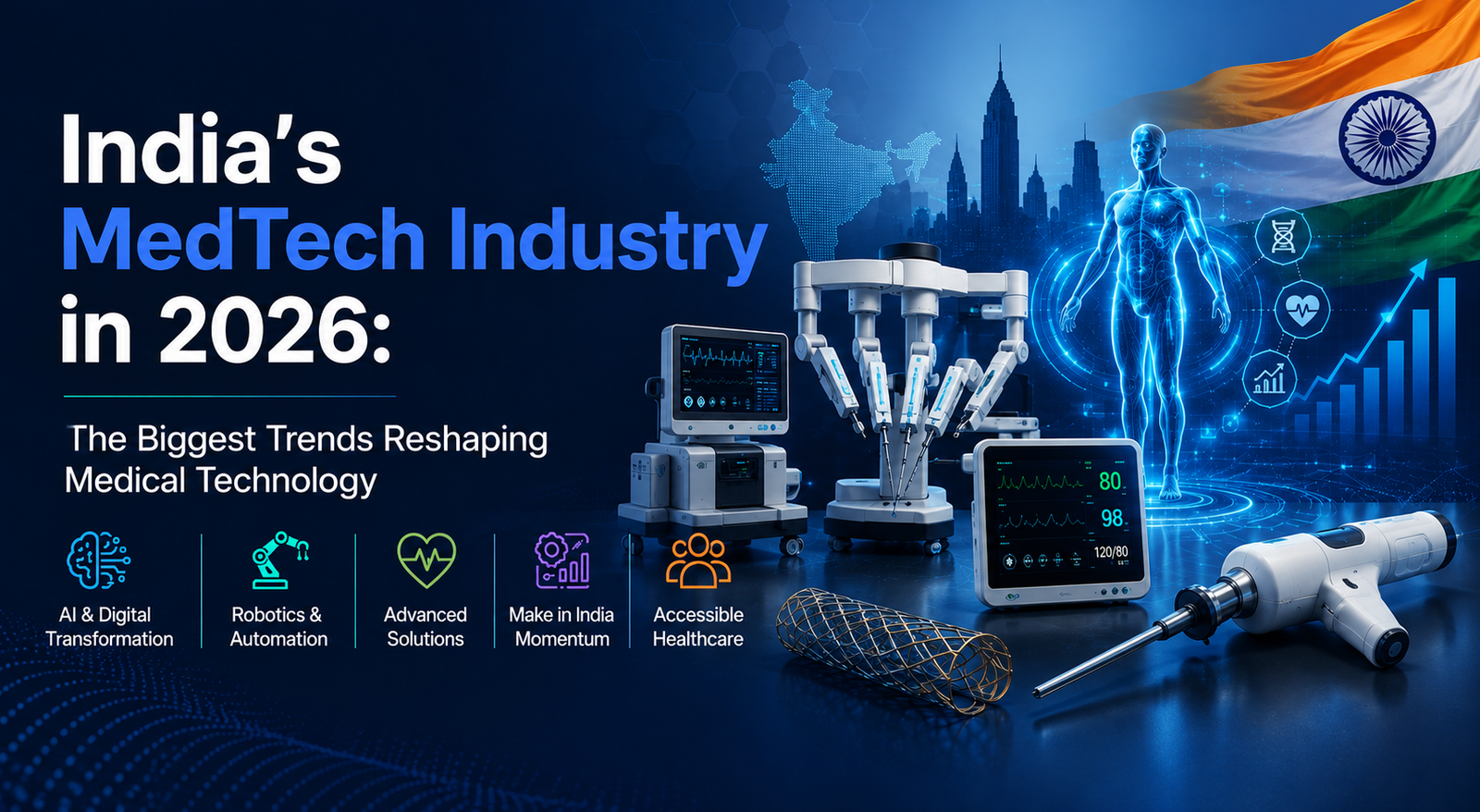
India’s medical technology sector has moved from the sidelines of global healthcare to the center of the conversation. Once seen mainly as an import-dependent market, India is now being talked about as a genuine contender for global MedTech manufacturing leadership. Industry estimates place the domestic medical devices market at roughly $15–17 billion in 2026, with projections pointing toward $44–50 billion by 2030 and an even more ambitious $250 billion vision by 2047. Behind these numbers is a sector going through real structural change — in manufacturing, technology adoption, regulation, and global ambition.
For anyone tracking India’s medical technology industry — clinicians, manufacturers, investors, or patients — here are the biggest trends defining 2026.
1. AI Moves From Pilot Projects to Everyday Clinical Workflows
Artificial intelligence in healthcare is no longer a proof-of-concept exercise in India. AI-powered diagnostic tools are being integrated directly into radiology, cardiology, and pathology workflows across metro and Tier 2 hospitals. Indian startups are building AI models for early disease prediction, including cardiac risk scoring and diabetic retinopathy screening, often in partnership with hospital networks that supply the real-world clinical data needed to validate these tools.
What’s changed in 2026 is the emphasis on responsible deployment. Hospitals and device makers are prioritizing AI systems with strong clinical validation, transparent decision logic, and workflows that clinicians actually trust — rather than standalone AI gadgets bolted onto existing processes. Software as a Medical Device (SaMD) has also become a formal regulatory priority, signaling that India’s approach to AI-enabled devices is maturing alongside the technology itself.
2. “Make in India” Medical Devices Gain Real Momentum
Domestic manufacturing is arguably the single biggest structural shift in India’s MedTech story. The share of locally manufactured medical devices in India’s consumption has more than doubled — from around 20% in 2022 to nearly 45% by 2025 — growing at a striking compound rate. Government-backed infrastructure like medical device parks, including the large-scale facility coming up in Uttar Pradesh’s Yamuna Expressway region, has attracted serious investment interest from global names such as Wipro GE, Philips, and Siemens.
Programs like the National Medical Devices Policy 2023 and the Production Linked Incentive (PLI) scheme continue to underpin this shift, aiming to reduce India’s historical reliance on imports — which still supply 80–85% of the medical devices used domestically — while building a more self-reliant, “Atmanirbhar” MedTech ecosystem.
3. From Import Substitution to Export Ambition
For years, India’s MedTech policy conversation centered on reducing imports. In 2026, the tone has shifted toward exports and global competitiveness. Government and industry leaders speaking at flagship events like India Medical Device 2026 have been explicit: India needs to move beyond import substitution and build an export-oriented industry capable of serving global markets, not just its own $16 billion domestic base against a $600 billion global opportunity.
Exports currently stand at roughly $4 billion and are expected to climb as component ecosystems, quality standards, and regulatory frameworks are harmonized with global benchmarks. Indian manufacturers are increasingly investing in R&D centers, Global Capability Centres, and clinical research infrastructure — positioning the country not just as a low-cost production base, but as a genuine innovation hub.
4. Robotic Surgery and Surgical Technology Expand Beyond Metro Hospitals
Robotic-assisted surgery, once confined to a handful of premium hospitals in major cities, is gradually reaching Tier 2 centers as costs come down and domestic manufacturing of surgical systems and components improves. This extends to the broader surgical technology space as well — including advanced wound closure solutions, minimally invasive instrumentation, and improved suture and staple technologies designed to reduce complication rates and speed recovery. As surgical volumes rise across India’s expanding hospital network, demand for reliable, locally serviceable surgical devices is becoming a growth category in its own right.
5. Digital Health and Remote Monitoring Reach the Mainstream — Slowly
India’s digital health infrastructure, anchored by the Ayushman Bharat Digital Mission (ABDM) and ABHA health IDs, continues to expand the foundation for connected care. Wearables and remote patient monitoring devices are increasingly used to track chronic conditions like diabetes and hypertension continuously, rather than relying solely on periodic checkups.
That said, adoption remains uneven. Less than 15% of patients managing chronic disease currently use digital health tools consistently, held back by device cost, digital literacy gaps, and language barriers. 2026 is being described as an inflection point — the year several of these tools begin moving from early adoption toward mainstream use in India’s cities and smaller towns alike.
6. Equipment Maintenance and Service Infrastructure Becomes a Priority
As India’s installed base of medical equipment grows, a less glamorous but increasingly critical issue has entered the spotlight: how well that equipment is serviced and maintained. A recent industry white paper flagged this as a defining challenge for the sector’s next phase — expensive diagnostic and surgical equipment delivers little value if it isn’t reliably maintained. Expect growing investment in service networks, technician training, and equipment lifecycle management as India’s hospital infrastructure scales.
7. Foreign Investment and Global Partnerships Deepen
Global MedTech leaders are treating India as more than an assembly market. Siemens Healthineers, Medtronic, GE HealthCare, and Johnson & Johnson MedTech, among others, have expanded R&D and engineering footprints in India in recent years, drawn by a skilled workforce and a large domestic market. FDI inflows into medical and surgical appliances have crossed roughly $4 billion cumulatively, reflecting sustained investor confidence even as global capital allocation in healthcare tightens.
What This Means for the Industry in 2026 and Beyond
Taken together, these trends describe a MedTech sector in transition — from import-dependent to increasingly self-reliant, from pilot AI projects to embedded clinical tools, and from a domestic growth story to a genuine export ambition. Execution will be the deciding factor: closing component-manufacturing gaps, strengthening regulatory pathways, and building service infrastructure that matches the pace of new device adoption.
For manufacturers, clinicians, and health systems, staying ahead in India’s MedTech landscape in 2026 means watching not just the technology itself, but the policy, manufacturing, and service ecosystem being built around it.
FAQ
How big is India’s MedTech industry in 2026? Estimates place India’s medical devices market at approximately $15–17 billion in 2026, with projections of $44–50 billion by 2030.
What is driving growth in India’s medical device manufacturing? Government initiatives like the National Medical Devices Policy 2023, the PLI scheme, dedicated medical device parks, and rising foreign investment are the key drivers.
Is AI widely used in Indian healthcare yet? AI adoption is accelerating, particularly in radiology, cardiology, and diagnostics, though full mainstream integration — especially in remote patient monitoring — is still developing.
What percentage of medical devices does India still import? India still imports roughly 80–85% of the medical devices used domestically, though this share is falling as local manufacturing expands.
Hi, this is a comment.
To get started with moderating, editing, and deleting comments, please visit the Comments screen in the dashboard.
Commenter avatars come from Gravatar.