

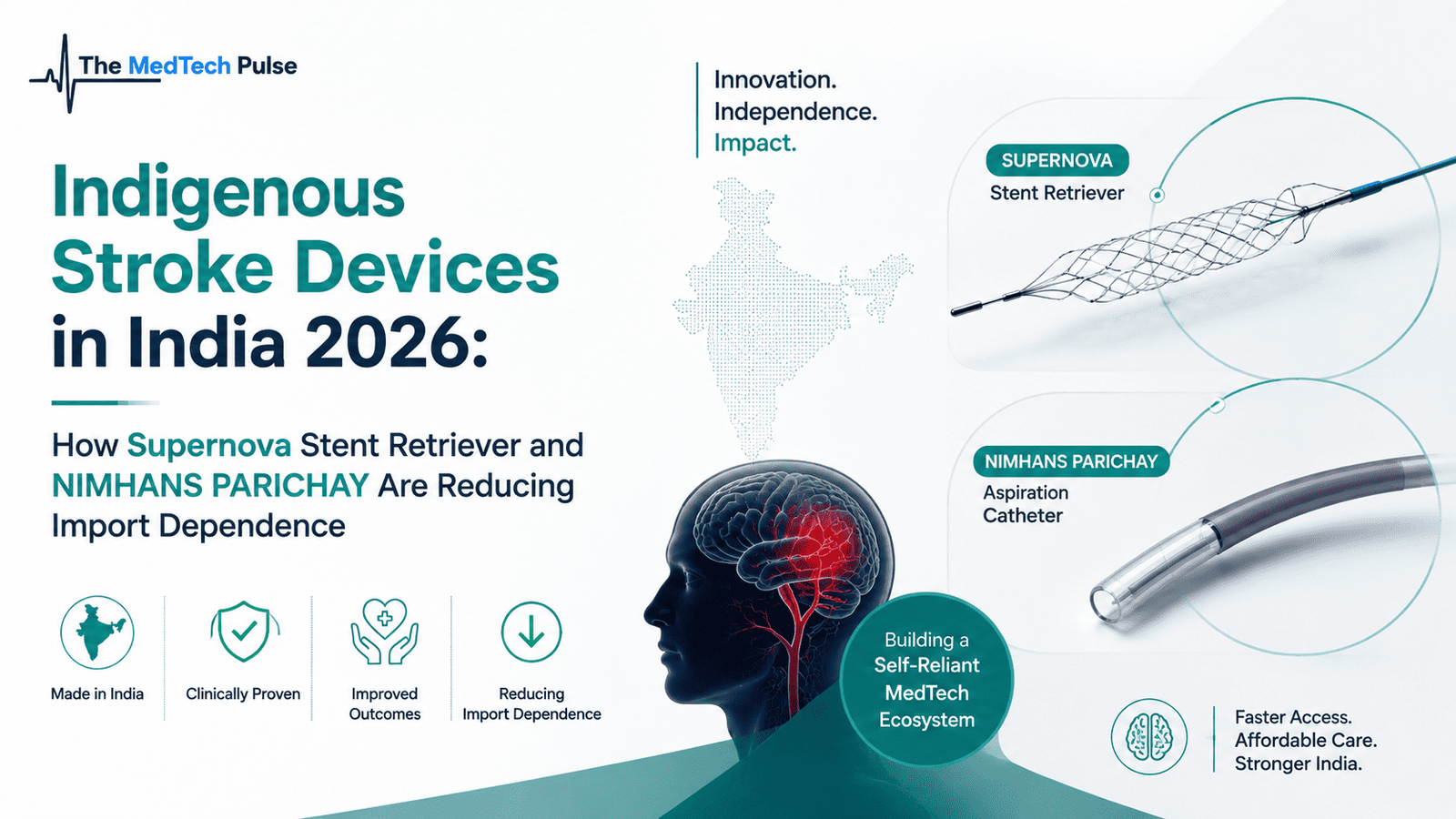
Stroke care in India has quietly reached an inflection point. For years, the devices used to physically pull clots out of a blocked brain artery — the procedure known as mechanical thrombectomy — have been almost entirely imported, made by global names like Medtronic and Stryker, and priced accordingly. That’s beginning to change, and 2025–2026 has produced two landmark moments: CDSCO’s approval of India’s first domestically trialled stent retriever, the Supernova, and the unveiling of a second-generation indigenous device, PARICHAY, out of NIMHANS Bengaluru.
Here’s what both devices are, what the clinical evidence actually shows, and why this matters for the roughly 1.7 million Indians who suffer a stroke every year.
Why Stroke Devices Matter So Much in India
(cite index=”35-1″>Supernova will now be manufactured and made available in India at affordable prices, offering new hope to the 1.7 million Indians who suffer strokes each year</cite> — a staggering annual burden that puts enormous pressure on India’s neurointerventional infrastructure. Acute ischemic stroke, where a clot blocks blood flow to part of the brain, is a race against time: every minute of delay costs brain cells, and the standard of care for large-vessel occlusions is mechanical thrombectomy — physically retrieving the clot using a stent retriever or aspiration catheter threaded up through an artery.
Until recently, every device used in that procedure in India was imported. That has two consequences: high costs that get passed to patients, and a device pipeline entirely dependent on global manufacturers’ India strategies, pricing, and supply chains. (cite index=”46-1″>Mechanical thrombectomy cost in India currently ranges from roughly ₹2.5 lakh to ₹8 lakh</cite> per procedure — a wide range driven heavily by which imported device and hospital tier is involved. A genuinely indigenous, India-validated device changes that cost equation from the ground up.
The Supernova Stent Retriever: India’s First Locally-Trialled Thrombectomy Device
The Supernova stent retriever, developed by Gravity Medical Technology, became the first stroke device in India to receive regulatory approval based entirely on domestic clinical trial data — a genuine first for the country’s neurovascular MedTech sector.
The GRASSROOT Trial
The device was validated through the GRASSROOT trial (Supernova Stent Retriever system study), and the results were notable enough to be published internationally. (cite index=”35-1″>The results were published in the Journal of Neurointerventional Surgery (JNIS), part of the British Medical Journal group.</cite> (cite index=”30-1″>The trial was a multicentre study that enrolled 32 patients across eight Indian stroke centres,</cite> with (cite index=”29-1″>AIIMS Delhi serving as the national coordinating centre and the lead enrolling site.</cite>
The outcomes were competitive with international thrombectomy benchmarks: (cite index=”29-1″>the Supernova stent retriever achieved high successful restoration of blood flow, with a brain-bleed rate of 3.1%, mortality of 9.4%, and 50% functional independence at 90 days.</cite> Dr. Shailesh B. Gaikwad, Professor and Head of Neuroimaging and Interventional Neuroradiology at AIIMS Delhi and the trial’s national principal investigator, (cite index=”29-1″>called the trial “a turning point for stroke treatment in India.”</cite>
Importantly, the device isn’t unproven outside a lab setting — it already has a real-world track record in the region. (cite index=”35-1″>The device has already treated more than 300 patients in Southeast Asia</cite> before the Indian trial even concluded, giving regulators additional real-world safety data to draw on alongside GRASSROOT’s own results.
CDSCO Approval and Regulatory Significance
(cite index=”29-1″>Earlier in 2025, data from the GRASSROOT trial were accepted by the Central Drugs Standard Control Organisation (CDSCO), and the Supernova stent retriever was approved for routine use in India.</cite> What makes this approval structurally important, beyond the device itself, is the precedent it sets: (cite index=”34-1″>it is the first stroke device in India to receive approval based entirely on domestic clinical trial data</cite>, rather than relying on a bridging study layered on top of a foreign trial. That’s a meaningful shift in how CDSCO is willing to evaluate high-end neurovascular technology, and it opens a template other Indian MedTech developers can now follow.
The device is (cite index=”32-1″>scheduled for commercial launch in India in February 2026,</cite> with manufacturing based domestically to keep pricing well below the imported alternatives currently dominating Indian cath labs.
PARICHAY: NIMHANS Bengaluru’s Next-Generation Indigenous Thrombectomy Device
While Supernova has already cleared the regulatory hurdle, a second indigenous device is now moving through early development — this one from a public academic institution rather than a private MedTech company.
(cite index=”40-1″>NIMHANS has launched India’s first dedicated Endovascular Research and Innovation (EVRI) Laboratory and introduced the alpha prototype of ‘PARICHAY,’ an indigenous stroke device prototype designed for acute ischemic stroke intervention.</cite> The lab itself is backed by public research funding: (cite index=”40-1″>the EVRI Laboratory has been established with support from the Science and Engineering Research Board (SERB) and now functions under the Anusandhan National Research Foundation (ANRF), Government of India.</cite>
The rationale mirrors the affordability argument behind Supernova, but stated even more explicitly around import substitution. (cite index=”39-1″>Mechanical thrombectomy devices are commonly imported and expensive, making treatment inaccessible for many patients — the unveiling of the ‘Parichay’ prototype represents an important milestone in India’s efforts to develop cost-effective, locally manufactured neurovascular technologies while promoting self-reliance in high-end medical equipment manufacturing.</cite>
PARICHAY was formally unveiled (cite index=”40-1″>by Dr. B. N. Gangadhar, former chairman of the National Medical Commission and former director of NIMHANS,</cite> with (cite index=”40-1″>NIMHANS Director Dr. Prabha S. Chandra emphasising the need to build domestic capabilities in high-end medical technology development, and Dr. Lingaraju T. S., principal investigator of the EVRI Laboratory, highlighting the role of clinician-led innovation in transforming research into practical, affordable devices.</cite>
The launch event itself was framed around exactly the intellectual-property and commercialisation questions that determine whether a prototype like this ever reaches patients. (cite index=”37-1″>NIMHANS hosted an “Atmanirbhar Bharat in NeuroScience IPR” workshop focused on patents, copyrights, and indigenous medical technology development in neurosciences, alongside collaboration between academia, healthcare, research, and industry to protect and commercialise neuroscience innovations.</cite>
It’s important to be clear about where PARICHAY currently stands: it is an alpha prototype, not an approved or commercially available device. It has not gone through anything comparable to the GRASSROOT trial yet, and there’s no public CDSCO timeline for it. What it represents is the second track of India’s neurovascular device pipeline — an academic-institution-led effort that could eventually pair with a manufacturing partner the way CSIR-IGIB paired with Serum Institute for gene therapy, or the way DRDO-linked defence R&D has spun out into commercial ventures.
What This Means for India’s Neurovascular MedTech Opportunity
Put Supernova and PARICHAY side by side and a pattern emerges that looks a lot like what’s happening across Indian MedTech more broadly: private device companies moving fast toward regulatory approval with rigorous trial data, and public research institutions building the next generation of prototypes behind them, feeding a longer-term pipeline.
A few things are worth watching as this space develops through 2026:
- Pricing transparency at commercial launch. Supernova’s February 2026 launch will be the first real test of whether “affordable” translates into a meaningfully lower price than the current ₹2.5–8 lakh procedure cost range dominated by imported devices — including established real-world data India already has on imported devices. (cite index=”47-1″>Medtronic’s own PRAAN registry — India’s first industry-sponsored dedicated registry on mechanical thrombectomy — enrolled 200 patients over 24 months across 14 centres and found mechanical thrombectomy to be a safe, effective, and cost-effective treatment for acute ischemic stroke in India,</cite> which sets a real benchmark for Supernova and future indigenous devices to beat.
- Hospital adoption beyond metro tertiary centres. GRASSROOT’s eight trial centres and Supernova’s forthcoming commercial rollout will need to reach comprehensive stroke centres well beyond Delhi and the other major metros if it’s going to meaningfully move the needle on the country’s 1.7-million-strokes-a-year burden.
- Whether PARICHAY finds a manufacturing partner. A prototype alone doesn’t reduce import dependence — commercialisation, regulatory trials, and manufacturing scale-up are the steps that actually matter, and none of those have been confirmed yet for PARICHAY.
- India’s population-specific device design. One detail that’s easy to overlook: (cite index=”29-1″>Supernova is designed for India’s diverse patient population, where strokes often strike patients younger than in the West</cite> — a population-specific design consideration that imported devices, optimised primarily for older Western patient cohorts, haven’t necessarily prioritised.
The Bigger Picture
India’s neurovascular device space has, until now, been a near-total import market — one of the clearest examples of the broader MedTech import dependence the country is trying to correct through PLI schemes and CDSCO regulatory reform (a topic covered elsewhere in this series). Supernova’s CDSCO approval, based entirely on Indian trial data, is the first real crack in that dependence for high-end stroke devices specifically. PARICHAY, still at the prototype stage, signals that this isn’t a one-device story — there’s an institutional pipeline behind it aimed at the same problem.
Whether this translates into meaningfully cheaper, more accessible stroke care at scale will depend on execution over the next 12–24 months: commercial pricing, manufacturing capacity, and how quickly these devices move from AIIMS- and NIMHANS-tier institutions into the district and Tier-2 hospitals where most stroke patients in India are actually treated.
References
- Telangana Today — AIIMS-led trial proves Supernova Stent safe and effective for stroke patients
- Outlook India — AIIMS-Led Trial Confirms Safety, Effectiveness Of Indigenous Stroke Stent
- Medical Buyer — AIIMS Delhi conducts India’s first clinical trial of advanced brain stent
- OC Academy — Supernova Stent Retriever: AIIMS Trial Proves Indigenous Device Global
- NewsBytes — Made-in-India Supernova stent retriever gets CDSCO nod for 2026 launch
- Shankar IAS Parliament — Supernova Stent Retriever Current Affairs
- Digital Health News — NIMHANS Launches India’s First Endovascular Innovation Lab, Unveils ‘PARICHAY’ Stroke Device Prototype
- Medical Buyer — NIMHANS launches India’s first dedicated EVRI laboratory
- Psychologs — NIMHANS Launches ‘Parichay’ Indigenous Stroke Device Prototype, Opens Endovascular Innovation Lab
- Yashoda Hospitals — Mechanical Thrombectomy Cost In India
- BioSpectrum India — Mechanical thrombectomy treatment is cost-effective for patients with stroke: Medtronic study
Note: PARICHAY is currently an alpha-stage device prototype and has not undergone the clinical trial or regulatory approval process that Supernova has completed. Commercial pricing for Supernova reflects its scheduled February 2026 launch and may be revised at market entry.