

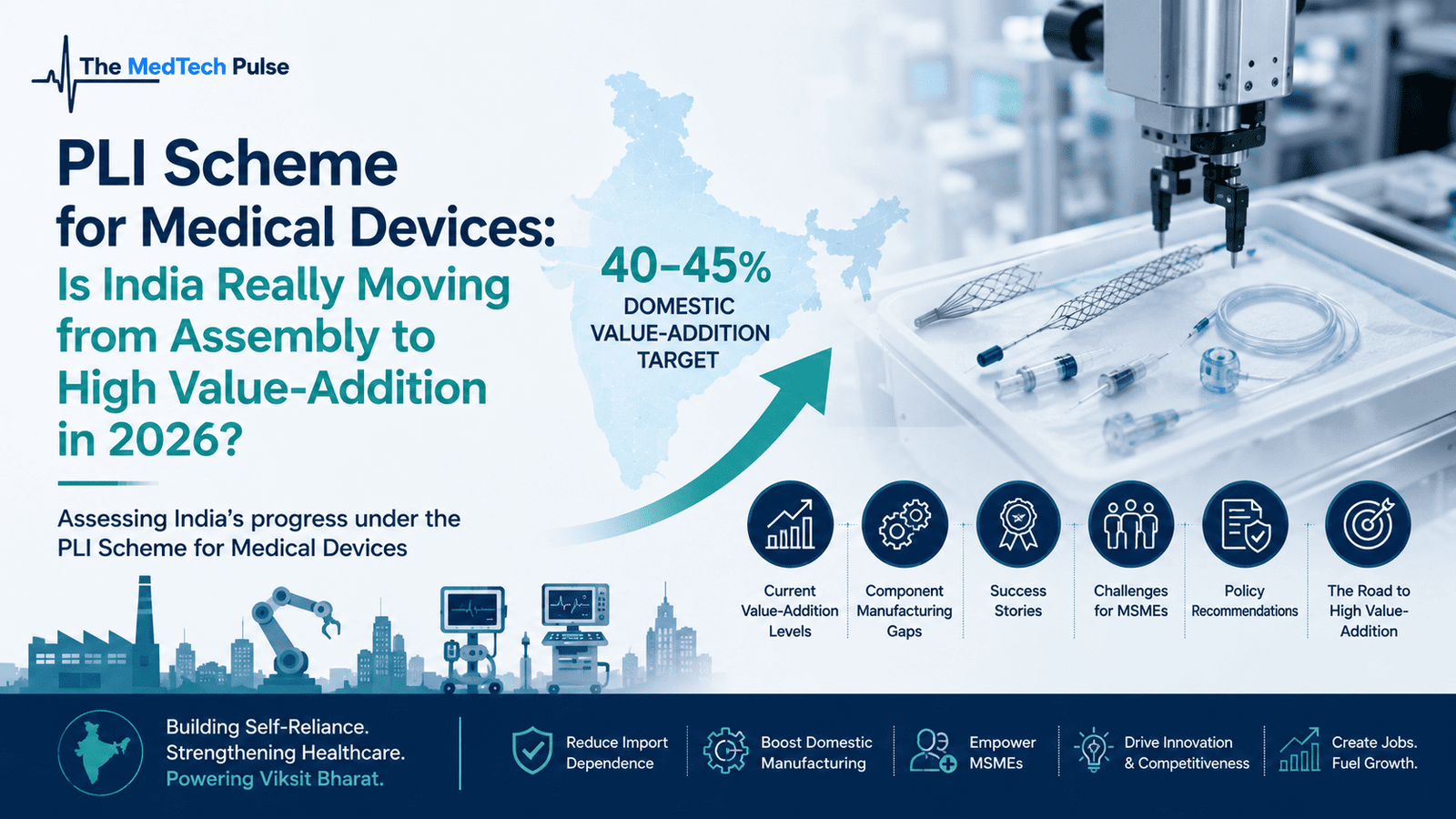
Walk into a state-of-the-art “Made in India” medical device factory and you’ll often find something the government itself has recently started admitting out loud: a lot of what’s happening on that floor is assembly, not manufacturing in the deeper sense. Components arrive from abroad, get put together under an Indian roof, and go out with a “Made in India” sticker. The Production Linked Incentive (PLI) Scheme for medical devices was designed to change that. Four years in, the honest answer to whether it’s working is: partially, and the government knows it.
Here’s what the data actually shows, in the words of the officials running the scheme.
What the PLI Scheme for Medical Devices Actually Is
The PLI Scheme for Promoting Domestic Manufacturing of Medical Devices, launched with a total outlay of INR 34.20 billion (₹3,420 crore), provides incentives at the rate of 5 percent on incremental sales of domestically manufactured medical devices over a five-year performance period running from FY 2022–23 to FY 2026–27.
The scheme deliberately targets the segments where India’s import dependence has historically been most severe: cancer care and radiotherapy devices; radiology and imaging equipment (ionizing and non-ionizing) and nuclear imaging devices; anaesthetics and cardio-respiratory medical devices including renal care; and all implants, including implantable electronic devices. These aren’t commodity products — they’re precisely the high-technology categories where India has traditionally had almost no domestic manufacturing base at all.
(cite index=”60-1″>Importantly, the government expanded participation by introducing a Category-B eligibility stream in 2023, which lowered investment and sales thresholds specifically to encourage entry by smaller and mid-sized manufacturers</cite> — a direct acknowledgement that the original scheme design favoured large, well-capitalised players over MSMEs.
The Numbers: What’s Actually Been Manufactured
By mid-2026, the scheme had moved past pilot-stage announcements into measurable production data. India’s PLI Scheme for Medical Devices has attracted actual investments of ₹1,153.07 crore, with 27 projects approved, including 14 MSMEs, according to details shared by Union Minister for Chemicals and Fertilizers Jagat Prakash Nadda in a written reply in the Lok Sabha on July 24, 2026.
The device categories now being locally produced read like a checklist of India’s historic import basket: domestic manufacturing has commenced for MRI and CT equipment, linear accelerators (LINACs), mammography systems, C-arms, ultrasound equipment, heart valves, stents, and dialysis products. A separate industry analysis puts the scale of this in sharper focus: twenty-two greenfield manufacturing projects have been commissioned under the scheme, and production has commenced for more than 55 medical devices, including MRI scanners, CT scanners, mammography systems, C-arm X-ray machines, ultrasound equipment, MRI coils, and linear accelerators.
On the financial side: as of September 2025, cumulative eligible sales under the PLI scheme reached approximately ₹123.44 billion (₹12,344 crore), of which exports accounted for around ₹58.69 billion (₹5,869 crore), meaning nearly half of eligible sales under the scheme are already going to export markets rather than staying purely domestic. Both multinational and Indian manufacturers have participated actively, with investments by firms including Siemens Healthcare, Philips, Allengers Medical Systems, Panacea Medical Technologies, and BPL Medical Technologies resulting in local production of devices that were previously almost entirely imported.
Earlier in the scheme’s rollout, the initial cohort of approved applicants included some of the biggest names in the sector:Siemens Healthcare, Sahajanand Medical Technologies, Nipro India Corporation, and Wipro GE Healthcare were among the companies approved, with a total committed investment of ₹729.63 crore and projected employment generation for about 2,304 people.
The Uncomfortable Admission: “Plain Assembly Line Operations”
This is where the PLI story gets more honest than most government-scheme retrospectives usually get. Speaking at the CII Global MedTech Summit in August 2026, Department of Pharmaceuticals Secretary Manoj Joshi didn’t hedge. “In the last five-seven years, a lot of imports have shifted to assembly in the country,” Joshi said. Although some components are produced in India, he added, “Some of the factories which you see are plain assembly line operations.”
That’s a striking statement from the official overseeing the scheme, and it directly frames the government’s next policy push: the medical devices sector needs to focus on more local value addition and component manufacturing, with the government now seeking 40–45% domestic value addition and eyeing more component manufacturing specifically.
Joshi was also candid about implementation problems on the incentive side. A large number of companies invested under the scheme but only a few are actually claiming incentives, he acknowledged — the government is now considering whether to give a longer time frame or extend the existing scheme so that already-invested companies who aren’t currently claiming PLI benefits can be enabled to do so. He framed this explicitly as a listening exercise: “We are looking at it. Any inputs would be welcome,” Joshi said, while the government also takes learnings from the scheme with the realisation that “we need to keep doing it” to keep promoting local manufacturing.
Where the Value-Addition Gap Actually Sits
The disconnect between “device assembled in India” and “device meaningfully manufactured in India” comes down to what’s happening below the finished-product level — sensors, electronics, printed circuit boards, precision-machined components, medical-grade plastics, imaging coils, detectors, and power systems. While final-device manufacturing has accelerated under the PLI scheme, upstream localization remains uneven, creating strategic openings specifically in sensors, electronics, printed circuit boards, precision machining, medical-grade plastics, coils, detectors, and power systems.
This is a familiar pattern from India’s broader industrial policy experience — it echoes what happened in electronics and mobile manufacturing, where PLI-driven assembly scaled rapidly while component ecosystems lagged years behind. Even in electronics more broadly, PLI progress data through 2025 shows manufacturing in certain industries is still focused on assembly rather than deep value addition, limiting the broader economic impact of the incentive programme. Medical devices risk repeating that pattern unless the component-manufacturing push Joshi described translates into actual capital investment.
Disbursement Reality Check
It’s also worth being precise about how much government money has actually gone out the door versus how much has been committed on paper — these are very different numbers, and PLI disbursement data makes that gap visible. A Press Information Bureau response from the Minister of State for Chemicals and Fertilizers, dated August 7, 2026, disclosed that medical devices PLI disbursement stood at ₹266.64 crore — described as showing “moderate disbursement, reflecting sector-specific challenges” — with a further point that a lack of a unified incentive framework for medical devices has hampered cohesive growth in the sector.
That figure needs context: against a total scheme outlay of ₹3,420 crore, ₹266.64 crore in disbursed incentives is a modest fraction — consistent with Joshi’s acknowledgment that many companies invested but haven’t successfully claimed incentives.
MSME Participation: Progress, But Real Barriers Remain
The Category-B eligibility stream introduced in 2023 was a direct response to a structural problem: high-end medical device manufacturing is capital-intensive, and the original PLI thresholds effectively locked out most Indian MSMEs. Of the 27 approved projects reported to the Lok Sabha in July 2026, 14 are MSMEs, meaning just over half of participating companies are smaller manufacturers, a meaningfully higher share than the scheme’s early years, when large multinational and domestic majors dominated the approved list.
Even so, MSMEs face compounding challenges beyond the incentive structure itself: capital expenditure needs before any incentive is realised, quality and technology upgrades required to meet ISO 13485 and CDSCO risk-based classification standards, and, as the disbursement data shows — real friction in actually converting investment into claimed incentives. Limited domestic value addition, especially in complex manufacturing, continues to constrain the broader economic multiplier effect the PLI programme is designed to generate.
The Bigger Market Context
None of this is happening in a market vacuum. India’s medical devices market is estimated at approximately US$14–16 billion as of 2025, with government and industry projections consistently indicating growth toward US$30–50 billion by 2030.driven by expanding Tier-2 and Tier-3 hospital infrastructure, rising non-communicable disease burden, and growing insurance penetration.
Despite this demand growth, import dependence remains significant, particularly in high-technology segments such as diagnostic imaging, oncology equipment, implants, and critical-care devices, precisely the categories the PLI scheme targets. The scheme’s regulatory backdrop has also matured alongside it: the Medical Devices Rules, 2017 now function as a standalone regulatory regime with risk-based classification, and medical device parks in Uttar Pradesh, Tamil Nadu, Madhya Pradesh, and Himachal Pradesh are gradually operationalising shared infrastructure for testing, validation, and common services.
Policy Recommendations: What Would Actually Move the Needle
Reading between the lines of Joshi’s CII Summit remarks and the broader data, three things stand out as the levers that would determine whether India’s medical device sector crosses from assembly into genuine high-value manufacturing over the next few years:
- A dedicated component-manufacturing incentive layer. The current PLI structure rewards incremental sales of finished devices; it doesn’t specifically reward domestic sourcing of the electronics, sensors, and precision parts inside those devices. A separate or nested incentive tied to component localisation — similar to how India’s semiconductor policy tries to build up the ecosystem layer by layer — would target the actual gap Joshi identified.
- Resolving the incentive-claim bottleneck. With a large share of invested companies unable to successfully claim incentives, and disbursement running well behind committed investment, fixing the claims process itself may do more for near-term sector confidence than any new headline scheme.
- Extending the scheme window with value-addition conditions attached. The government is already considering extending timelines for existing investors. Tying any such extension to explicit, auditable domestic value-addition thresholds — rather than incremental sales alone — would directly target the 40–45% goal Joshi articulated, rather than simply rewarding continued assembly at greater volume.
The Bottom Line
The PLI scheme for medical devices has undeniably moved the needle on what gets physically produced in India — MRI and CT scanners, LINACs, heart valves, and stents are now coming off Indian production lines that simply didn’t exist five years ago, and nearly half of eligible sales are already reaching export markets. That’s a genuine achievement against a historically import-dominated sector.
But the government’s own senior official overseeing the scheme has been unusually direct that a meaningful share of that manufacturing capacity is still assembly rather than deep value-addition, and that disbursement and claims friction remain unresolved as the scheme approaches its FY 2026–27 conclusion. Whether India’s medical device industry becomes a genuine high-value manufacturing base — or a well-subsidised assembly hub — will be decided less by the headline investment figures and more by what happens in the unglamorous layer beneath them: sensors, PCBs, coils, and precision components that, for now, mostly still come from somewhere else.
References
- India Briefing — India’s Medical Devices Sector: PLI Progress & 2026 Outlook
- Medical Dialogues — Govt Seeks 40-45% Domestic Value Addition in Medical Devices, Eyes More Component Manufacturing
- Indian Pharma Post — India’s medical devices PLI scheme attracts Rs. 1,153 crore investment, 27 projects approved
- Plutus IAS — PLI Scheme for Pharma Sector: Key Updates for UPSC & State PCS 2026
- Deccan Herald — Centre gives nod to several firms under PLI scheme for medical devices
- Bajaj Finserv — What is PLI Scheme? Benefits, Sectors, and 2026 Guide
- News on Air (PIB) — PLI Scheme Boosts Domestic Production of Medical Equipment in India
Note: Figures on investment, disbursement, and value addition are drawn from official government statements (Lok Sabha replies and PIB releases) current as of August 2026 and are subject to revision as the scheme approaches its FY 2026–27 conclusion.