

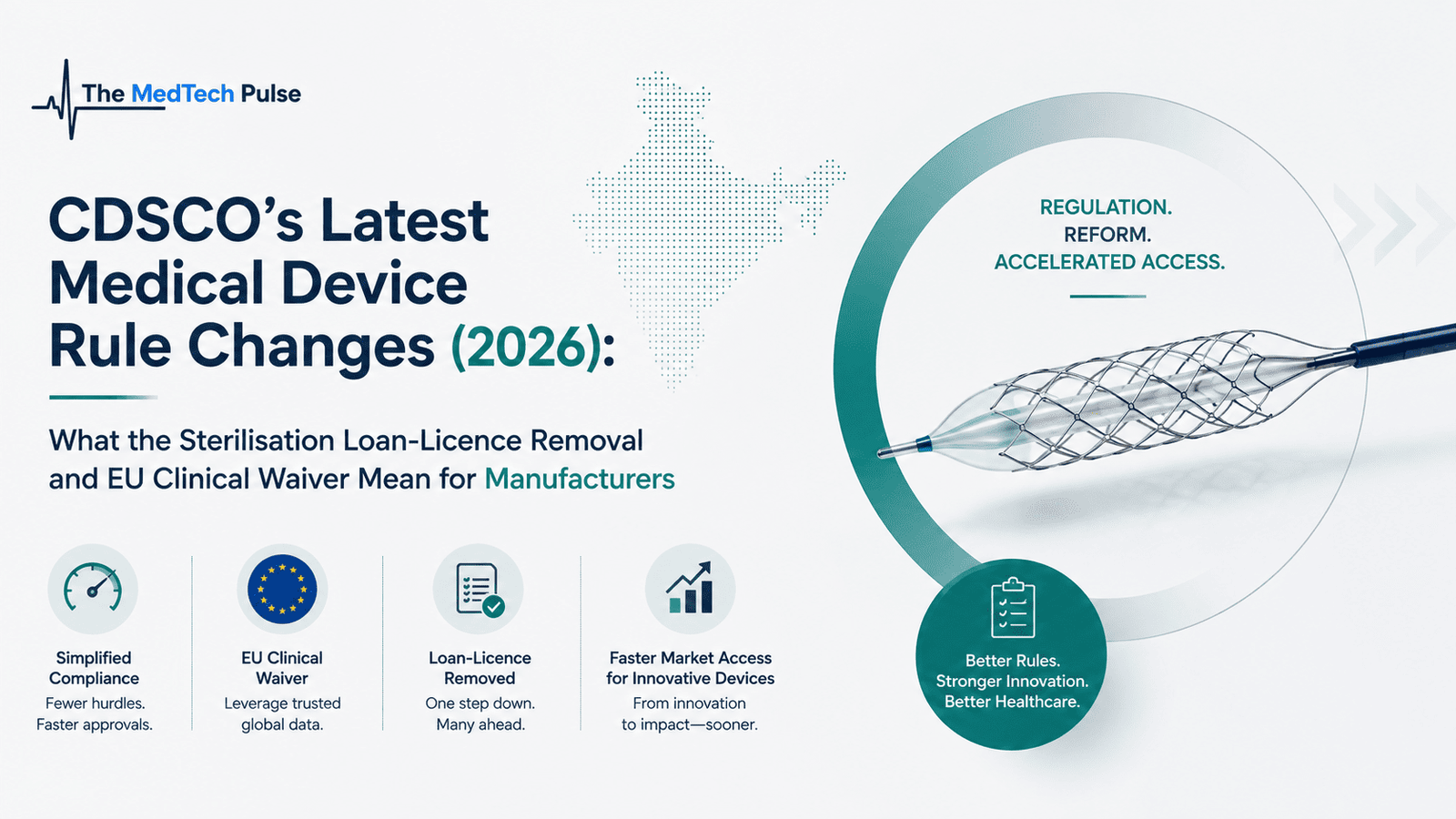
If you’ve ever tried to get a medical device manufacturing licence in India, you know the Central Drugs Standard Control Organisation’s paperwork has a reputation. Through 2025 and 2026, though, CDSCO has been quietly dismantling some of the more redundant parts of that paperwork — while simultaneously beefing up its scientific manpower to handle more complex device evaluations faster. Two changes stand out for their practical, day-to-day impact on manufacturers: the removal of the sterilisation loan-licence requirement, and an expanding “trusted jurisdiction” framework that includes clinical waivers tied to EU approval.
Here’s what actually changed, who benefits, and what still needs to happen for market access.
Change #1: No More Loan Licence for Outsourced Sterilisation
What the old rule required
Sterilisation — the process of eliminating microbial contamination on a device before it reaches a hospital — is one of the last manufacturing steps most device companies don’t handle in-house. Instead, they send products to specialised third-party sterilisation facilities using gamma radiation, ethylene oxide, or steam. Under the old regime, that simple business arrangement carried an outsized regulatory burden. A CDSCO Loan License was an approval that allowed a company without its own manufacturing unit to legally manufacture medical devices by using another company’s registered manufacturing facility — issued under Form MD-6 and linked to the manufacturer’s Form MF-5 licence. Before 2025, if a medical device company wanted to sterilise its products using someone else’s facility, it had to apply for a separate licence to do so legally — even when that facility already held a valid CDSCO sterilisation licence of its own.
Industry pushback on this was direct. According to reporting on the issue, CDSCO had recently been insisting that manufacturers obtain loan licences for external gamma-radiation or ethylene oxide sterilisation facilities — a requirement industry representatives argued was duplicative, since the sterilisation facility itself was already licensed and regulated for exactly that activity.
What changed
CDSCO relaxed the requirement of a loan licence for outsourcing sterilisation of medical devices to other facilities. Manufacturers are now allowed to carry out such activities via a mutual third-party agreement, provided those facilities hold a valid licence to undertake the process. In practical terms: manufacturers who outsource sterilisation to a third-party facility no longer need to obtain a separate loan licence for that facility, provided the steriliser already holds a valid CDSCO licence — previously mandatory regardless of the facility’s existing approvals.
Crucially, this isn’t a reduction in oversight — it’s a reduction in duplicate paperwork. CDSCO built in a transparency safeguard alongside the relaxation: the recommendation to remove the loan-licence requirement was approved by the Drugs Technical Advisory Board (DTAB) in April 2025, subject to including an appropriate mechanism for submitting documentary evidence to licensing authorities in support of proper sterilisation of products. That mechanism has since taken shape as a labelling requirement — device labels must now disclose which third-party facility handled sterilisation, so accountability for the process remains traceable even without a separate licence. While the loan-licence requirement has been lifted, CDSCO has taken steps to ensure regulatory oversight remains intact by insisting on QMS compliance, label transparency, and prior documentary submission, so quality and safety are not compromised despite the relaxed norms.
Who this actually helps
This reform disproportionately benefits smaller manufacturers and startups — the companies least likely to have in-house sterilisation infrastructure and least equipped to absorb a parallel licensing process just to use someone else’s already-licensed facility. This move aims to streamline the manufacturing process, especially for smaller manufacturers who face hurdles in obtaining loan licences, and CDSCO has framed it as part of a broader deregulation push: this regulatory change reflects a broader trend within CDSCO to make the regulatory framework more adaptive and business-friendly, following other recent reforms such as revision of export NOC rules and approval timelines for new drugs — initiatives aligned with the government’s push to ease business operations and support the Make in India campaign. The practical upshot, per industry commentary, is straightforward: this reduces paperwork, speeds up time to market for smaller manufacturers, and reflects CDSCO’s continued modernisation efforts.
Change #2: Expanding the “Trusted Jurisdiction” Clinical Waiver Framework — Including the EU
The existing waiver pathway
CDSCO has for some time allowed certain devices to skip local clinical trials in India if they already have a strong safety and performance track record abroad. The clinical investigation in India may be waived if the medical device has been approved by regulatory authorities and marketed in the UK, USA, Canada, or Japan for at least two years, provided the safety, performance, and pharmacovigilance data submitted to the Central Licensing Authority is satisfactory. Devices with a registered predicate already on the Indian market benefit even more directly: Class IIa, IIb, and III devices with a predicate on the Indian market and GHTF-country approval do not require local trials, and typical review timelines for that pathway run 6–9 months if predicate and GHTF-country approval is available, versus 9–12 months if there’s no predicate and a review is needed, and 18+ months if clinical investigations in India are required.
What’s expanding in 2026
The 2026 shift is about widening that recognised list of trusted jurisdictions — most notably to explicitly fold in the European Union alongside the traditional GHTF countries. This was announced alongside a much larger regulatory capacity investment: the Central Government approved the creation of 1,500 additional posts in CDSCO, with a substantial share earmarked for strengthening the medical device regulatory system, announced by Dr. Rajeev Raghuvanshi, Drugs Controller General of India, at the 9th edition of India Medical Device 2026. According to Raghuvanshi, the newly sanctioned posts will evaluate regulatory applications, provide technical guidance, support innovators, and assist applicants through the approval process, significantly enhancing CDSCO’s scientific and technical capacity. A substantial portion of the new positions will build an internal scientific cadre bringing on specialists from engineering backgrounds, software development, AI expertise, and ophthalmic and other clinical specialities.
Tied directly to this expansion is the clinical-waiver reform manufacturers care about most: as CDSCO expands its scientific cadre, it is implementing major regulatory reforms — including T-licence waivers and EU recognition — meaning manufacturers can increasingly leverage CE Marking under EU MDR/IVDR, or US FDA clearances, to secure accelerated CDSCO clinical investigation waivers under an expanded trusted jurisdiction framework.
This closes a real gap in the old system. The European Union runs one of the world’s most rigorous device conformity regimes under MDR and IVDR, yet CE marking alone didn’t automatically streamline India’s clinical-waiver pathway the way FDA, UK, Canadian, or Japanese approval historically could. Bringing EU-approved devices more clearly into the trusted-jurisdiction framework means a device that has already cleared MDR’s notified-body scrutiny doesn’t need to re-prove safety and performance from scratch in India.
What This Means in Practice: Startups vs Large Players
For large multinational device makers (Siemens, Philips, Medtronic, GE Healthcare, and similar companies with mature EU and US regulatory dossiers), the EU-recognition expansion mainly shortens time-to-market for devices that already have CE marking but were previously funnelled through India’s slower “no strong GHTF equivalence” pathway. Combined with more CDSCO reviewers on staff, expect measurably faster review cycles for well-documented dossiers — though the 6–9-month floor for even the fast-track predicate pathway isn’t disappearing.
For Indian startups and MSMEs, the sterilisation loan-licence removal is the more immediately consequential change. Most early-stage device companies don’t own sterilisation infrastructure; they were previously forced into a duplicate licensing process just to use an already-licensed contract steriliser. Removing that step lowers both cost and calendar time between manufacturing readiness and market launch — a meaningful deregulation win specifically for the companies with the least regulatory-affairs bandwidth to spare.
For device developers targeting export markets, the broader signal matters as much as either individual reform: CDSCO is actively trying to align its recognition framework with the world’s major regulatory regimes rather than treating India as a fully separate evaluation track. That has knock-on benefits beyond the specific waiver — it makes India a more credible node in global regulatory strategy, not just a market to enter after everything else is done.
A Practical Compliance Checklist for Manufacturers
Given these overlapping changes, here’s what device manufacturers — especially smaller ones — should be doing now:
- Audit your sterilisation contracts. Confirm your third-party sterilisation partner holds a valid, current CDSCO licence for the specific sterilisation method used (gamma, EO, steam). The loan-licence exemption only applies if that underlying licence is in place.
- Update device labelling for sterilisation traceability. Since the relaxed rule is paired with a documentary-evidence and label-transparency requirement, make sure labels correctly disclose the sterilisation subcontractor.
- Reassess your regulatory pathway if you hold CE marking. If your device already has EU MDR or IVDR approval, revisit whether it now qualifies for the expanded trusted-jurisdiction clinical waiver rather than a full India-specific clinical investigation — this could meaningfully shorten your approval timeline.
- Track the Draft Medical Devices (Amendment) Rules, 2026. Separately from the waiver and sterilisation changes, the Ministry of Health & Family Welfare has proposed amendments under which a QMS audit conducted by a registered Notified Body would become mandatory before the grant of a manufacturing licence — a stricter quality-oversight requirement manufacturers should plan for even as other parts of the process ease.
- Watch for procedural clean-up notifications. A separate draft notification under G.S.R. 270(E), dated April 10, 2026, proposes textual and procedural amendments — including standardised MD-33 application fees per the Ninth Schedule — aimed at improving clarity, labelling requirements, and testing-fee standardisation across CDSCO’s medical device framework.
The Bigger Picture: Deregulation Without Losing the Safety Net
What’s notable about CDSCO’s 2025–2026 reform pattern is that it isn’t simply cutting red tape — it’s replacing duplicate licensing steps with more targeted oversight (label disclosure, documentary evidence, notified-body QMS audits) while simultaneously investing in the human capacity needed to evaluate more complex applications faster. That combination — fewer redundant approvals, more scientific reviewers, wider international recognition — is precisely the mix that both innovative startups and established manufacturers have been asking for.
Whether this actually accelerates market access for genuinely novel Indian devices, rather than just easing the path for imports with existing EU or US approval, will depend on how quickly the 1,500 new CDSCO positions are filled and how consistently the expanded waiver framework gets applied in practice over the rest of 2026.
References
- Business Standard — CDSCO relaxes loan licence norms for medical device sterilisation
- Qualio — CDSCO Medical Device Registration in India: What’s Changed in 2026
- Compliance Calendar — CDSCO Relaxes Loan License Requirement for Medical Device Sterilisation
- Business Standard — Centre mandates sterilisation subcontractor disclosure on device labels
- Medical Device Registration — CDSCO 2026 Medical Device Update: Loan License Rules
- Medical Dialogues — Centre Sanctions 1,500 New CDSCO Posts to Strengthen Medical Device Regulation
- Operon Strategist — CDSCO Adds 1,500 Posts & Major Medical Device Reforms
- CEHTRA — CDSCO Draft Medical Devices (Amendment) Rules, 2026: Key Changes for Manufacturers
- Mace Corporation — Medical Devices Rules Amendment 2026 India | G.S.R. 270(E) CDSCO Changes Explained
- CliniExperts — Manufacture/Import New Medical Devices Permission/License India
- Morulaa — India Medical Device Registration: CDSCO Compliance Guide
Note: Regulatory timelines, waiver eligibility, and draft rule details reflect publicly available information as of August 2026. The Draft Medical Devices (Amendment) Rules, 2026 remained open for public consultation as of this writing — final notified provisions may differ from the draft text. Manufacturers should verify current requirements directly with CDSCO or a qualified regulatory consultant before relying on any specific pathway.