

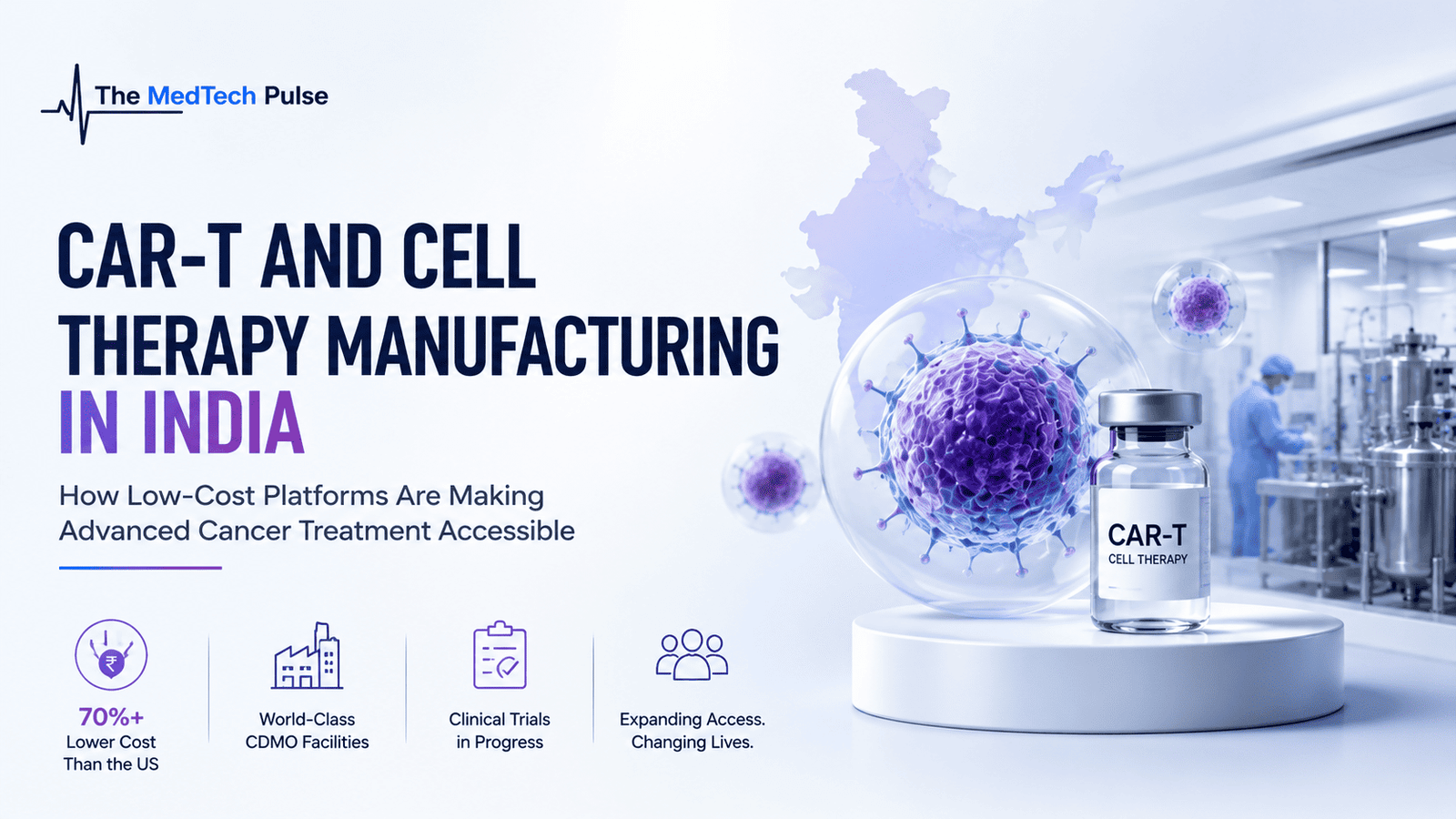
In the United States, a single course of CAR-T cell therapy — a treatment that reprogrammes a cancer patient’s own immune cells to hunt down and destroy tumour cells — can cost close to half a million dollars once you include the treatment process around it. In India, the equivalent therapy costs roughly $30,000. That’s not a rounding difference; it’s close to a 13-fold cost reduction, achieved not by cutting corners on efficacy, but by building the entire manufacturing and delivery pipeline domestically, from a public university lab outward. This is the story of NexCAR19, and of what India’s approach to cell therapy manufacturing could mean for the rest of the world’s underserved cancer patients.
What CAR-T Therapy Actually Is, and Why It’s So Expensive Everywhere Else
CAR-T — Chimeric Antigen Receptor T-cell therapy — is a form of personalised immunotherapy. A patient’s own T-cells (the white blood cells responsible for cellular immunity) are collected through a process called leukapheresis, genetically engineered outside the body to recognise and attack cancer cells, expanded into billions of copies, and then infused back into the patient. Because every dose is manufactured from an individual patient’s own cells, CAR-T therapy is inherently difficult to scale the way a conventional drug can be — there’s no shared manufacturing batch to spread costs across. That fundamental manufacturing complexity is a large part of why globally approved CAR-T products have carried price tags in the hundreds of thousands of dollars.
NexCAR19: India’s First Indigenous CAR-T Therapy
NexCAR19 was developed by ImmunoACT (Immunoadoptive Cell Therapy Private Limited), a company incubated at IIT Bombay, in close partnership with Tata Memorial Centre — one of the world’s leading cancer research and treatment institutions — with funding and support from the Department of Biotechnology (DBT) and its biotechnology industry research arm, BIRAC.
The therapy is an autologous anti-CD19 CAR-T, indicated for relapsed or refractory B-cell Non-Hodgkin’s Lymphoma (B-NHL) and B-cell Acute Lymphoblastic Leukaemia (B-ALL) — blood cancers where patients have already failed at least two prior lines of treatment. In October 2023, NexCAR19 received Market Authorization from CDSCO, making it the world’s first domestically developed CAR-T therapy to reach regulatory approval, at a target price of approximately $30,000 (roughly ₹25 lakh).
What makes NexCAR19 scientifically distinctive isn’t just where it was made — it’s a genuinely novel therapeutic design. It’s described as a “humanized” CAR-T therapy, engineered with receptors that are better tolerated by the human immune system than earlier-generation CAR-T constructs, which reduces the risk of immune-related side effects while improving both safety and efficacy for Indian patients. The clinical data supporting Indian approval showed response rates comparable to the internationally approved CAR-T products it competes with — meaning the affordability isn’t coming at the expense of clinical outcomes.
President Droupadi Murmu formally launched the therapy on April 4, 2024, at IIT Bombay, calling it a “major breakthrough” in the country’s fight against cancer. The therapy was later showcased to Prime Minister Narendra Modi at the Emerging Science, Technology & Innovation Conclave (ESTIC) 2025 in Delhi, presented alongside other frontier Indian innovations including a quantum security chip and a 25-qubit quantum processing unit — a signal of how seriously the government is positioning cell therapy as a strategic biotech achievement, not just a healthcare product.
The Cost Breakdown: How ImmunoACT Got to ₹25 Lakh
The cost gap between NexCAR19 and its Western counterparts is the headline number, and it’s worth being precise about it: NexCAR19’s manufacturing and drug cost runs approximately ₹25 lakh (about $30,000) — described in industry cost analysis as roughly 13 times less than the cheapest US-approved CAR-T product, and separately reported as costing patients around one-tenth the price of international alternatives that can run as high as ₹4 crore when the full international treatment cost is included.
A large part of that cost advantage comes from vertical control over the manufacturing process rather than outsourcing it. ImmunoACT describes its proprietary technology platform as enabling efficient CAR-T cell production with in-house lentiviral vector (LV) and plasmid manufacturing — meaning the company controls the upstream biological components that go into engineering each patient’s T-cells, rather than sourcing them from expensive third-party contract manufacturers the way many Western CAR-T programmes historically have. That in-house control over the trickiest and most expensive part of the CAR-T supply chain — viral vector production — is arguably the single biggest lever behind the cost difference.
Beyond the base price, ImmunoACT has also worked to make even the ₹25 lakh cost more accessible within India. A December 2025 partnership with Mango Sciences, a Boston- and Bengaluru-based data and AI company, introduced what’s described as the world’s first bridge financing plan and value-based offering for CAR-T therapy — giving clinically eligible patients access to 0% interest EMI plans of up to ₹10 lakh, plus a value-based offering of up to a further ₹10 lakh for those who qualify. That financing layer matters as much as the base manufacturing cost reduction: even a “13 times cheaper” therapy is still a meaningful sum for most Indian families without some form of structured payment support.
Taking It Global: The Cipla Partnership
NexCAR19’s story took an important international turn in January 2026. Cipla Limited, through its subsidiary Medpro Pharmaceutica, entered an exclusive license and supply agreement with ImmunoACT to commercialise talicabtagene autoleucel — NexCAR19’s generic drug name — in South Africa, Algeria, and Morocco. Under the arrangement, ImmunoACT will continue leading manufacturing, while Cipla oversees commercialisation and market access across those three African markets.
This is a genuinely significant model to watch, because it’s the first real test of whether India’s low-cost CAR-T manufacturing platform can serve patient populations beyond India itself — markets where advanced cell therapy has historically been almost entirely inaccessible due to the sheer cost of Western-manufactured alternatives. ImmunoACT has framed the collaboration explicitly around that mission: expanding access to cell and gene therapies in underserved regions worldwide, not just scaling revenue in wealthy markets.
What’s Next in ImmunoACT’s Pipeline
NexCAR19 for B-cell malignancies is just the first product out of ImmunoACT’s pipeline, not the endpoint. The company has publicly disclosed active development of a BCMA-directed CAR-T therapy targeting multiple myeloma, along with several solid tumour CAR-T programmes still in earlier development — a much harder scientific problem than blood cancers, since solid tumours present additional biological barriers (physical tumour microenvironments, immunosuppressive signalling) that CAR-T cells struggle to penetrate effectively. The Department of Biotechnology has signalled it wants this pipeline to widen further still, stating an ambition to promote both early- and late-stage translational research in CAR-T and other immunotherapies to develop indigenous solutions for multiple cancers, including multiple myeloma, relapsed or refractory B-cell leukaemia, and glioblastoma — while also tackling the toxicity management challenges that come with cellular immunotherapy more broadly.
Patient Access Challenges That Remain
None of this means CAR-T access in India is a solved problem, and it’s worth being honest about what’s still missing:
- Geographic concentration. CAR-T manufacturing and administration require highly specialised cell-processing facilities and clinical expertise currently concentrated in a small number of centres, led by Tata Memorial Centre. Patients outside India’s major cancer-treatment hubs still face significant travel and logistics burdens to access the therapy at all.
- ₹25 lakh is still a large sum. Even at roughly one-tenth the international price, the base cost remains well beyond what most Indian households can absorb without financing support — which is precisely why the Mango Sciences bridge-financing partnership matters, but it also underscores that price reduction alone hasn’t solved affordability for India’s broader population.
- Eligibility and treatment-line requirements. NexCAR19 is currently approved for patients who have already failed multiple prior lines of therapy — meaning it’s positioned as a later-line option rather than a first-line treatment, which limits how many patients at diagnosis can access it immediately.
- Solid tumour CAR-T remains unproven. The much larger population of solid-tumour cancer patients — who represent the majority of cancer cases globally — won’t benefit from this platform until ImmunoACT’s early-stage solid tumour programmes mature through clinical trials, a process that will likely take years.
The Bigger Picture: A CDMO Model Other Diseases Could Follow
What ImmunoACT has built with NexCAR19 fits a pattern that’s showing up repeatedly across Indian biotech in 2025–2026: a public research institution (IIT Bombay, working with Tata Memorial Centre) does the core science, with government translational-research funding (DBT/BIRAC) bridging the gap to a commercially viable, vertically integrated manufacturer — very similar in structure to how CSIR-IGIB partnered with Serum Institute on BIRSA 101 for sickle cell gene therapy. The Cipla partnership for African markets suggests this model doesn’t have to stop at India’s borders; it can become an export platform for advanced medicine to other price-sensitive healthcare systems that have historically been locked out of cell and gene therapy entirely.
Whether NexCAR19 becomes a genuine template for low-cost cell therapy manufacturing globally — rather than a singular Indian success story — will depend on how well ImmunoACT’s in-house vector manufacturing model scales as it expands into new indications, new geographies, and eventually, the much harder frontier of solid tumours.
References
- ImmunoACT — Official Website (https://immunoact.com/)
- ImmunoACT — Press Release: ImmunoACT Partners with Cipla (https://immunoact.com/press-release/immunoact-partners-with-cipla/)
- Cipla — Cipla Partners with ImmunoACT to Launch Talicabtagene Autoleucel for Blood Cancers in Africa (https://www.cipla.com/sites/default/files/Cipla-partners-with-ImmunoACT-to-launch-talicabtagene-autoleucel-an-anti-CD19-CAR-T-cell-therapy-for-blood-cancers-in-Africa.pdf)
- Digital Health News — India Launches First Indigenous CAR-T Cell Therapy NexCAR19 for Blood Cancer Treatment (https://www.digitalhealthnews.com/india-launches-first-indigenous-car-t-cell-therapy-nexcar19-for-blood-cancer-treatment)
- Arodya — CAR-T Cell Therapy India Blood Cancer Cost 2026 (https://www.arodya.com/blog/car-t-cell-therapy-india-blood-cancer)
- Medpath — India Launches World’s Most Affordable CAR-T Cell Therapy at One-Tenth International Cost (https://trial.medpath.com/news/india-launches-world-s-most-affordable-car-t-cell-therapy-at-one-tenth-international-cost)
- Medical Buyer — India Develops World’s First Humanized CAR-T Therapy (https://medicalbuyer.co.in/india-develops-worlds-first-humanized-car-t-therapy/)
- Business Wire — Mango Sciences Announces Partnership With ImmunoACT for Bridge Financing Plan for CAR-T Therapy (https://www.businesswire.com/news/home/20251205886457/en)
Note: Pricing figures reflect publicly disclosed target prices and cost analyses current as of early 2026 and may vary based on individual patient treatment plans, hospital charges, and financing arrangements. This article is for informational purposes and is not medical advice; patients should consult an oncologist regarding treatment eligibility.