

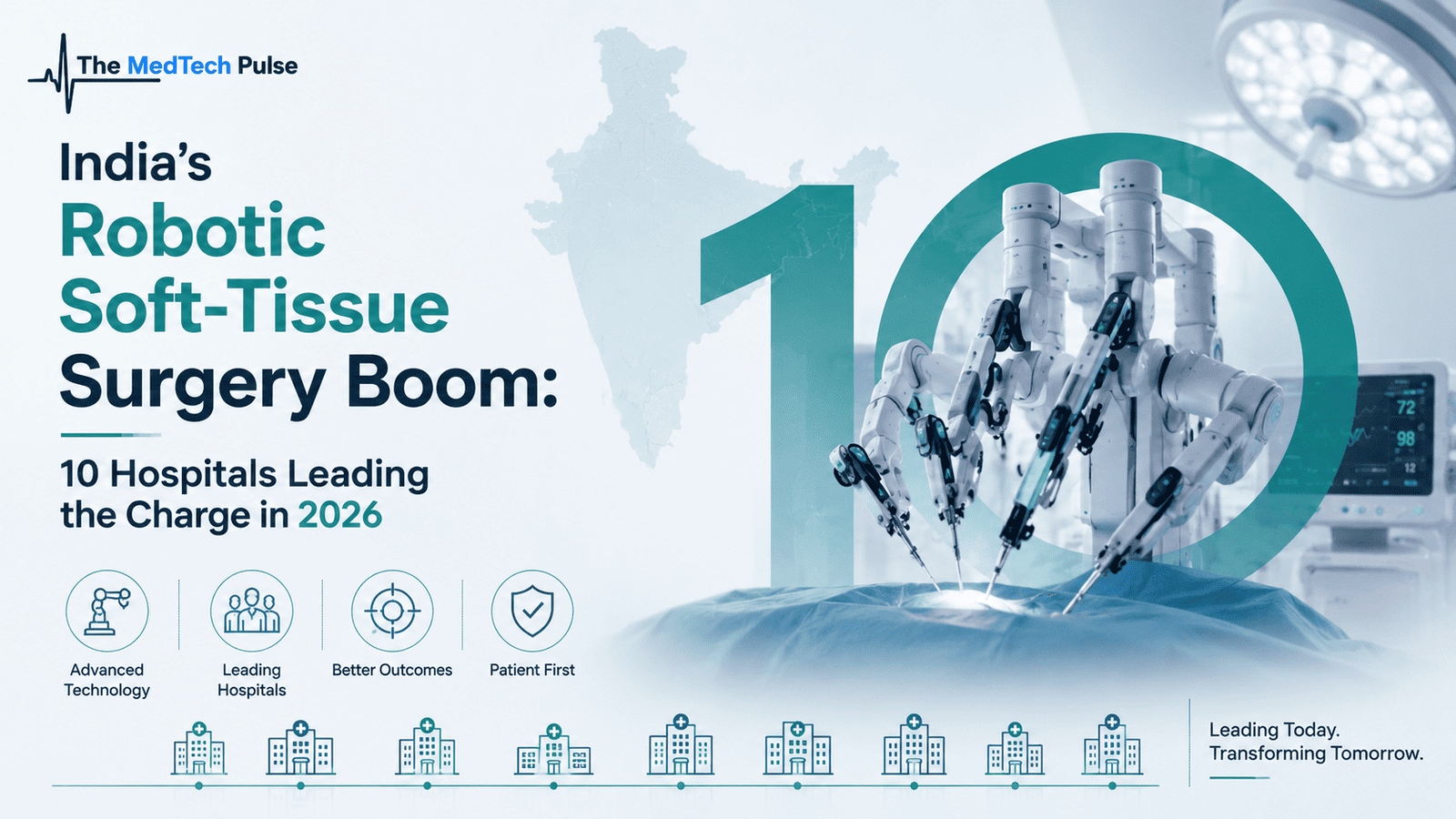
Robotic-assisted surgery is no longer confined to a handful of metro flagship hospitals in India. Through 2026, tier-1 and tier-2 cities alike have added multi-arm surgical robots capable of handling complex soft-tissue procedures — from colectomies and hysterectomies to prostatectomies and lung lobectomies. This wave of installations reflects a broader trend in minimally invasive surgery (MIS): smaller incisions, greater surgical precision, reduced blood loss, and faster patient recovery, all of which place new demands on the wound closure devices — sutures and staplers — used to complete these procedures safely.
Here’s a look at the hospitals and platforms shaping India’s robotic soft-tissue surgery ecosystem this year, and why it matters for clinicians and patients alike.
A Nationwide Expansion, Not Just a Metro Trend
One of the clearest signals of 2026’s growth is geographic spread. Robotic soft-tissue platforms are no longer limited to Delhi, Mumbai, and Bengaluru — they’re now reaching Tier 2 cities such as Trichy, Ludhiana, and Ajmer.
Dr. G. Viswanathan Hospital in Trichy, Tamil Nadu, became the first hospital in the state to install the MedBot Toumai multi-arm surgical robot, a platform supporting colectomy, hysterectomy, gastrectomy, nephrectomy, prostatectomy, thyroidectomy, and lung lobectomy procedures. Similarly, JLN Medical College & Hospital in Ajmer, Rajasthan, launched its robotic surgery programme in June 2026 with the indigenous SSi Mantra system, demonstrating multi-specialty cases including cardiac procedures at launch. Fortis Hospital, Ludhiana, added the SSi Mantra as its 17th robotic system network-wide, extending precision surgery access to Punjab.
This spread matters clinically: broader access to robotic platforms means more patients across India can benefit from smaller incisions and faster recovery — but it also means surgical teams in more locations need reliable, high-performance sutures and staplers suited to robotic and laparoscopic ports.
Multi-Platform Ecosystems at Major Centres
Larger hospital networks are moving beyond a single robot to build multi-platform ecosystems that let surgeons choose the best-fit system for each specialty.
Apollo Spectra Hospitals, Pusa Road (Delhi-NCR), launched a multi-robot ecosystem that pairs the SSI Mantra for soft-tissue interventions with orthopaedic robotic systems and 3D surgical planning tools. Apollo Hospitals’ wider Tamil Nadu and multi-city network recently crossed 8,000-plus robotic surgeries using a combination of da Vinci Xi, SSI Mantra, and HUGO RAS platforms across urology, gynaecology, general surgery, colorectal, thoracic, and oncology cases — underscoring how established players are diversifying rather than standardising on one vendor.
Kokilaben Dhirubhai Ambani Hospital, Mumbai, continues high-volume robotic oncology and urology work, using the Toumai platform for cross-border telesurgery and da Vinci Xi for complex cases such as large prostate procedures.
Telesurgery: India’s Emerging Differentiator
Perhaps the most technologically significant theme of 2026 is the rise of long-distance robotic telesurgery — where a surgeon operates a console in one city while the robotic arms perform the procedure in another.
GEM Hospital, Chennai, integrated the Mizzo Endo 4000 by Meril, the first of its kind in South India, and has used it for dual-console long-distance telesurgery between Chennai and Vapi. Sir Ganga Ram Hospital, New Delhi, has performed a series of robotic telesurgeries using the same Mizzo Endo 4000 platform, remotely operating on patients from Vapi, Gujarat, in urology and general soft-tissue cases.
This capability is particularly relevant for India’s healthcare access gap, allowing specialist surgeons based in major cities to treat patients in regions that otherwise lack robotic surgery expertise — a model that indigenous manufacturers like SS Innovations (maker of the SSi Mantra) have also been actively demonstrating through multi-specialty telesurgery showcases this year.
Oncology and AI-Driven Imaging Take Centre Stage
Robotic soft-tissue systems installed in 2026 increasingly emphasise oncology applications supported by advanced imaging.
The HCG (HealthCare Global) network, based in Bengaluru, introduced India’s first EDGE Multi-Port Endoscopic Surgical Robot System, featuring AI-driven imaging and fluorescence-guided modes designed for complex minimally invasive procedures with a strong oncology focus. Meanwhile, Medical Trust Hospital, Kochi, saw its new Robotic-Assisted Surgery (RAS) Block — powered by da Vinci systems — inaugurated to expand capacity for surgical oncology, gynaecology, gastroenterology, urology, and related soft-tissue procedures.
Fluorescence imaging and AI-assisted visualisation give surgeons better real-time views of tumour margins and vascular structures, which is expected to further reduce complication rates in complex resections.
What This Means for Surgical Teams and Wound Closure
Every one of these installations ultimately converges on the same clinical moment: closure. Robotic and laparoscopic soft-tissue procedures place unique demands on sutures and surgical staplers — smaller working ports, delicate tissue handling, and a premium on secure, low-tension closures that support faster healing. As robotic caseloads climb across colectomy, gastrectomy, hysterectomy, nephrectomy, and thoracic procedures, hospitals and surgical teams are increasingly prioritising wound closure products engineered for consistency and reliability in minimally invasive settings.
For clinicians evaluating robotic programmes, closure technology is not an afterthought — it’s a critical part of ensuring that the precision gained during the procedure translates into the outcomes patients expect: less pain, lower infection risk, and quicker return to normal activity.
The Road Ahead
India’s 2026 robotic soft-tissue surgery landscape shows three clear patterns: geographic expansion beyond metro hubs, the rise of multi-platform hospital ecosystems, and telesurgery emerging as a genuine tool for extending specialist care to underserved regions. With indigenous platforms like SSi Mantra scaling installations alongside established global systems such as da Vinci and newer entrants like Toumai, Mizzo Endo, and EDGE, competition is driving both affordability and innovation.
For hospitals, surgeons, and medtech partners alike, the message is clear: robotic soft-tissue surgery in India has moved from a novelty to standard infrastructure — and the entire surgical ecosystem, including wound closure, needs to keep pace.
Reference Sites
- SS Innovations International — Press Releases (SSi Mantra installation & procedure milestones)
- Tribune India — Health & Business coverage of Indian hospital robotic surgery launches
- News on Air (Government of India) — Official coverage of hospital and institutional healthcare inaugurations
- GlobeNewswire — SS Innovations corporate announcements on SSi Mantra
- TipRanks — Shanghai MicroPort MedBot (Toumai) regulatory and market updates
- Intuitive Surgical — da Vinci surgical system information
- Meril Life Sciences — Mizzo Endo robotic surgical platform
Note: This article draws on hospital and industry announcements circulating as of 2026, supplemented with general industry context from the sources above. Given the fast pace of new installations, readers are encouraged to verify hospital-specific figures (installation dates, procedure counts, “first-in-region” claims) against the respective hospital’s official newsroom or press release before citing them in clinical or promotional material.
Disclosure: This article summarises publicly reported hospital and platform announcements as of 2026 and is intended for informational purposes for clinical and industry readers.