

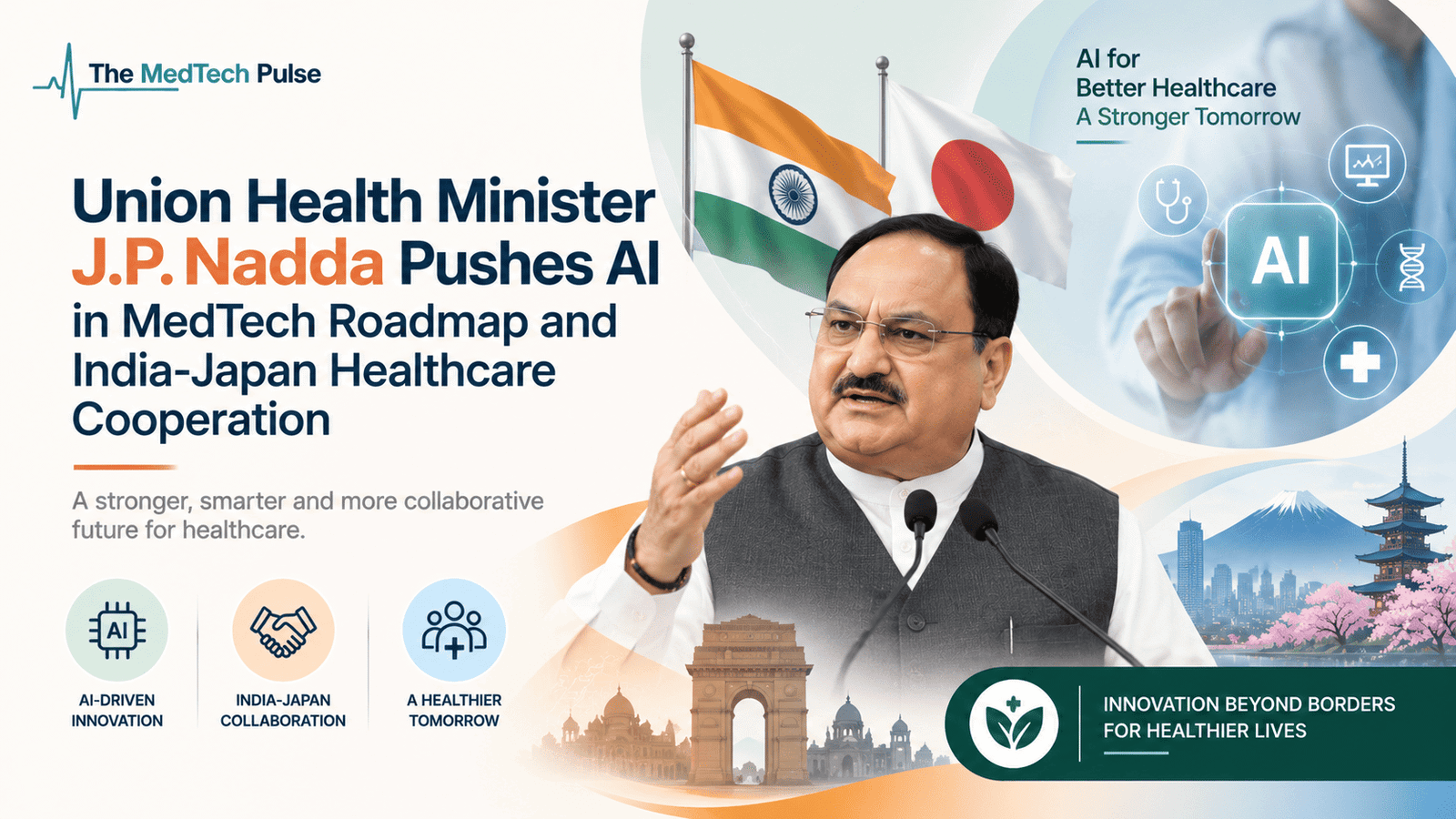
India’s health policy leadership has been unusually active in recent weeks on two fronts that, at first glance, look separate — a domestic push to scale artificial intelligence across the MedTech sector, and a deepening bilateral healthcare partnership with Japan — but that are, in practice, two halves of the same broader ambition: positioning India as a genuinely competitive, innovation-driven global healthcare technology hub.
The AI in MedTech Roadmap
Union Minister of Health & Family Welfare Jagat Prakash Nadda has been the central figure driving this agenda, releasing a knowledge paper titled “AI in MedTech: Revolutionising Healthcare Through Artificial Intelligence” at India Medical Device 2026, the two-day conference organised by the Department of Pharmaceuticals in association with the Federation of Indian Chambers of Commerce and Industry (FICCI) at Vigyan Bhawan, New Delhi. The report was jointly developed by Praxis Global Alliance and FICCI, examining India’s evolving AI-enabled MedTech landscape and outlining the measures needed to move AI solutions from successful pilots to genuine large-scale clinical adoption.
The knowledge paper outlines five key priorities to accelerate responsible AI adoption in India’s healthcare sector, with AI-enabled diagnostics identified as the first major large-scale application opportunity. The reasoning is straightforward and directly tied to India’s structural healthcare access challenges: AI diagnostics can help extend specialist-level expertise to primary and secondary healthcare settings, improve clinical productivity, and reduce longstanding inequalities in access to quality diagnostic care between India’s metro hospitals and its Tier-2, Tier-3, and rural facilities — precisely the pattern already visible in real-world deployments like Qure.ai’s TB screening tool, covered elsewhere in this series.
Alongside releasing the paper, Nadda chaired a CEO roundtable bringing together more than 40 chief executives from global and domestic medical technology companies and MSMEs, alongside senior government officials from the Departments of Pharmaceuticals, Health Research, Health and Family Welfare, and Promotion of Industry and Internal Trade, as well as representatives from NITI Aayog, the National Health Authority, and FICCI. The roundtable’s stated focus areas were direct: boosting innovation and investment, strengthening domestic medical device manufacturing, and creating an enabling environment for Indian MedTech companies to expand their global presence — alongside the specific policy and regulatory measures needed to make India a genuinely competitive hub for medical device development and manufacturing.
The knowledge paper’s central message is one of coordination rather than any single silver-bullet intervention: it underlines that coordinated action among government, regulators, healthcare providers, payers, industry, and academia will be essential for India to move from scattered experimentation to large-scale, responsible AI deployment in healthcare. That framing echoes an earlier, related initiative — Nadda had previously launched the Strategy for AI in Healthcare for India (SAHI) and the Benchmark Open Data Platform in Health (BODH) at the India AI Impact Summit, with SAHI positioned as a national roadmap for ethical, responsible, and people-centric AI adoption in healthcare, and BODH designed to fill a critical gap in testing and validating AI solutions before they’re deployed in the field.
Nadda’s broader address at India Medical Device 2026 was delivered under the banner “Atmanirbhar MedTech: Accelerating India’s Journey towards Viksit Bharat” — explicitly tying the AI and manufacturing agenda to India’s Viksit Bharat @2047 development vision, and to the localisation and testing-infrastructure themes that have run through India’s medical device policy discussions throughout the year, including PLI scheme reforms and CDSCO’s regulatory modernisation covered elsewhere in this series.
Deepening India-Japan Healthcare Cooperation
Running in parallel with the domestic AI and manufacturing push, India and Japan have been reinforcing their bilateral healthcare partnership through the structured Joint Committee Meeting (JCM) mechanism established under the two countries’ Memorandum of Cooperation (MoC) on Healthcare and Wellness. The most recent JCM, the third such meeting, was held at Bharat Mandapam in New Delhi, co-chaired by Nadda and Japan’s Minister in charge of Healthcare Policy, Kimi Onoda.
Union Health Secretary Punya Salila Srivastava, welcoming the Japanese delegation, described the JCM mechanism as having become a cornerstone platform for structured dialogue and policy alignment between the two countries. The meeting’s agenda covered several areas directly relevant to India’s broader MedTech ambitions: digital health, the growing burden of non-communicable diseases (NCDs), and resilient medical supply chains.
The NCD discussion carried particular weight given India’s disease burden: non-communicable diseases account for over 60% of deaths in India, a share consistent with global patterns. The Indian delegation presented a strategy built around early screening, preventive healthcare, and a continuum of care aligned with the UN Sustainable Development Goals — a framing that connects directly to the AI-diagnostics opportunity Nadda’s MedTech roadmap identifies as the sector’s first major scaling priority, since early NCD screening at scale is precisely the kind of task AI-assisted diagnostic tools are best positioned to support.
On human resource development, the two sides discussed complementary strengths: India highlighted its policy and regulatory ecosystem supporting a skilled, globally competitive healthcare workforce, along with structured pathways for exchange programmes, joint training, and mutual recognition of professional competencies, while Japan detailed its own cooperation frameworks supporting joint research, personnel exchanges, and collaborative scientific engagement in medical fields.
In his closing remarks, Nadda said the deliberations had imparted renewed momentum to the India-Japan health partnership, framing the collaboration as reflecting a shared commitment to strengthening healthcare systems, expanding accessibility, and fostering innovation — language he explicitly connected to India’s broader developmental philosophy of “Sabka Saath, Sabka Vikas” (collective effort, inclusive growth), positioning the partnership as one aimed at equitable healthcare outcomes rather than narrowly commercial or diplomatic gain.
How These Two Threads Connect
It’s worth being explicit about why a domestic AI-in-MedTech roadmap and a bilateral healthcare cooperation meeting belong in the same story. India’s stated ambition — repeated across Nadda’s India Medical Device 2026 address, the AI in MedTech knowledge paper, and the India-Japan JCM — is consistent: build domestic AI and manufacturing capability strong enough to be globally competitive, not just adequate for domestic demand. Resilient medical supply chains, a specific focus area named in the India-Japan talks, is directly relevant to India’s ongoing effort to reduce medical device import dependence (the ₹89,000 crore-plus import bill covered elsewhere in this series). Digital health and AI-enabled technology cooperation with Japan gives India access to a specific set of technical and research partnerships that complement, rather than compete with, its domestic AI in MedTech roadmap.
What to Watch Going Forward
Several concrete developments from these announcements are worth tracking through the rest of 2026 and into 2027:
- Whether the AI in MedTech knowledge paper’s five priorities translate into specific funding, regulatory, or procurement mechanisms — a knowledge paper alone doesn’t move AI diagnostics from pilot to scale; the coordinated action it calls for among government, regulators, providers, payers, and industry will need concrete follow-through.
- How SAHI and BODH mature as functioning platforms — particularly BODH’s role in testing and validating AI solutions, which will matter directly for how quickly CDSCO’s newly finalised Medical Device Software guidance (covered elsewhere in this series) can be applied to a growing pipeline of AI diagnostic tools.
- Concrete outcomes from the India-Japan JCM’s digital health and supply chain commitments — joint committee meetings set direction, but the practical test is whether specific joint research programmes, personnel exchanges, or supply chain resilience initiatives materialise in the JCM’s aftermath.
References
- Asianet Newsable — Nadda Unveils Paper on AI in MedTech, Lists Priorities for Healthcare (https://newsable.asianetnews.com/india/nadda-unveils-paper-on-ai-in-medtech-lists-priorities-for-healthcare-articleshow-bgk2gcp)
- Digital Health News — Union Health Minister JP Nadda Unveils Roadmap for AI Adoption in Healthcare (https://www.digitalhealthnews.com/union-health-minister-jp-nadda-unveils-roadmap-for-ai-adoption-in-healthcare)
- DD News — Health Minister Nadda Chairs MedTech CEO Roundtable, Unveils Roadmap for Responsible AI Adoption in Healthcare (https://ddnews.gov.in/en/health-minister-nadda-chairs-medtech-ceo-roundtable-unveils-roadmap-for-responsible-ai-adoption-in-healthcare/)
- eHealth Magazine — J.P. Nadda to Address India Medical Device 2026, Focus on Building a Globally Competitive MedTech Ecosystem (https://ehealth.eletsonline.com/2026/08/j-p-nadda-to-address-india-medical-device-2026-focus-on-building-a-globally-competitive-medtech-ecosystem/)
- Devdiscourse — India-Japan Healthcare Partnership Gains Momentum During 3rd Joint Committee Meeting (https://www.devdiscourse.com/article/law-order/3897396-indiajapan-healthcare-partnership-gains-momentum-during-3rd-joint-committee-meeting)
- Medical Buyer — India, Japan Deepen Health Cooperation — New Delhi Highlights MedTech Potential (https://medicalbuyer.co.in/india-japan-deepen-health-cooperation-new-delhi-highlights-medtech-potential/)
- News on Air (PIB) — Union Minister Nadda Launches Strategy for AI in Healthcare at India AI Impact Summit (https://www.newsonair.gov.in/day-two-of-india-ai-impact-summit-focuses-on-inclusive-ai-growth)
Note: This article synthesises related announcements and events from mid-2026 through early September 2026, including the release of the “AI in MedTech” knowledge paper at India Medical Device 2026 and the 3rd India-Japan Joint Committee Meeting on Healthcare. Some events referenced occurred in the weeks prior to this article’s publish date; readers should verify the latest developments directly through Ministry of Health & Family Welfare press releases for the most current status.