

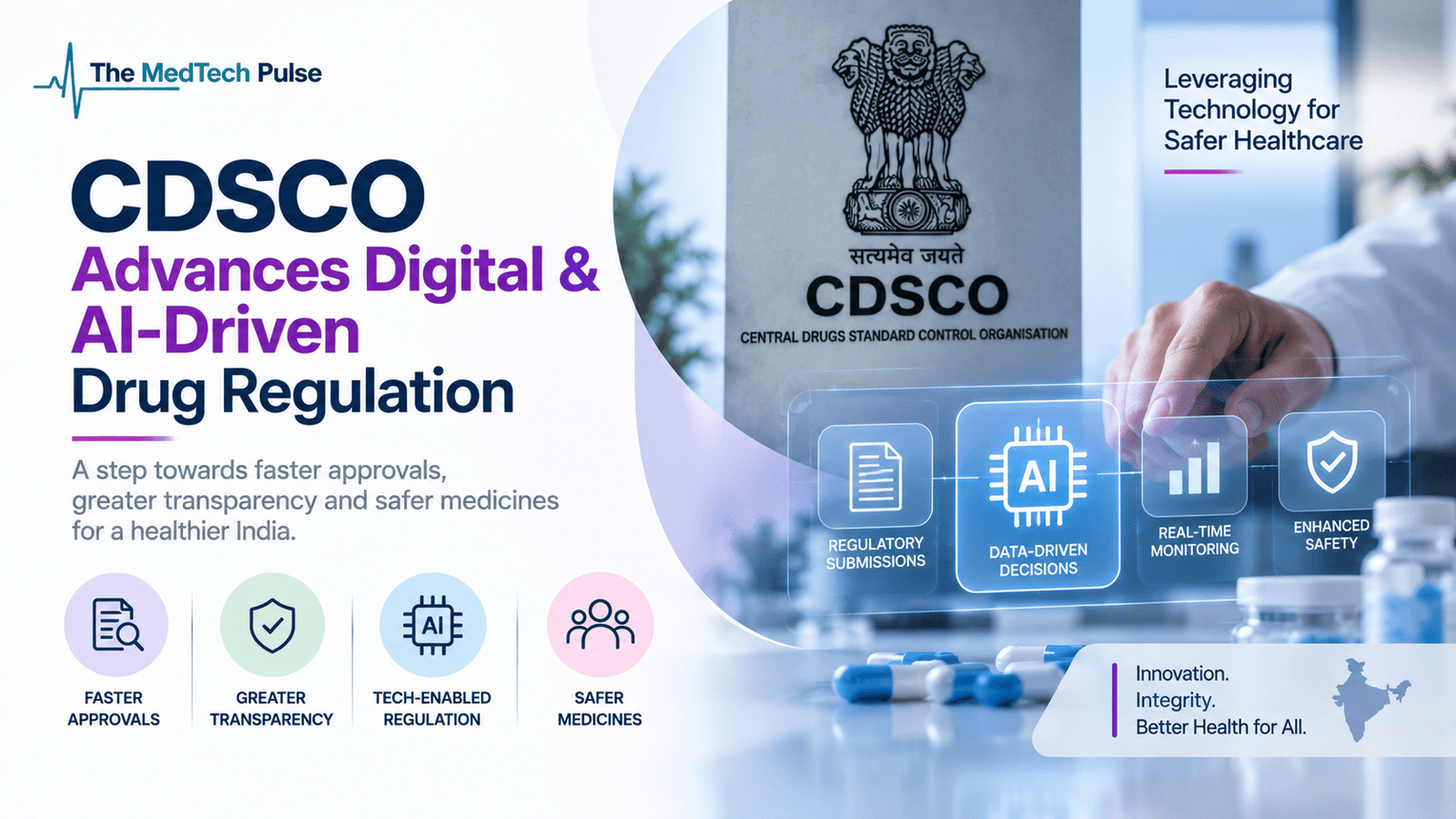
India’s apex drug regulator is moving from incremental digitisation toward something closer to a full regulatory overhaul. The Central Drugs Standard Control Organisation (CDSCO) has confirmed it will roll out the first phase of a comprehensive, end-to-end digital drug regulatory platform within the next 18 months — a single-window system intended to modernise how pharmaceutical companies, distributors, and pharmacovigilance experts interact with India’s regulatory apparatus, from initial filing through post-market surveillance.
The Digital Drug Regulatory System (DDRS)
Speaking at the inaugural Global Drug Regulatory Conclave (GDRC) 2026, organised by the Pharmaceuticals Export Promotion Council of India (Pharmexcil) in association with CDSCO, Drugs Controller General of India (DCGI) Dr. Rajeev Singh Raghuvanshi laid out the scope of the planned Digital Drug Regulatory System (DDRS): an integrated, end-to-end platform bringing manufacturers, distributors, and pharmacovigilance stakeholders into a single interface, capable of tracking a pharmaceutical product’s entire lifecycle — from initial filings and approvals through to post-market safety surveillance.
A notable feature planned for the system: visibility indicators tracking individual companies’ compliance histories, including any instances of Not of Standard Quality (NSQ) findings and Good Manufacturing Practice (GMP) audit outcomes. That’s a meaningful shift toward transparency-by-design — the kind of feature intended to help government procurement agencies make better-informed decisions during tender evaluations, rather than relying on fragmented or after-the-fact compliance checks.
Dr. Raghuvanshi noted that CDSCO has already digitised more than 99% of its regulatory processes — a foundation the DDRS is meant to build on rather than replace. Alongside the digital platform, CDSCO is also piloting a digital ticketing system designed to automate reviewer allocation and pre-screen incoming applications, with the regulator projecting this could cut first-response times by up to 80% and reduce overall processing time by roughly 40%.
AI Pilots Across Regulatory Functions
Beyond the platform itself, CDSCO confirmed it is actively piloting Artificial Intelligence tools across several regulatory functions, with the explicit aim of building a faster, more agile, and genuinely data-driven regulatory system — rather than AI as an add-on feature layered onto an otherwise unchanged process. Combined with the digital ticketing pilot, this signals CDSCO’s ambition to shift meaningful parts of routine application triage and review support toward automation, freeing up scientific and technical reviewers for the more complex regulatory judgment calls that genuinely need human expertise.
QR-Code Authentication for GMP and COPP Certificates
One of the most concrete, near-term deliverables announced is QR-code-based digital authentication for two of the most commonly requested regulatory documents in pharmaceutical export: Good Manufacturing Practice (GMP) certificates and Certificates of Pharmaceutical Product (COPP). Dr. Raghuvanshi confirmed these certificates have already started being issued with QR codes, enabling overseas regulators to instantly verify authenticity rather than relying on slower manual verification processes.
The practical impact for exporters is significant: Dr. Raghuvanshi specifically noted that this QR-code authentication helps exporters save up to six months that were previously spent securing the clearances needed for product registration in overseas markets. For an industry where regulatory delay directly translates into lost market entry time, that’s a substantial, tangible efficiency gain — not just a paperwork modernisation exercise.
This sits alongside other export-facing digitisation CDSCO has already implemented, including a fully digitised Export No Objection Certificate (NOC) system and globally aligned regulatory reliance mechanisms — pathways that let India recognise certain approvals granted by trusted international regulators rather than requiring a fully independent Indian review from scratch. Dr. Raghuvanshi also noted that around 25–30% of clinical trials are currently being considered for a waiver for eligible innovative products under these reliance mechanisms, accelerating patient access to new therapies.
The Final MDSW Guidance: Where Software Regulation Now Stands
Running in parallel with these platform and AI announcements, CDSCO finalised a separate but closely related piece of regulatory infrastructure: its Guidance Document on Medical Device Software (MDSW), issued July 21, 2026 (Document No. CDSCO/MD/GD/MDSW/01/2026), following review of stakeholder feedback on the draft first circulated in October 2025.
The final guidance takes a notably broader, function-based approach than the draft version. Rather than adopting the SaMD/SiMD terminology as a rigid classification label, the final document determines regulatory status based on what the software actually does — its intended medical purpose — reducing ambiguity around digital health products, including AI-enabled software, mobile apps, and cloud-hosted platforms, regardless of whether the software operates standalone or drives a hardware device.
Several specific provisions are worth flagging for manufacturers and developers:
- AI/ML-specific disclosure requirements. Manufacturers of AI-enabled MDSW must now disclose in their market applications whether the datasets used to train their models come from real-world data, public databases, or synthetic data — a transparency requirement aimed squarely at helping reviewers assess bias risk and real-world generalisability.
- The Algorithm Change Protocol (ACP). This is arguably the guidance’s most practically significant feature for AI/ML developers: companies that lay out predefined, bounded modification rules in advance can make minor algorithm updates without filing a new licence application for each iteration — a meaningful concession to how machine learning products genuinely evolve post-deployment, rather than forcing developers back through full re-licensing for every model update.
- Stronger quality and cybersecurity requirements. The guidance expects manufacturers to implement a Quality Management System based on standards including IEC 62304, ISO 14971, and IEC 82304-1, alongside explicit requirements around cybersecurity documentation, Software Bill of Materials (SBOM) disclosure, and continuous performance monitoring — bringing India’s expectations closer in line with how the US FDA and EU regulators already treat software-based medical devices.
- Software driving hardware inherits that hardware’s risk class. Software that drives or influences a hardware medical device is classified in the same risk class as that hardware, while standalone SaMD gets its own dedicated classification based on intended use and degree of autonomy.
Importantly, the guidance does not create an entirely new approval pathway — manufacturing, import, and marketing of MDSW continue to follow the existing Medical Devices Rules, 2017 process. What it does is formalise, in far more explicit and internationally aligned detail, how CDSCO classifies software-based medical products and what documentation reviewers will expect to see — precisely the kind of regulatory clarity that AI diagnostics developers, covered elsewhere in this series, have been asking for.
Why This Matters
Taken together, these announcements point to a regulator trying to modernise on two fronts simultaneously: administrative efficiency (the DDRS platform, AI-assisted triage, QR-authenticated certificates) and substantive regulatory clarity for genuinely new product categories (the finalised MDSW guidance). For pharmaceutical and MedTech companies operating in India, the practical takeaway is that compliance is becoming both faster to navigate procedurally and more precisely defined in terms of what’s expected — a combination that, if the 18-month DDRS timeline holds, could meaningfully shift how quickly new drugs and software-based medical devices reach the Indian market and, via the strengthened export-certification process, international markets as well.
References
- Medical Dialogues — Digital Drug Regulation: CDSCO to Introduce Integrated Compliance Platform in 18 Months (https://medicaldialogues.in/news/industry/pharma/digital-drug-regulation-cdsco-to-introduce-integrated-compliance-platform-in-18-months-176181)
- BioSpectrum India — CDSCO is Piloting AI Across Regulatory Processes to Create Data-Driven Regulatory System: DCGI (https://www.biospectrumindia.com/news/16/28242/cdsco-is-piloting-ai-across-regulatory-processes-to-create-data-driven-regulatory-system-dcgi.html)
- KNN India — CDSCO To Launch Integrated Digital Drug Regulatory Platform In 18 Months (https://knnindia.co.in/news/newsdetails/sectors/cdsco-to-launch-integrated-digital-drug-regulatory-platform-in-18-months)
- Deccan Herald — Explained: CDSCO’s Updated Medical Device Software Guidance (https://www.deccanherald.com/health/healthcare/explained-cdscos-updated-medical-device-software-guidance-heres-everything-that-has-changed-4082957)
- Medical Buyer — CDSCO Issues Final Guidance on Regulating Medical Device Software (https://medicalbuyer.co.in/cdsco-issues-final-guidance-on-regulating-medical-device-software/)
- National Law Review — Code Compliance: Decoding India’s Medical Device Software Guidance (https://natlawreview.com/article/code-compliance-decoding-indias-medical-device-software-guidance)
- Emergo by UL — India CDSCO Finalizes Guidance on Medical Device Software (https://www.emergobyul.com/news/india-cdsco-finalizes-guidance-medical-device-software)
Note: The Digital Drug Regulatory System remained in planning/early rollout stages at the time of writing, with the first phase targeted within 18 months of the July 2026 announcement. The final MDSW guidance is in effect and applies to current MDR-2017 filings; this article reflects publicly available information as of early September 2026.