

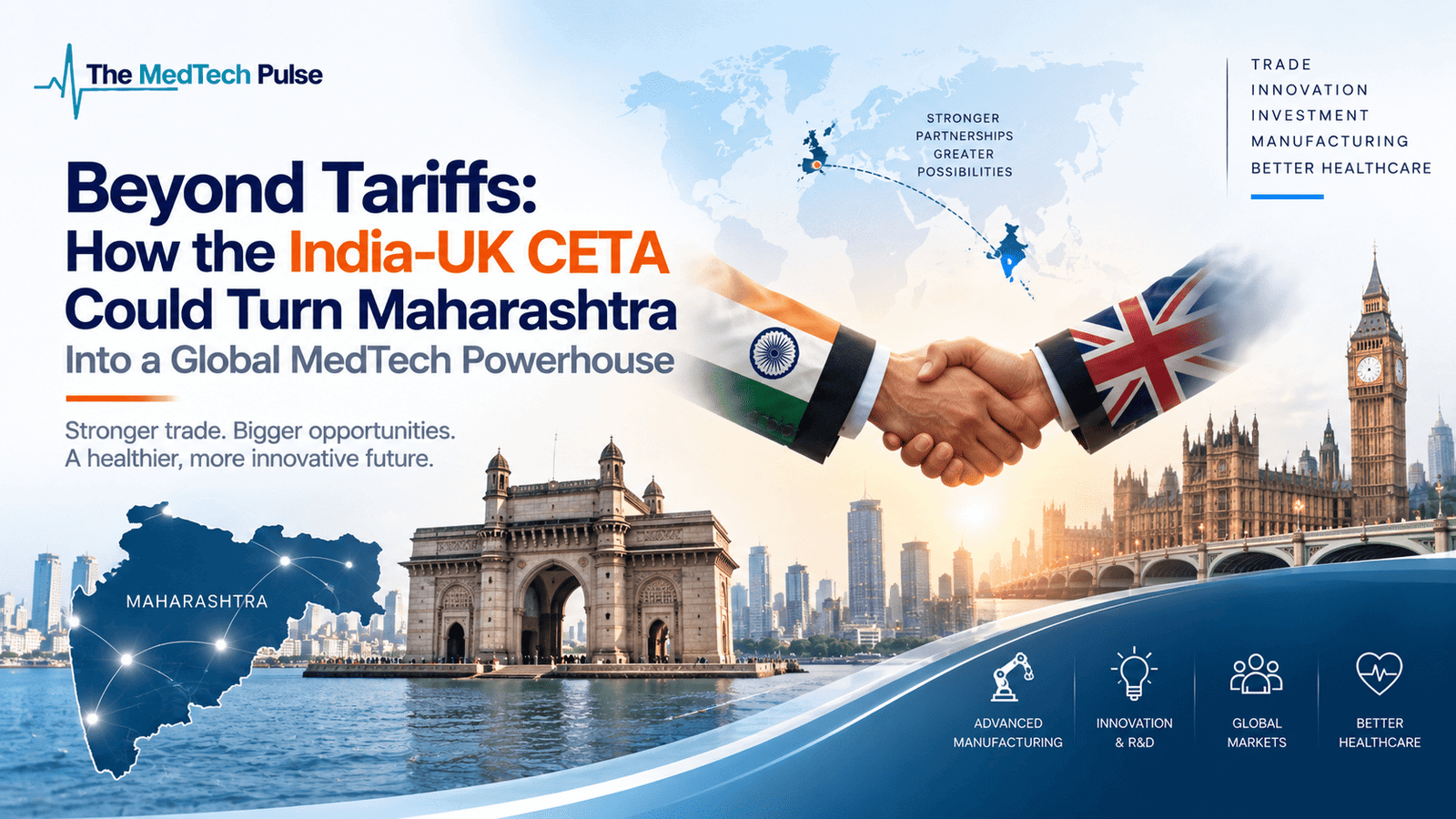
Trade agreements are usually discussed in the language of tariff schedules and market access percentages — useful for economists, forgettable for almost everyone else. But at the CII Hospital Tech 2026 conference in Mumbai, Maharashtra’s government made the case that the India-UK Comprehensive Economic and Trade Agreement (CETA) is something far more concrete for the state’s healthcare sector: a genuine lever to pull in global capital, technology, and research partnerships, turning Maharashtra into a serious global hub for medical technology, digital healthcare, and biotechnology.
The Announcement: A State-Level Healthcare Vision With Global Ambitions
Speaking at the conference, organised by the Confederation of Indian Industry (CII), Jaykumar Rawal — Maharashtra’s Minister for Protocol, Foreign Direct Investment, and Pravasi Maharashtriya Sampark — laid out the state’s ambition in explicit terms. Maharashtra will be developed as a global hub for medical technology, digital healthcare, biotechnology, research, and advanced medical equipment manufacturing, as part of the state’s “Developed Maharashtra 2047” vision, aligned with Prime Minister Narendra Modi’s broader “Developed India” (Viksit Bharat) agenda and led at the state level under Chief Minister Devendra Fadnavis.
Rawal was clear that healthcare is being positioned as one of the central pillars of that long-term development goal, not a peripheral talking point. “Maharashtra, particularly Mumbai, has a strong ecosystem of world-class hospitals, medical colleges, research institutions, pharmaceutical companies and healthcare start-ups,” he said, framing the government’s role as leveraging that existing ecosystem to establish the state as a leading destination for medical innovation, rather than building from scratch.
Notably, the conference itself signalled the international dimension of this ambition directly: attendees included British Deputy High Commissioner Harjinder Kang and Netherlands Consul General Thierry van Helden, alongside senior healthcare sector figures including Padma Shri Dr. Ramakant Deshpande — a lineup that reflects Maharashtra actively courting both UK and European investment and technology partnerships simultaneously, not treating CETA as its only international lever.
Why CETA Specifically Matters for Healthcare
The India-UK CETA — signed July 24, 2025, and described as the UK’s largest negotiated trade deal since its exit from the European Union, and India’s biggest agreement with a G7 economy in over a decade — secured Indian market access across all 12 major service sectors and 137 sub-sectors, collectively covering more than 99% of India’s export interests. Healthcare and life sciences sit explicitly within that services framework, alongside IT, professional services, financial services, education, and telecommunications.
For MedTech and healthcare specifically, CETA’s relevance goes beyond simple tariff reduction on imported devices. Industry engagement following the agreement’s signing has focused heavily on regulatory alignment, manufacturing partnerships, and technology transfer — a seven-member Indian medical devices industry delegation, led by AiMeD Forum Coordinator Rajiv Nath, held a dedicated Roundtable at the House of Lords with the Association of British Healthcare Industries specifically to explore these opportunities, with both sides identifying scope for co-developing scalable, patient-centric healthcare solutions in digital health, remote monitoring, and point-of-care diagnostics.
That framing — regulatory cooperation and manufacturing linkages, not just cheaper imports — is precisely the lever Maharashtra is now trying to pull at the state level. As one industry analysis of the UK and EU trade agreements’ healthcare impact put it: the agreements set the national tariff and market-access framework, but the depth of the healthcare-sector gain will come down to what states such as Maharashtra actually do with it — pairing investment facilitation with MedTech manufacturing, pharma-biotech collaboration, hospital-led validation, regulatory capability, and export logistics, to shift the outcome from higher imports toward genuine local value creation.
Maharashtra’s Existing Advantages — and Its Policy Framework
Maharashtra isn’t approaching this ambition without foundations already in place. The state’s pitch rests on a combination of assets that few Indian states can match simultaneously: a dense concentration of world-class hospitals and medical colleges, an established pharmaceutical and biotechnology manufacturing base, a deep pool of skilled doctors and healthcare professionals, and Mumbai’s financial and logistics connectivity as India’s commercial capital.
The Maharashtra Industry, Investment and Services Policy 2025 provides the formal policy backbone for this ambition, explicitly positioning healthcare and life sciences as important engines of the state’s broader economic growth strategy. Rawal specifically emphasised that the state wants this growth to extend well beyond Mumbai — naming Pune, Nagpur, Nashik, Chhatrapati Sambhajinagar, Kolhapur, Amravati, and Gadchiroli as regions the government wants included in the healthcare investment push, a deliberate signal against concentrating all new MedTech and biotech investment in a single metro cluster.
The state government’s Protocol Department, per Rawal, is also working to convert diplomatic and diaspora relationships into concrete investment channels — strengthening coordination with foreign governments and diplomatic missions, while specifically tapping the expertise of Maharashtrian doctors, researchers, and healthcare professionals working internationally to drive research, technology transfer, and new healthcare initiatives back into the state.
A Patient-Centric Framing for Technology Adoption
One notable element of Rawal’s remarks is worth highlighting for a MedTech-focused audience specifically: his explicit framing that rapid advances in artificial intelligence, robotics, telemedicine, and advanced diagnostics must remain patient-centric, affordable, and accessible to the common citizen, rather than treating technology adoption as valuable in itself. That’s a meaningful qualifier for a state pitching itself as an investment destination — it signals that Maharashtra’s ambition isn’t simply to attract capital and manufacturing for export, but to ensure the resulting healthcare innovation genuinely reaches Indian patients, echoing the affordability and access themes running through India’s broader MedTech policy conversation this year, from the PLI scheme’s manufacturing push to AMTZ’s Tier-2 and Tier-3 expansion ambitions.
What Success Would Actually Require
Turning this ambition into results will depend on execution well beyond a single conference announcement. The comparison worth watching is Maharashtra’s parallel courtship of Belgian capital and technology as part of its stated goal of becoming a USD 1 trillion state economy by 2030 — a dual-track approach that suggests the state sees CETA as one important lever among several, rather than a singular solution. Industry commentary has specifically suggested Maharashtra could go further on the UK-facing side by building a dedicated UK-Maharashtra life-sciences and MedTech facilitation cell, targeting UK companies in diagnostics, imaging, surgical technology, digital health, and laboratory equipment, and actively linking them with the state’s existing pharma companies, hospitals, medical colleges, engineering institutions, and contract manufacturers — essentially replicating and extending the more structured playbook already being tested with Belgium.
The Bottom Line
Maharashtra’s pitch at CII Hospital Tech 2026 represents a genuine attempt to translate a national trade agreement into concrete, state-level industrial strategy — pairing CETA’s regulatory and market-access framework with Maharashtra’s existing pharmaceutical, hospital, and research infrastructure, and an explicit policy commitment through the Industry, Investment and Services Policy 2025. Whether this ambition converts into actual UK investment, manufacturing partnerships, and technology transfer at meaningful scale will depend on follow-through: dedicated facilitation infrastructure, regulatory execution, and Maharashtra’s ability to extend investment genuinely beyond Mumbai into the Tier-2 cities it has named. For now, though, the state has made its intent unusually explicit — positioning itself not just as India’s financial capital, but as its most credible bid yet for becoming a global MedTech and life-sciences investment destination.
References
- Free Press Journal — Maharashtra To Become Global Hub For Medical Technology, Digital Healthcare, Biotechnology: Minister Jaykumar Rawal (https://www.freepressjournal.in/mumbai/maharashtra-to-become-global-hub-for-medical-technology-digital-healthcare-biotechnology-minister-jaykumar-rawal)
- Medical Buyer — India’s UK, EU FTAs Redraw MedTech and Pharma Landscape (https://medicalbuyer.co.in/indias-uk-eu-ftas-redraw-medtech-and-pharma-landscape/)
- Medical Buyer — India, UK Explore New MedTech Trade Avenues Under CETA (https://medicalbuyer.co.in/india-uk-explore-new-medtech-trade-avenues-under-ceta/)
- Mondaq — India-UK CETA And Its Strategic Implications For Investors (https://www.mondaq.com/india/international-trade-investment/1666856/india-uk-ceta-and-its-strategic-implications-for-investors)
- ETHealthworld — India-UK CETA a Key Lever to Scale Up Healthcare Investment in Maharashtra: Rawal (https://health.economictimes.indiatimes.com/news/policy/india-uk-ceta-a-key-lever-to-scale-up-healthcare-investment-in-maharashtra-rawal/133922473)
Note: This article reflects Minister Jaykumar Rawal’s remarks at the CII Hospital Tech 2026 conference in Mumbai on September 8, 2026, and related coverage of India-UK CETA’s healthcare provisions. Specific investment figures, timelines, and partnership agreements referenced as ambitions were not detailed as finalised deals at the time of writing.