

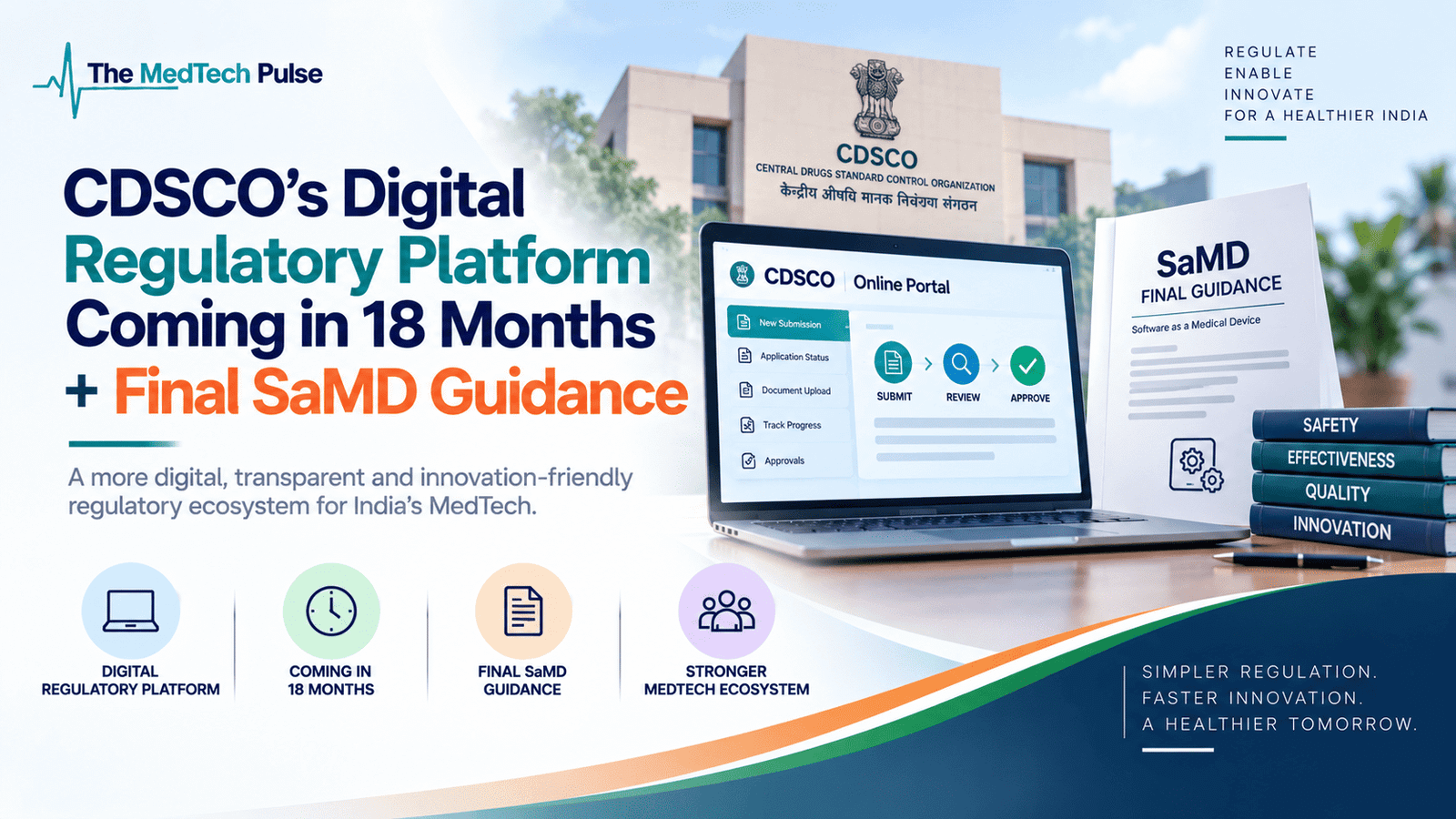
India’s drug and medical device regulator is in the middle of its most significant modernisation push in years. At the inaugural Global Drug Regulatory Conclave (GDRC) 2026, Drugs Controller General of India (DCGI) Dr. Rajeev Singh Raghuvanshi confirmed that the Central Drugs Standard Control Organisation (CDSCO) will launch the first phase of a comprehensive, end-to-end Digital Drug Regulatory System (DDRS) within 18 months — a single-window platform designed to unify how manufacturers, distributors, and pharmacovigilance stakeholders interact with the regulator across a product’s entire lifecycle.
A Platform Built on an Already-Digitised Foundation
CDSCO isn’t starting from zero. Dr. Raghuvanshi noted that more than 99% of the organisation’s regulatory processes are already digitised — the DDRS is meant to unify and streamline that existing digital infrastructure into a genuinely integrated, single-window system, rather than a first attempt at digitisation itself.
The planned platform will track applications from initial filing through approval and into post-market surveillance, all within one continuous digital thread. A particularly notable feature: the system is designed to include compliance visibility indicators for individual companies, flagging any history of Not of Standard Quality (NSQ) findings or Good Manufacturing Practice (GMP) audit outcomes — information intended to help government procurement bodies make better-informed decisions during tender evaluations.
CDSCO is also piloting a digital ticketing system to automate reviewer allocation and pre-screen incoming applications before human review even begins. The regulator projects this could cut first-response times by up to 80% and reduce overall processing time by roughly 40% — a substantial efficiency claim, if it holds up once deployed at scale.
AI Enters the Regulatory Process
Beyond the platform architecture itself, CDSCO confirmed it is actively piloting Artificial Intelligence tools across multiple regulatory functions, with the explicit goal of building what Dr. Raghuvanshi described as a faster, more agile, data-driven regulatory system. Combined with the digital ticketing pilot, this points toward genuine automation of routine application triage — freeing CDSCO’s scientific reviewers to focus on the complex regulatory judgment calls that still require human expertise, rather than getting bottlenecked on high-volume administrative sorting.
QR Codes and the Export Timeline Problem
One of the most immediately practical changes announced is QR-code-based digital authentication for GMP certificates and Certificates of Pharmaceutical Product (COPP) — two of the documents most frequently requested by overseas regulators during export registration. These certificates have already started being issued with QR codes, letting foreign regulatory bodies verify authenticity instantly rather than relying on slower manual checks.
The impact, according to Dr. Raghuvanshi, is concrete: this QR-code system helps exporters save up to six months previously spent securing clearances for product registration in overseas markets. For pharmaceutical and device exporters, where regulatory delay directly costs market entry time, that’s a genuine competitive advantage baked directly into the certification process itself.
The Final MDSW Guidance: Clarity for Software-Based Devices
Running alongside these platform and AI announcements, CDSCO finalised its Guidance Document on Medical Device Software (MDSW) on July 21, 2026, following stakeholder review of the October 2025 draft. This is arguably the more consequential development for India’s fast-growing digital health and AI diagnostics sector specifically.
The final guidance takes a function-based approach to classification — determining a software product’s regulatory status based on its actual intended medical purpose, rather than rigid upfront labelling. This reduces ambiguity for standalone software, AI/ML-based diagnostic tools, mobile health apps, and cloud-hosted platforms alike, regardless of whether they operate independently or drive a piece of hardware.
Several specific provisions matter for companies building in this space:
AI/ML training data disclosure. Manufacturers must now disclose whether their models were trained on real-world data, public databases, or synthetic data — giving reviewers a clearer basis for assessing bias risk and how well a tool will generalise across India’s diverse patient population.
The Algorithm Change Protocol (ACP). Perhaps the guidance’s most practically useful feature: companies that define predefined, bounded modification rules upfront can make minor algorithm updates without filing a fresh licence application for every iteration — a genuine concession to how machine learning products actually evolve after deployment.
Cybersecurity and Software Bill of Materials (SBOM) requirements, alongside Quality Management System expectations built on standards including IEC 62304, ISO 14971, and IEC 82304-1 — bringing India’s expectations for software-based medical devices closer in line with how the US FDA and EU regulators already treat this category.
Importantly, the guidance doesn’t introduce a new licensing pathway — MDSW products continue to be regulated under the existing Medical Devices Rules, 2017. What’s changed is the clarity around classification and documentation expectations, which had previously left considerable ambiguity for companies building AI-enabled diagnostic and digital health tools.
Why This Combination Matters
Taken together, these developments point to a regulator modernising on two fronts at once: administrative efficiency (the DDRS, AI-assisted triage, QR-authenticated certificates) and substantive regulatory clarity for genuinely new categories of medical product (the finalised MDSW guidance). That combination directly supports the Indian government’s broader “AI in MedTech” roadmap, which has specifically identified AI-enabled diagnostics as the first major opportunity for scaling responsible AI adoption across Indian healthcare — a scaling effort that depends heavily on developers having a clear, predictable regulatory pathway to build against.
What Happens Next
The DDRS’s 18-month rollout window means the platform’s full benefits won’t be immediate — companies navigating CDSCO approvals in the near term will still be working through a system in transition. The real tests ahead: whether the projected efficiency gains from AI-assisted triage hold up at scale, whether the DDRS timeline is met, and whether the MDSW guidance’s more detailed documentation requirements — while providing welcome clarity — prove manageable for smaller AI diagnostics startups with limited regulatory-affairs bandwidth, even with the Algorithm Change Protocol’s built-in flexibility for ongoing updates.
For an industry that has long cited regulatory unpredictability as one of its biggest operational headaches, the direction of CDSCO’s reform is unambiguous — faster, more transparent, and more internationally aligned regulation. Execution over the coming 18 months will determine how much of that promise translates into reality.
References
- Medical Dialogues — Digital Drug Regulation: CDSCO to Introduce Integrated Compliance Platform in 18 Months (https://medicaldialogues.in/news/industry/pharma/digital-drug-regulation-cdsco-to-introduce-integrated-compliance-platform-in-18-months-176181)
- BioSpectrum India — CDSCO is Piloting AI Across Regulatory Processes to Create Data-Driven Regulatory System: DCGI (https://www.biospectrumindia.com/news/16/28242/cdsco-is-piloting-ai-across-regulatory-processes-to-create-data-driven-regulatory-system-dcgi.html)
- KNN India — CDSCO To Launch Integrated Digital Drug Regulatory Platform In 18 Months (https://knnindia.co.in/news/newsdetails/sectors/cdsco-to-launch-integrated-digital-drug-regulatory-platform-in-18-months)
- Medical Buyer — CDSCO Issues Final Guidance on Regulating Medical Device Software (https://medicalbuyer.co.in/cdsco-issues-final-guidance-on-regulating-medical-device-software/)
- National Law Review — Code Compliance: Decoding India’s Medical Device Software Guidance (https://natlawreview.com/article/code-compliance-decoding-indias-medical-device-software-guidance)
Note: The DDRS and AI-pilot announcements were made at GDRC 2026 (July 30–31, 2026); the final MDSW guidance was issued July 21, 2026. This article reflects publicly available information as of early September 2026; the DDRS remained in planning stages at the time of writing.