
There’s a lot of noise around “AI in healthcare” — pilot announcements, funding rounds, glossy hospital press releases. What’s harder to find is a clear-eyed answer to a simple question: is any of it actually working, at scale, in real Indian hospitals? The honest answer in 2026 is yes, in a handful of specific, well-documented use cases — and the regulatory system that governs all of it just got its first real structure.
Here’s what’s genuinely deployed, what the data shows, and where the gaps still are.
The Regulatory Foundation: CDSCO Finally Defines SaMD
For years, AI diagnostic tools in India operated in a grey zone — regulated in principle under the Medical Device Rules, 2017, but without software-specific clarity on classification or documentation. That changed in October 2025, when CDSCO released its draft Guidance Document on Medical Device Software — the most comprehensive regulatory clarification India has issued for software-based devices to date.
The guidance draws a critical distinction that any hospital or developer working with AI now has to understand. Software embedded in and inseparable from physical hardware — firmware in a pacemaker or an imaging analyser, for instance — is classified as Software in a Medical Device (SiMD) and simply inherits its parent hardware’s risk class. Standalone software performing a medical function independently — diagnostic apps, AI-based imaging tools, remote monitoring platforms, clinical decision support systems — falls under Software as a Medical Device (SaMD), and gets its own dedicated, risk-based classification system running from Class A (low risk, such as retrospective data analysis tools) through Class D (high risk — AI-based cancer detection or autonomous diagnostic decision systems, subject to full Central Licensing Authority review).
One detail that matters more than it sounds: classification is based on intended use, not just technical architecture. Even minor changes in labelling or promotional language can shift a product from Class B to Class C if the wording implies diagnostic or life-supporting functionality — a reminder to developers that marketing copy has genuine regulatory consequences.
The guidance also introduces an Algorithm Change Protocol (ACP) specifically for AI/ML-based tools — a mechanism that lets models update post-deployment without triggering a full re-licensing process each time. That’s a meaningful, practical concession to how machine learning products actually evolve, and it aligns India more closely with how the US FDA and EU regulators handle adaptive AI/ML software. Class A and B SaMD are licensed at the state level; Class C and D require full Central Licensing Authority approval, with a technical dossier, risk assessments, QMS evidence (ISO 13485), and clinical data, typically taking 90–180 days depending on class.
What’s Actually Deployed: The TB Screening Success Story
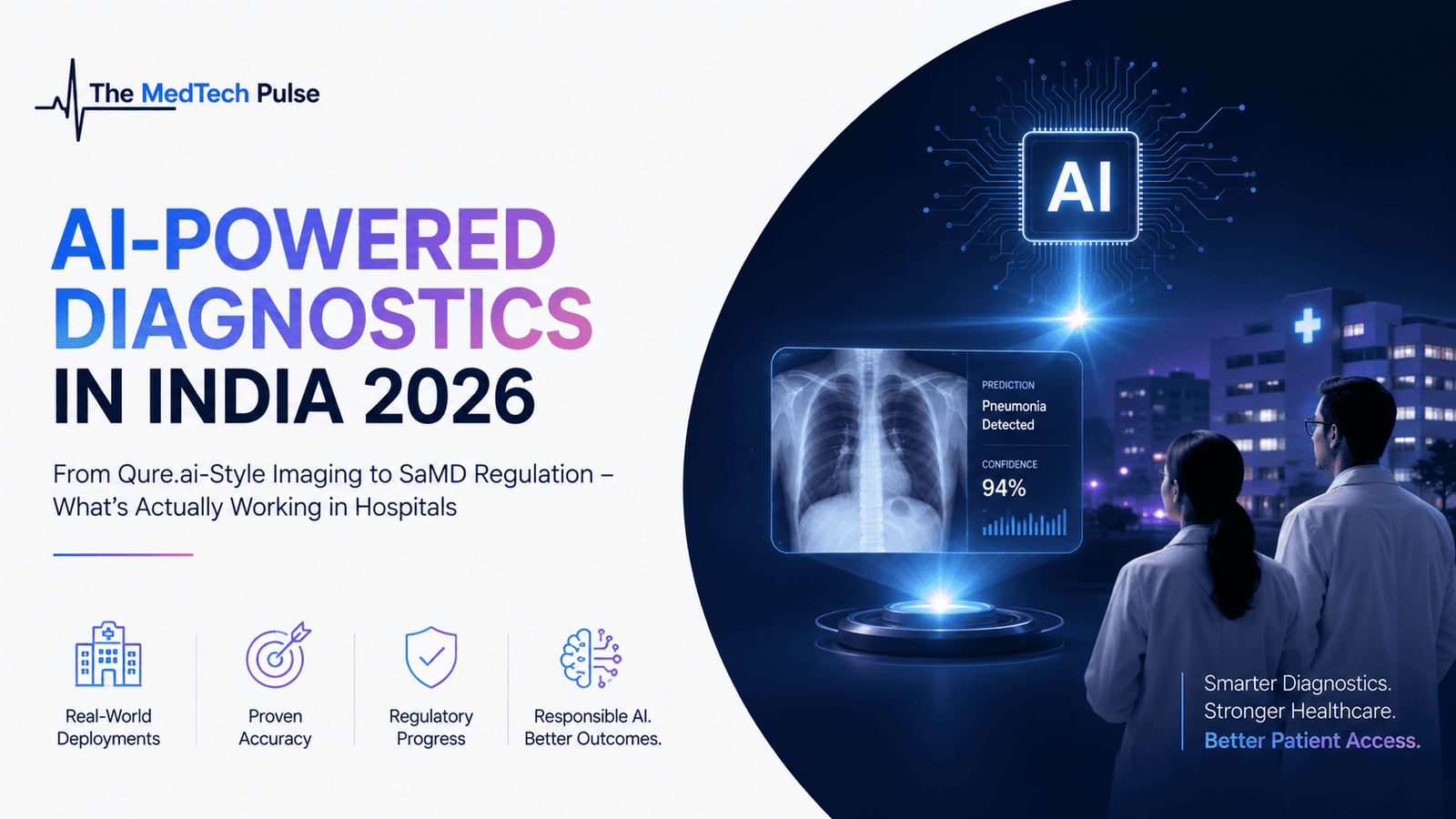
If there’s one AI diagnostic use case in India with genuinely strong, independently verified evidence behind it, it’s AI-assisted chest X-ray reading for tuberculosis — and Qure.ai’s qXR tool is the clearest example.
The numbers are unusually well documented for a health-tech deployment. A Health Technology Assessment conducted by the Indian Institute of Public Health Gandhinagar found qXR to be the strongest performer among CDSCO-cleared TB AI solutions in India, on both accuracy and cost. A separate ICMR-conducted assessment found an incremental cost-effectiveness ratio of minus ₹9,864.77 — in plain terms, the AI-assisted pathway detected more TB cases while costing less per case than manual interpretation. A PATH-run pilot across eight private chest X-ray labs in Nagpur screened 10,481 individuals and recorded a 15.8% increase in TB case detection compared to screening without AI assistance. In a separate deployment supported by the India Health Fund, qXR’s high sensitivity — above 90% — cut the need for follow-on confirmatory testing by half, and reduced average diagnosis time from 5.7 days to 3.2 days.
The scale of rollout is real, not pilot-stage: qXR is deployed across more than 2,600 sites in 67-plus countries, with a substantial footprint inside India specifically, including integration into NIDAAN, the government’s national AI-based lung health and TB screening programme, which uses the qXR platform to detect more than 30 chest abnormalities beyond TB itself. Where this matters most isn’t the metro teaching hospitals — it’s rural areas where no radiologist is available within 100 kilometres, where AI-assisted reading isn’t a convenience upgrade over a human radiologist; it’s the only timely reading available at all.
Beyond TB: Diabetic Retinopathy, Cancer Screening, and Clinical Decision Support
TB screening isn’t the only place AI diagnostics have moved from pilot to real deployment.
Diabetic retinopathy, the leading cause of avoidable blindness among India’s roughly 18 million diabetics, is being screened through MadhuNetrAI, launched in December 2025. The system lets healthcare workers with no ophthalmology training capture retinal images using portable scanners, with AI flagging patients who need urgent specialist referral. In its first six months, the programme screened over 7,100 patients across 38 healthcare facilities — the first AI-assisted community screening programme for diabetic retinopathy launched in India.
Cancer screening is showing similarly strong early numbers at the district-hospital level: AI screening tools for cervical and breast cancer deployed at district hospitals are reporting diagnostic accuracy above 90%, according to reporting in eHealth Magazine.
Clinical decision support has taken a genuinely national turn. India’s National Health Authority is rolling out Smart Doctor, an AIIMS-built clinical decision support system, across close to 70,000 hospitals under the Ayushman Bharat Digital Mission (ABDM) framework — alongside dedicated AI research centres now running across 22 AIIMS campuses. It’s worth being precise about the limits of this rollout, though: the government’s rule-based CDSS covers standardised protocols for common conditions. It does not cover specialty workflows, imaging triage, documentation support, or machine-learning-driven risk prediction — those remain open ground for private and academic developers to build on top of the newly available distribution and identity infrastructure ABDM provides.
Telemedicine completes the picture on reach: the AI-assisted eSanjeevani platform processed 282 million consultations between April 2023 and November 2025, and an AI-powered Media Disease Surveillance System has generated over 4,500 disease outbreak alerts — both operating at a scale most health systems globally simply don’t have the digital backbone to attempt.
Where Tier-2 and Tier-3 Adoption Actually Struggles
None of this success is evenly distributed, and it’s worth being honest about why. Field experience from AI TB screening rollouts has surfaced a consistent set of practical obstacles that have little to do with model accuracy and everything to do with deployment conditions: basic infrastructure — reliable internet access and compatible hospital systems — proved critical for smooth AI software installation, and its absence is precisely what limits reach into India’s more remote facilities. Initial reluctance from local radiology associations, driven by simple unfamiliarity with AI tools rather than evidence against them, had to be worked through with education, transparency, and sustained engagement before adoption took hold — a soft barrier that shows up again and again in Tier-2 and Tier-3 rollouts, regardless of how strong the underlying accuracy data is.
Data quality also varies significantly across hospital tiers, and FHIR-based interoperability — the technical standard ABDM increasingly mandates for health data exchange — is considerably less mature outside major institutions. That creates a real gap between what a well-resourced AIIMS campus can plug an AI tool into and what a district hospital’s existing digital infrastructure can actually support.
What “Responsible AI” Looks Like in the Indian Context
The regulatory scaffolding going up around AI diagnostics — SaMD classification, the Algorithm Change Protocol, mandatory cybersecurity risk assessments, post-market surveillance plans, and DPDP Act compliance for patient data handling — is explicitly designed to keep pace with how fast these tools are being deployed, rather than regulate them after the fact. That’s a meaningfully different posture than earlier waves of Indian health-tech regulation, which tended to catch up to technology years after adoption had already happened.
The practical implication for hospitals evaluating AI tools: verify a vendor’s CDSCO registration number and SaMD device class before procurement — marketing material is not regulatory clearance, and that gap has already been flagged by industry as a real due-diligence risk for buyers.
The Bottom Line
AI diagnostics in India in 2026 aren’t a speculative future technology — in TB screening specifically, they’re a documented, cost-saving, accuracy-improving reality operating at genuine national scale, with independent health-economics data to back it up. Diabetic retinopathy and cancer screening are following a similar trajectory, still earlier in their deployment curve but showing comparably strong early numbers. What’s still unresolved is less about whether the AI works and more about whether the infrastructure, workforce familiarity, and data interoperability needed to deploy it exist evenly across India’s hospital tiers — and that gap, not model accuracy, is now the real bottleneck standing between AI diagnostics and universal reach.
References
- 5C Network — Radiology AI in India: 2026 Hospital Guide (https://www.5cnetwork.com/resources/radiology-ai-india-guide)
- Qualio — CDSCO Medical Device Registration in India: What’s Changed in 2026 (https://www.qualio.com/blog/cdsco-registration-india-2026-update)
- Freyr Solutions — SaMD Regulation in India: CDSCO Classification (Class A–D) (https://www.freyrsolutions.com/blog/samd-regulation-in-india-cdsco-classification-class-a-d-registration-requirements-emerging-market-strategy)
- ACPL Group India — CDSCO SaMD Guidance 2025–26: What India’s Digital Health Companies Must Do Now (https://acplgroupindia.co.in/cdsco-samd-guidance-2025-26-what-indias-digital-health-companies-must-do-now/)
- eCorpIT — India’s 70,000-Hospital AI Clinical Rollout, 2026 (https://ecorpit.com/india-ai-clinical-decision-support-70000-hospitals-2026/)
- ARC Advisory Group — AI in Healthcare in India (https://www.arcweb.com/blog/ai-healthcare-india)
- Qure.ai — India: Qure.ai’s qXR Boosts TB Detection & Saves Costs (https://www.qure.ai/us/news-press-coverages/Qure.ai-increases-TB-detection-while-saving-costs-shows-evaluation-in-India)
- Qure.ai — AI in TB Programs with the Qure.ai AI Toolkit (https://www.qure.ai/us/impact-stories/introducing-ai-toolkit-simplifying-ai-deployments-for-tb-programs)
- India Health Fund — Explaining qXR, an AI-Powered TB Screening Tool (https://www.indiahealthfund.org/portfolio-qure-ai/)
- NITI Aayog Frontier Tech Hub — AI-Driven Tuberculosis Diagnosis: A Transformative Solution for India’s Healthcare Challenges (https://frontiertech.niti.gov.in/story/ai-driven-tuberculosis-diagnosis-a-transformative-solution-for-indias-healthcare-challenges)
- Organiser — How India AI and Ayushman Bharat Digital Mission Are Powering an AI-Driven Healthcare Revolution (https://organiser.org/2026/02/25/341713/bharat/how-ai-and-ayushman-bharat-digital-mission-are-powering-an-ai-driven-healthcare-revolution-in-india/)
- Lumichats — AI in Healthcare India 2026: From AIIMS to Rural Villages (https://www.lumichats.com/blog/ai-in-healthcare-india-2026-complete-guide)
Note: Deployment figures, accuracy data, and regulatory timelines reflect the most recent publicly available sources as of the publish date. CDSCO’s Medical Device Software guidance was in draft form at the time of writing; final notified provisions may differ.