

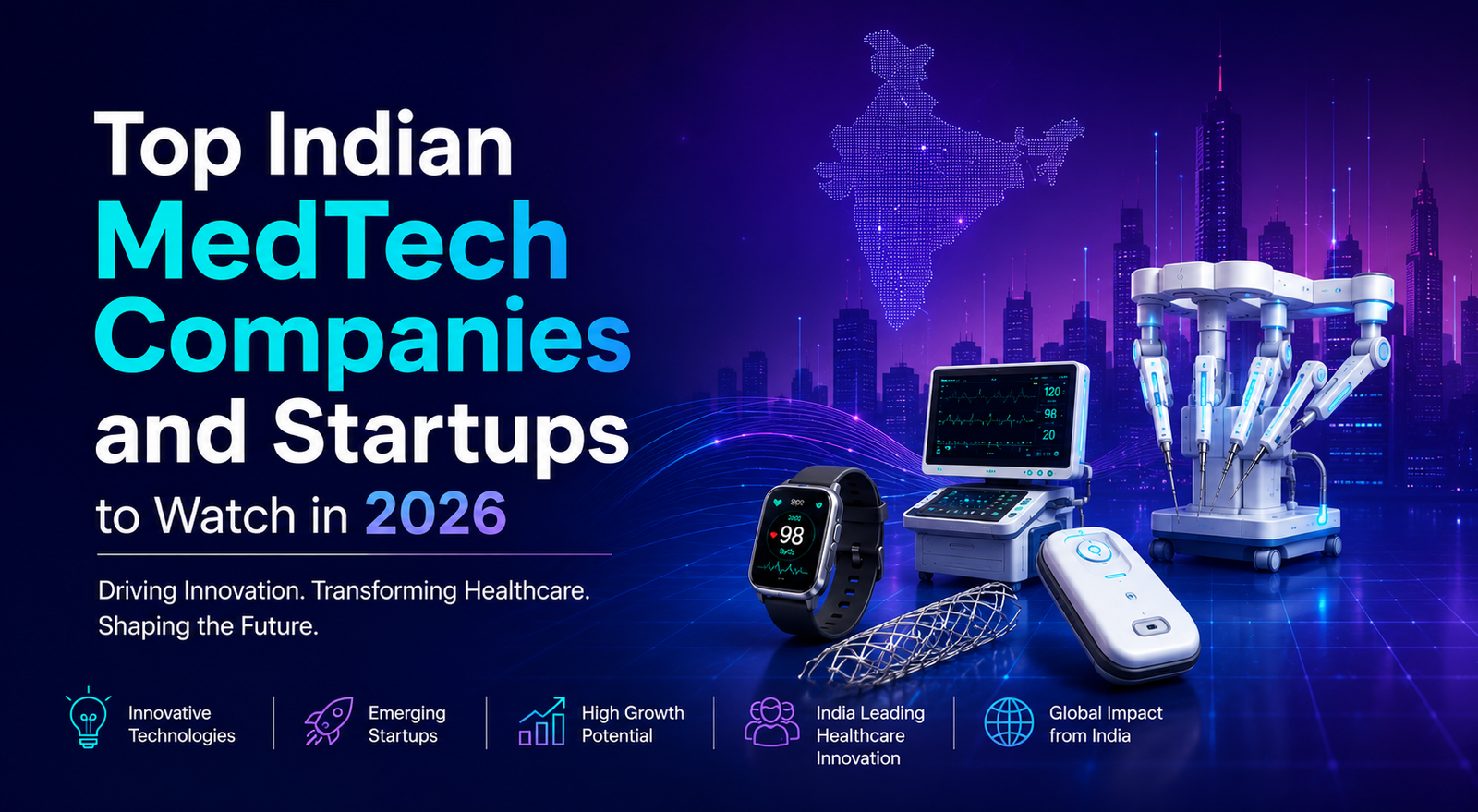
India’s medical technology (MedTech) sector is having a breakout decade. Once dependent on imports for even basic surgical consumables, India is now emerging as a global medical device manufacturing and innovation hub — driven by government initiatives like Make in India, the Production Linked Incentive (PLI) scheme, and a fast-maturing startup ecosystem. With the Indian MedTech industry now valued in the billions and growing at double-digit rates, 2026 is shaping up to be a pivotal year for domestic manufacturers, AI-diagnostics innovators, and digital health platforms alike.
Whether you’re a healthcare investor, a hospital procurement leader, or simply tracking India’s medical device innovation story, here are the Indian MedTech companies and startups worth watching this year.
Why India’s MedTech Sector Is Booming in 2026
India is home to roughly 750–800 registered medical device manufacturers, alongside thousands of health-tech and biotech startups. Several factors are fueling this growth:
- Government-backed manufacturing hubs, such as the Andhra Pradesh MedTech Zone (AMTZ) in Visakhapatnam — one of the world’s largest MedTech clusters — which today houses more than 180 manufacturers and 200+ startups generating substantial annual business.
- Policy support through PLI schemes and faster in-vitro diagnostic (IVD) approvals, encouraging local manufacturing over imports.
- A funding shift toward core MedTech and diagnostics rather than pure telemedicine, with a growing share of healthcare venture capital now flowing into device-based and AI-diagnostic startups.
- Export ambitions, with Indian-made devices now reaching over 100 countries worldwide.
Against this backdrop, a mix of established manufacturers and emerging startups are shaping India’s medical device and digital health landscape.
Established Indian MedTech Companies Leading the Way
Meril Life Sciences
A Vapi-based, home-grown leader in cardiovascular, orthopedic, and diagnostic devices, Meril has built a reputation for globally competitive stents, orthopedic implants, and IVD solutions — proof that Indian-engineered medical devices can hold their own against multinational giants.
Poly Medicure
One of India’s largest manufacturers of disposable medical devices, Poly Medicure supplies IV cannulas, catheters, and other single-use consumables to hospitals across the globe, reinforcing India’s strength in high-volume, export-grade medical disposables.
Trivitron Healthcare
A diversified MedTech player spanning diagnostics, imaging, and critical care equipment, Trivitron continues to expand its footprint across emerging markets while investing in indigenous R&D.
Molbio Diagnostics
Best known for its Truenat portable molecular diagnostic platform, Molbio has scaled point-of-care testing technology to more than 40 countries, demonstrating how Indian diagnostic innovation can address global public health needs — from tuberculosis screening to infectious disease surveillance.
Transasia Bio-Medicals
A long-standing name in in-vitro diagnostics, Transasia continues to strengthen India’s diagnostic manufacturing base with a wide portfolio of analyzers and reagents.
AI-Powered Diagnostics and Digital Health Startups to Watch
Qure.ai
A pioneer in AI-driven medical imaging, Qure.ai’s deep-learning algorithms assist radiologists in detecting conditions like tuberculosis, stroke, and lung abnormalities — and its technology is now deployed across hospitals and screening programs worldwide.
Dozee
This Bengaluru-based startup has built contactless, AI-powered patient monitoring systems that track vital signs like heart rate, respiration, and sleep through bedside sensors, feeding continuous data to clinicians for early deterioration alerts. Dozee is a strong example of how remote patient monitoring is moving from hospital ICUs into home care.
CitiusTech and Innovaccer
Both companies are scaling healthcare data and AI platforms that power interoperability, analytics, and clinical decision support for hospitals and health systems — an increasingly critical layer as India’s healthcare digitization accelerates.
Emerging Startups Shaping the Next Wave
Beyond the established names, India’s startup ecosystem is producing a steady pipeline of innovators tackling everything from affordable diagnostics to wearable robotics and biotech platforms. Incubators like IIT Madras’s MedTech Incubator (HTIC) and IIT Bombay’s ATMAN program are actively funding early-stage ventures working on AI-assisted diagnostics, wearable care devices, and regulatory-tech platforms designed to help startups navigate India’s evolving medical device compliance landscape.
This shift is notable: industry experts have observed that while many Indian MedTech startups have historically focused on lower-risk product categories, there’s growing momentum toward more ambitious, higher-value innovation — supported by university-industry collaborations and dedicated MedTech accelerator programs.
What This Means for the Broader Wound Care and Surgical Device Industry
As India’s MedTech manufacturing base matures, the ripple effects extend well beyond diagnostics and monitoring. Surgical consumables — including sutures, surgical staplers, and wound closure devices — are also benefiting from the same tailwinds: PLI-driven local manufacturing incentives, stricter quality benchmarks aligned with international standards, and rising domestic demand as hospital infrastructure expands into tier-2 and tier-3 cities. Companies across the wound closure and surgical device space are increasingly positioned to combine global manufacturing quality with the cost and scale advantages of Indian production.
Key Takeaways for 2026
- India’s MedTech sector is shifting from import dependence to export-ready manufacturing, backed by hubs like AMTZ and PLI incentives.
- AI-powered diagnostics and remote patient monitoring are among the fastest-growing MedTech sub-sectors, led by startups like Qure.ai and Dozee.
- Established device manufacturers — Meril, Poly Medicure, Trivitron, and Molbio — continue to prove that Indian-made devices can compete globally on quality and cost.
- Startup incubation programs at IITs and government bodies are pushing the ecosystem toward higher-value, more technically ambitious innovation.
- The broader momentum is creating opportunities across adjacent categories, including surgical and wound care devices, as India positions itself as a global medical technology hub by 2030.
For clinicians, hospital administrators, and healthcare investors alike, keeping an eye on these companies isn’t just about tracking India’s MedTech growth story — it’s about understanding where the next generation of affordable, scalable medical innovation will come from.
Sources: Industry data compiled from AMTZ, Tracxn, Inc42, and MedTech industry reports (2026).