

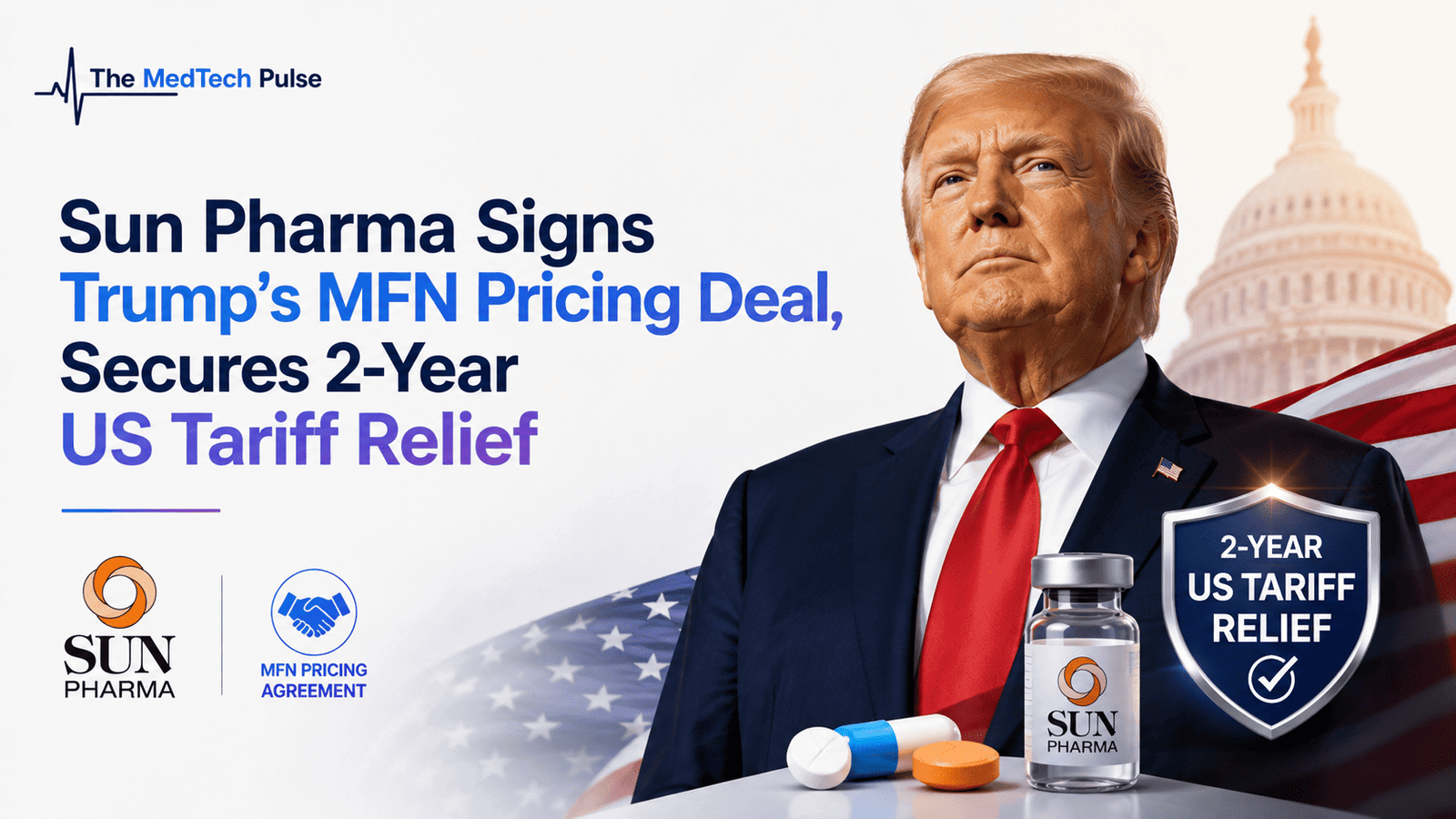
Sun Pharmaceutical Industries has become the latest — and one of the largest Indian — drugmakers to sign onto the Trump administration’s Most Favoured Nation (MFN) drug pricing programme, trading pricing concessions on US Medicaid sales for meaningful protection from a tariff threat that has been hanging over Indian pharma exporters for the better part of a year.
The agreement was announced on September 1, 2026, following a White House signing ceremony attended by Sun Pharma alongside several other global pharmaceutical manufacturers. In exchange for committing to MFN pricing, Sun Pharma secured a reprieve from potential Section 232 tariffs on innovative pharmaceutical products for more than two years — a genuinely material outcome for a company whose US business has become central to its long-term growth strategy.
What the Deal Actually Covers
The core commitment Sun Pharma made is twofold. First, the company will extend MFN pricing — prices comparable to the lowest paid in other developed nations — to state Medicaid programmes across the US for its existing products. Second, that same MFN pricing commitment will apply prospectively to future innovative medicine launches, meaning any new specialty or branded product Sun Pharma brings to the US market going forward is already locked into the same pricing discipline.
In return, the company received a delay of more than two years on potential Section 232 tariffs specifically targeting innovative pharmaceutical products — the tariff category that would have hit Sun Pharma’s fastest-growing, most profitable US segment hardest. Other terms of the agreement have not been made public, a pattern consistent with most of the individual MFN deals the administration has struck so far.
Sun Pharma’s deal was part of a nine-manufacturer announcement that also included Alcon, Astellas Pharma, BeOne Medicines, BridgeBio, CSL, Kyowa Kirin, Teva Pharmaceuticals, and UCB. As part of the broader package, several of the nine companies committed to contributing active pharmaceutical ingredients to the US government’s Strategic Active Pharmaceutical Ingredients Reserve (SAPIR) — Sun Pharma’s contribution specifically consists of 71.4 tons of clindamycin and 6.75 tons of doxycycline, both antibiotics used to treat bacterial infections. The nine companies collectively committed to invest at least $19.6 billion in US manufacturing in the near term, though the individual company-level breakdown of that figure has not been disclosed.
The Broader MFN Campaign and the Section 232 Threat
To understand why Sun Pharma signed this deal, it helps to understand the pressure campaign it sits inside. President Trump’s MFN pricing initiative has been running since early 2026, built around voluntary agreements that tie US drug prices to the lowest rates paid in other wealthy countries — with TrumpRx.gov, launched February 5, 2026, serving as the public-facing platform where patients can access MFN-linked discounts directly. With this latest round of nine agreements, the administration now has MFN deals with 26 pharmaceutical manufacturers, covering an estimated 89% of the US branded drug market — a list that already included major players like Pfizer, AstraZeneca, Eli Lilly, Novo Nordisk, Merck, and Johnson & Johnson before Sun Pharma joined. The White House’s Council of Economic Advisers has projected the cumulative MFN programme could generate $600 billion in savings over the next decade, though independent analysts caution that figure is based on the administration’s own projections and the real-world pricing impact — particularly for Medicaid recipients, who already benefit from statutory “best price” protections — remains genuinely uncertain.
The tariff side of this equation is where things get sharper for Indian pharma specifically. In September 2025, Trump announced via social media that starting October 1, 2025, the administration would impose a 100% tariff on any branded or patented pharmaceutical product, unless the company in question was actively building a US manufacturing plant. That announcement triggered an immediate, sharp selloff across Indian pharma stocks — the Nifty Pharma index dropped over 2%, with Sun Pharma, Dr Reddy’s, Cipla, Lupin, Glenmark, and several other major exporters all falling as much as 4-5% in a single session. Generic formulations were explicitly exempted from that threat, which is why India’s broader low-cost generics export business — the segment companies like Dr Reddy’s, Sun Pharma, Lupin, and Aurobindo depend on most heavily — was comparatively insulated. But the innovative, branded, and specialty drug categories were left exposed, and that’s precisely the exposure Sun Pharma’s new MFN agreement now buys more than two years of protection against, a real financial cushion given the pace at which the company has been trying to scale that specific part of its business.
Why Sun Pharma Signed: The US Specialty Business Bet
Sun Pharma’s willingness to accept MFN pricing constraints in exchange for tariff certainty makes considerably more sense once you look at how central the US specialty business has become to the company’s growth story. Sun Pharma’s dermatology-focused specialty portfolio in the US — anchored by Ilumya, Cequa, and Winlevi — has grown from near-zero five years ago to contributing over 20% of the company’s total US revenue today, according to recent equity research. That’s exactly the kind of high-margin, innovative-medicine business line that a Section 232 tariff on branded pharmaceuticals would have hit hardest, and exactly the kind of business Sun Pharma has been most aggressively investing in scaling.
That specialty ambition was underscored just months before the MFN deal by Sun Pharma’s largest-ever acquisition: an $11.75 billion all-cash deal to acquire Organon & Co., a New Jersey-based women’s health and biosimilars company spun off from Merck in 2021. Announced in April 2026, the deal — Sun Pharma paying $14.00 per share, a roughly 24% premium to Organon’s prior closing price — will nearly double Sun Pharma’s revenue to approximately $12.4 billion and lift it into the top 25 global pharmaceutical companies by revenue, while catapulting it to roughly the 7th-largest global seller of biosimilars. Sun Pharma’s own leadership described the Organon acquisition as “a logical next step in strengthening Sun Pharma’s global business” — language that fits neatly with a company making a near-complete strategic transition toward being a specialty-focused player, rather than remaining primarily a generics volume business. With Organon’s US-heavy revenue base about to be absorbed into Sun Pharma’s balance sheet, tariff certainty on branded and innovative products isn’t a nice-to-have for the company right now — it’s central to protecting the return on its single largest-ever acquisition.
Impact on Indian Pharma More Broadly
Sun Pharma is unlikely to be the last major Indian pharmaceutical company to weigh a similar trade-off. The core dynamic — accept MFN pricing discipline on US sales in exchange for tariff protection on the innovative-drug categories most exposed to Section 232 — is a template other Indian pharma majors with meaningful US specialty or branded portfolios will now have to evaluate on their own merits. Dr Reddy’s and Cipla, both of which have been building out more complex generics and specialty pipelines in the US alongside their traditional generics base, sit in a broadly similar position: heavily exposed to the same tariff threat, and facing the same underlying choice about whether pricing concessions are worth the certainty that comes with them.
It’s worth noting that India’s pure-generics exporters — the volume business that still represents the bulk of India’s roughly $28 billion in annual pharma exports — remain comparatively insulated regardless of the MFN conversation, since generic formulations were exempted from the original Section 232 tariff threat. The MFN calculus specifically matters most for the innovative, specialty, and branded segments of Indian pharma companies’ US businesses — a smaller but fast-growing and increasingly strategically important slice of the sector’s overall revenue.
Market Reaction: A Muted, Slightly Negative Response
Investors did not treat the MFN agreement as unambiguously good news. Sun Pharma shares fell more than 2% on September 1, trading around ₹1,936 on the NSE shortly after the announcement — a reaction that reflects the market pricing in the cost of pricing concessions on Medicaid and future launches more heavily, in the near term, than the value of multi-year tariff certainty. That’s a fairly typical pattern across the broader MFN deal cycle: markets have generally treated these agreements as a trade-off rather than a clean win, weighing near-term margin pressure from mandated pricing discipline against the harder-to-quantify benefit of removing tariff uncertainty from forward guidance.
For context, Sun Pharma’s stock had been trading closer to ₹1,885 in the weeks prior, with a market capitalisation above ₹4.5 lakh crore, making it comfortably the largest pharmaceutical company listed in India by market cap. A roughly 2.5% single-day move on deal news, while not trivial, is well within the range of normal volatility for a stock of that scale reacting to a genuinely two-sided piece of news.
What This Means Going Forward for Indian Drugmakers in the US
A few things are now reasonably clear for Indian pharmaceutical companies with meaningful US ambitions:
- Tariff exposure is no longer a hypothetical risk to model around — it’s an active negotiation every company with branded or specialty US products will eventually have to have. With 26 manufacturers now holding MFN deals covering 89% of the branded US drug market, the pressure on remaining large pharma companies — Indian or otherwise — to strike similar agreements is only going to intensify.
- The trade-off is real, not cosmetic. MFN pricing on Medicaid and future launches is a genuine constraint on US pricing power, not a symbolic gesture — companies weighing whether to sign need to model the actual margin impact against the tariff exposure they’re avoiding, on a product-by-product basis.
- Scale and specialty exposure determine urgency. Companies like Sun Pharma, with a large and rapidly growing branded/specialty US revenue base (and now Organon’s book of business layered on top), have considerably more at stake in this negotiation than smaller, purely generics-focused exporters who remain largely outside the tariff’s original scope.
- Expect more Indian names to follow. Given the pattern of the administration systematically working through the world’s largest drug manufacturers — the White House noted MFN deals now cover 14 of the world’s 17 biggest pharmaceutical companies — it’s a reasonable expectation that other large Indian players with significant US innovative-medicine ambitions will face the same decision point before long.
Conclusion
Sun Pharma’s MFN agreement is less a standalone pricing story than a signal of how central the US market — and specifically its higher-margin specialty and innovative-medicine segments — has become to the strategy of India’s largest pharmaceutical company. Coming just months after the company’s landmark $11.75 billion Organon acquisition, the timing makes the calculus clear: two years of tariff certainty is worth more to Sun Pharma right now than the pricing flexibility it’s giving up, at least while it’s in the process of digesting its largest-ever bet on the US specialty business. Whether other major Indian drugmakers reach the same conclusion — and how quickly — will be one of the more consequential storylines for Indian pharma’s US strategy through the rest of 2026 and into 2027.
References
- Business Today — How Sun Pharma Is Avoiding a Tariff Hit by Agreeing to MFN Pricing for US Medicaid (https://www.businesstoday.in/industry/pharma/story/how-sun-pharma-is-avoiding-a-tariff-hit-by-agreeing-to-mfn-pricing-for-us-medicaid-552560-2026-09-01)
- The White House — Fact Sheet: President Trump Announces Deal with Nine Additional Pharmaceutical Manufacturers to Lower Drug Prices for Americans (https://www.whitehouse.gov/fact-sheets/2026/08/fact-sheet-president-donald-j-trump-announces-deal-with-nine-additional-pharmaceutical-manufacturers-to-lower-drug-prices-for-americans/)
- Newsweek — Donald Trump Announces New Pharma Deal: List of Drugs Getting Prices Reduced (https://www.newsweek.com/trump-pharma-deal-drug-prices-reduced-list-medications-12387625)
- Office Newz — Trump Announces Drug Pricing Deals with India’s Sun Pharma and 8 More Drug Companies (https://us.officenewz.com/trump-announces-drug-pricing-deals-with-indias-sun-pharma-and-8-more-drug-companies/)
- EquityPandit — Sun Pharma Shares Fell 2% Over US Drug Pricing Deal (https://www.equitypandit.com/sun-pharma-shares-fell-2-over-us-drug-pricing-deal/)
- CBS News — Trump Announces Agreements with 9 More Drugmakers to Lower Prices for Medicaid Recipients (https://www.cbsnews.com/news/trump-announces-agreements-with-9-more-drugmakers-to-lower-prices-for-medicaid-recipients)
- Republic World — Indian Pharma Stocks Take a Bitter Pill: Sun Pharma, Dr Reddy, Cipla Share Price Plunge Up to 5% on Trump’s Tariff Shock (https://www.republicworld.com/business/indian-pharma-stocks-take-a-bitter-pill-sun-pharma-dr-reddy-cipla-share-price-plunge-up-to-5-on-trumps-tariff-shock)
- CNBC — Indian Drugmaker Sun Pharma to Buy US Firm Organon in $11.75 Billion Deal (https://www.cnbc.com/2026/04/27/indian-drugmaker-sun-pharma-to-buy-us-firm-organon-in-11point75-billion-deal.html)
- Fierce Pharma — Sun Pharma Strikes Biopharma’s Largest Deal of ’26 with $11.75B Buyout of Organon (https://www.fiercepharma.com/pharma/sun-pharma-strikes-biopharmas-largest-deal-26-1175b-buyout-organon)
- Organon — Sun Pharma Signs Definitive Agreement to Acquire Organon (https://www.organon.com/news/sun-pharma-signs-definitive-agreement-to-acquire-organon/)
- Univest — Top 3 Pharma Stocks in India 2026: Sun Pharma, Dr Reddy’s, Cipla (https://univest.in/blogs/pharma-stocks-india-2026)
Note: This article reflects publicly available information as of September 2, 2026. Terms of the Sun Pharma–White House agreement beyond those officially disclosed remain confidential, and the Organon acquisition remains subject to stockholder approval and regulatory clearances, with closing targeted for early 2027. Share price figures are intraday/near-announcement snapshots and will have moved since publication; readers should check current market data before making investment decisions. This article is not financial advice.