

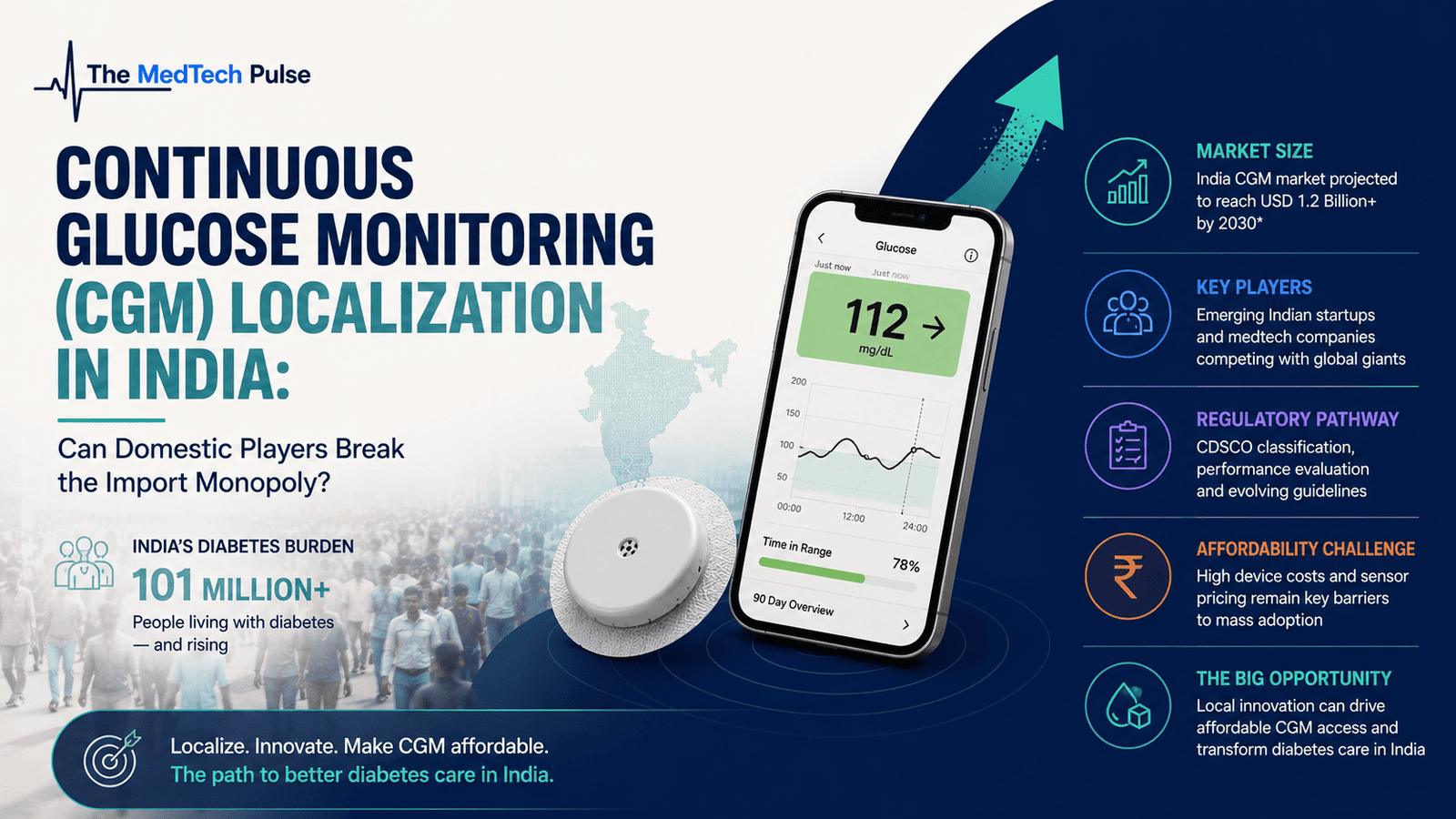
Continuous glucose monitoring — a small wearable sensor that tracks blood sugar in real time, without finger-pricks — has gone from a niche clinical tool for Type 1 diabetics to something closer to a mainstream lifestyle product in urban India, marketed alongside sleep trackers and fitness rings. The market is genuinely growing fast. What’s less discussed is who actually owns the sensor technology underneath the sleek apps — and on that question, India’s CGM story is still mostly an import story wearing a domestic-brand wrapper.
Here’s an honest look at the market size, the players, and how far “localization” has actually gone.
Why CGM Matters So Much for India
The scale of India’s diabetes burden is genuinely staggering, and it’s the entire reason this device category matters. The International Diabetes Federation’s most recent Diabetes Atlas put the number of Indian adults living with diabetes at 89.8 million in 2024, with that figure forecast to climb to 156.7 million by 2050. Layer on top of that an estimated 136 million pre-diabetic adults, and India isn’t just a large CGM market opportunity — it may be the single highest-potential CGM market in Asia over the coming decade, given the sheer number of people who could plausibly benefit from continuous monitoring rather than occasional finger-prick testing.
Digital infrastructure is also unusually favourable here: the Ayushman Bharat Digital Mission has issued roughly 689 million ABHA health IDs, creating a data-exchange backbone that CGM platforms can plug into for seamless glucose-data sharing with doctors and health records — infrastructure most CGM markets globally simply don’t have.
The Market Size: Wildly Different Numbers, Same Direction
Ask five research firms how big India’s CGM market actually is and you’ll get five different answers — a sign of how new and fast-evolving this category still is. IMARC Group puts the 2025 market at USD 240.6 million, projected to reach USD 359.4 million by 2034. Mordor Intelligence estimates USD 207.52 million in 2025, growing to USD 399.69 million by 2031. Grand View Research’s more conservative estimate puts the device-only market at just USD 45.92 million in 2025, rising to USD 105.67 million by 2033. Knowledge Sourcing’s estimate is smaller still — around USD 5.5 million in 2026, rising sharply to USD 16 million by 2031.
The wide spread mostly reflects different scope definitions — some estimates count only medical-grade CGM devices sold through clinical channels, while others fold in the fast-growing consumer wellness segment sold direct-to-consumer online. What’s consistent across every estimate, though, is the growth direction: double-digit compound annual growth through the early 2030s, driven by rising diabetes prevalence, growing consumer wellness awareness, and gradually improving affordability.
Who Actually Makes the Sensors: Still Overwhelmingly Global
This is the uncomfortable part of the localization story. The core sensor technology inside virtually every CGM device sold in India — medical-grade or consumer-wellness — still comes from a small handful of global manufacturers: Abbott Laboratories (FreeStyle Libre), Dexcom, Medtronic, and F. Hoffmann-La Roche. These four companies have built their dominance over more than a decade of sensor R&D, enzymatic chemistry patents, and manufacturing scale that no Indian company has yet replicated end to end.
Ultrahuman: India’s Biggest CGM Brand, But Not a Sensor Manufacturer
Ultrahuman, the Bengaluru-based health-tech company founded in 2019 by Mohit Kumar and Vatsal Singhal, is by far the most visible Indian name in this space — its M1 device has become almost synonymous with CGM for India’s urban wellness-conscious consumers, priced around ₹8,000–8,700 for a two-sensor pack.
But it’s important to be precise about what Ultrahuman actually builds. The company’s own product documentation is transparent about this: the Ultrahuman M1 platform runs on third-party manufactured CGM sensors — historically Abbott’s FreeStyle Libre, and more recently GlucoRx’s Vixxa 2 sensor for the M1 Lite subscription in India. Ultrahuman’s genuine innovation is the software layer — the app, the metabolic scoring, the integrations with Google Fit, Apple Health, Oura, Garmin, and Fitbit, and the coaching ecosystem wrapped around the data. That’s a real and valuable business, and it has done more than any other Indian company to popularise CGM as a mainstream wellness category. But it is not, today, a story of India manufacturing its own glucose sensor chemistry — it’s a story of India building the best consumer software experience on top of imported sensor hardware.
Tracky and the Early Domestic Hardware Attempts
A genuinely hardware-first domestic entrant does exist: Tracky, by DrStore, is described as India’s first Bluetooth-enabled CGM, built around a reusable transmitter paired with a 14-day disposable sensor, positioned specifically around affordability for Indian users. This is closer to the kind of domestic hardware innovation the “break the import monopoly” framing implies — a device where the transmitter and product design, not just the software layer, is being built for the Indian market specifically. Compared to Ultrahuman’s global scale and brand recognition, though, Tracky remains a much smaller, earlier-stage player, and independent, large-scale clinical accuracy data comparable to what Abbott and Dexcom have published globally isn’t yet widely available for domestic entrants at this stage.
Where the PLI Scheme Fits In
There is a real, if modest, domestic assembly layer building underneath the consumer brands. Industry analysis linked to the government’s medical device Production Linked Incentive scheme indicates that PLI-subsidised domestic sensor assembly is already having a measurable effect on pricing — lowering average selling prices for CGM devices in India by an estimated 10–30%. That’s a meaningful number for affordability, but it’s worth being precise about what “assembly” means here versus full sensor manufacturing: it typically describes final-stage device assembly and packaging happening on Indian soil, using core sensor components and enzymatic membrane technology still largely developed and manufactured abroad — the same assembly-versus-deep-manufacturing distinction that the Indian government’s own PLI review flagged as a broader issue across the medical device sector.
The Real Barriers to Deeper Localization
A few structural reasons explain why India hasn’t yet produced a true, vertically-integrated domestic CGM sensor manufacturer the way it has for some other device categories:
- Sensor chemistry is genuinely hard IP. The enzymatic glucose-oxidase membrane technology at the heart of every CGM sensor represents well over a decade of patented R&D at Abbott, Dexcom, and Medtronic. Replicating that chemistry domestically — not just assembling imported sensor components — requires a different order of biomedical materials science investment than most Indian MedTech startups have raised to date.
- Regulatory validation is capital-intensive. A genuinely new domestic sensor would need extensive clinical accuracy trials (measured against the industry-standard Mean Absolute Relative Difference metric) before CDSCO approval and before any hospital or endocrinologist would trust it over an established global brand — a long, expensive validation runway that assembly-based business models can currently skip.
- The consumer wellness segment doesn’t require it. Because companies like Ultrahuman have found a profitable business model wrapping software around licensed or third-party sensors, there’s less immediate commercial pressure driving investment into ground-up domestic sensor manufacturing compared to a category where the hardware itself is the entire value proposition.
What Would Actually Constitute “Breaking the Monopoly”
For India’s CGM sector to move from assembly and software-layer innovation to genuine import substitution, three things would need to happen roughly in this order:
- A domestic company (or a CSIR-linked public-private effort, similar to the BIRSA 101 or Supernova stent retriever models covered elsewhere in this series) would need to develop and clinically validate its own sensor chemistry, not just its own transmitter and app.
- That sensor would need to clear CDSCO’s device-specific accuracy and safety bar with published clinical data comparable to what FreeStyle Libre and Dexcom G7 have published internationally.
- Pricing would need to undercut the current ₹8,000+ per sensor-pack range meaningfully enough to reach India’s much larger Tier-2/3 and rural diabetic population — most of whom are currently priced out of CGM entirely and rely on periodic fingerstick testing, if they monitor glucose at all.
The Bottom Line
India’s CGM market is one of the clearest examples in Indian MedTech of a category where consumer adoption and brand visibility have sprinted ahead of genuine manufacturing localization. Ultrahuman has done more than any company to make CGM a mainstream health conversation in urban India — but it is, honestly described, a software and consumer-experience company sitting on top of imported sensor hardware, not a sensor manufacturer. PLI-linked domestic assembly is shaving real cost off retail pricing, and early hardware-first entrants like Tracky point toward where genuine localization could eventually go. But breaking Abbott, Dexcom, and Medtronic’s grip on the underlying sensor technology — the way BIRSA 101 is attempting to do for gene therapy, or Supernova for neurovascular devices — hasn’t happened yet in glucose monitoring, and won’t until an Indian company puts real capital behind sensor-level R&D rather than the app layer sitting on top of it.
References
- IMARC Group — India Continuous Glucose Monitoring Devices Market 2034 (https://www.imarcgroup.com/india-continuous-glucose-monitoring-devices-market)
- Mordor Intelligence — India Continuous Glucose Monitoring (CGM) Market Size & Share Analysis 2026–2031 (https://www.mordorintelligence.com/industry-reports/india-continuous-glucose-monitoring-market)
- Grand View Research — India Continuous Glucose Monitoring Devices Market Report, 2033 (https://www.grandviewresearch.com/industry-analysis/india-continuous-glucose-monitoring-devices-market-report)
- Knowledge Sourcing Intelligence — India Continuous Glucose Monitoring Market: Forecast 2031 (https://www.knowledge-sourcing.com/report/india-continuous-glucose-monitoring-market)
- IndexBox — Continuous Glucose Monitoring Systems Market in India (https://www.indexbox.io/store/india-continuous-glucose-monitoring-systems-market-analysis-forecast-size-trends-and-insights/)
- Wikipedia — Ultrahuman (https://en.wikipedia.org/wiki/Ultrahuman)
- Ultrahuman — M1 Pricing in India (https://www.ultrahuman.com/in/pricing/)
- Ultrahuman Blog — Ultrahuman M1: A Game-Changer for Metabolic Health in India (https://www.ultrahuman.com/blog/ultrahuman-m1-a-game-changer-for-metabolic-health-in-india/)
- International Diabetes Federation — IDF Diabetes Atlas, 11th Edition (https://diabetesatlas.org)
Note: Market size estimates vary significantly across research firms due to differing scope definitions (medical-grade vs. consumer-wellness CGM). Figures on PLI-linked pricing effects and domestic sensor-assembly are drawn from industry market analysis current as of mid-2026 and should be verified against official Department of Pharmaceuticals data where precision is required.