

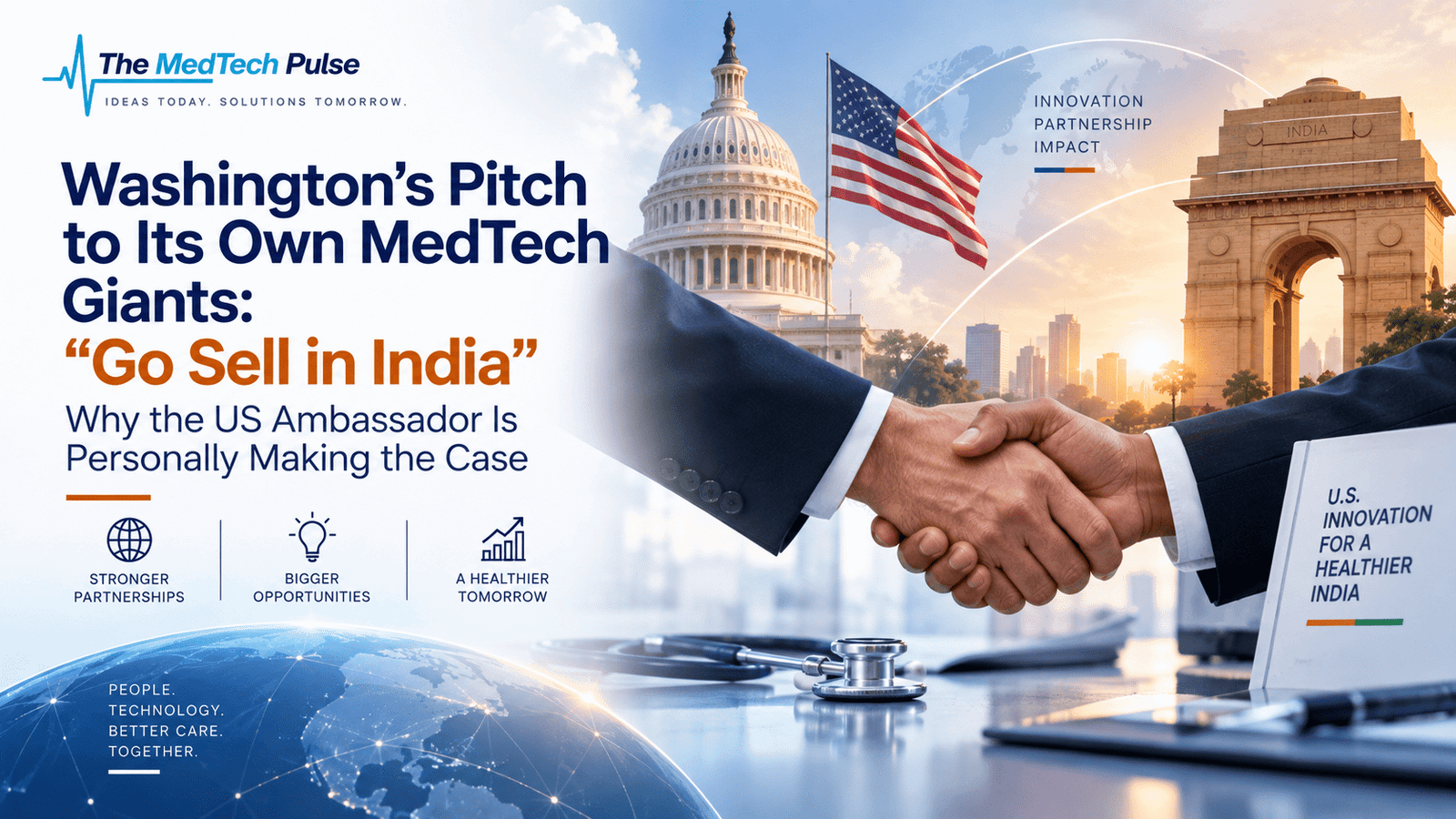
Trade diplomacy doesn’t usually happen over a boardroom table with device makers instead of ministers. But that’s exactly what played out at the US Embassy in New Delhi on September 4, 2026, when US Ambassador to India Sergio Gor sat down with executives from leading American medical technology companies, not to announce a deal, but to actively sell them on India as a market worth expanding into. It’s a notable role for an ambassador to play personally, and it says as much about where India-US trade relations currently stand as it does about India’s own healthcare technology ambitions.
What Actually Happened
Gor described the meeting himself, writing on social media platform X shortly afterward: “Productive discussion with leading U.S. MedTech companies on unlocking greater opportunities in India. Expanding market access and increasing U.S. exports will strengthen our commercial ties and deepen U.S.-India cooperation in health and medical technology.”
The framing here is worth noting closely, Gor positioned the conversation around increasing US exports to India specifically, not simply generic “cooperation.” That’s consistent with a broader message he’d delivered just a day earlier, on the sidelines of the 66th Annual Session of the Automotive Component Manufacturers Association of India (ACMA), where he described the ambition behind the current trade relationship in explicitly reciprocal terms: “As our governments work through the details of our trade relationship, we should aim to create an environment where American suppliers and technology can freely access the market and be sold to Indian manufacturers, while Indian firms can compete fairly in the US market.”
That’s a two-way ask, not a one-sided market-opening request, American MedTech companies want easier access to sell into India, while Indian manufacturers want a fair shot at competing in the US market too. Gor also highlighted that the US Embassy in India had led American diplomatic missions globally in attracting new investment, a detail that frames this MedTech meeting as part of a broader, sustained pattern of commercial diplomacy rather than an isolated event.
The Bigger Trade Context
This meeting didn’t happen in isolation. Gor’s public comments in the days surrounding it made clear that India-US trade engagement is currently running on multiple tracks simultaneously. He noted that Commerce and Industry Minister Piyush Goyal was scheduled to travel to the United States within weeks for G20-related engagements, describing the two governments as “working very closely together” with “a lot happening” across the broader trade relationship. Addressing the ACMA session, Gor characterised the overarching goal in careful, deliberate language: building a trade relationship that is “fair, reciprocal, and mutually beneficial”, phrasing that echoes the kind of balanced-access language that has defined much of the recent India-US trade negotiation cycle, including the ongoing conversations around tariffs, market access, and sector-specific carve-outs.
For MedTech specifically, that reciprocity framing matters. It suggests the sector is being treated as a genuine two-way negotiation, American device makers gaining smoother access to India’s fast-growing healthcare market, in exchange for Indian manufacturers securing a fairer competitive footing in the US.
Why India, and Why Now
India’s appeal to American MedTech companies rests on a straightforward but powerful combination: a healthcare market that’s expanding quickly, and a persistent, well-documented dependence on imports in exactly the device categories where US companies are strongest.
India’s medical device import bill has been running into the tens of thousands of crores annually, concentrated heavily in a relatively narrow list of high-value categories, diagnostic imaging equipment (MRI and CT systems specifically), cardiac pacemakers, implants, and critical-care devices among them. These are precisely the segments where major American MedTech companies, device makers with deep expertise in imaging, cardiovascular technology, and critical-care equipment, have historically been strongest globally. For US companies, that import dependence represents a substantial, still largely untapped commercial opportunity; for India, closing that gap through a mix of imports, technology partnerships, and eventual domestic manufacturing investment is a stated national priority running through nearly every major Indian MedTech policy conversation this year.
That alignment of interests, American companies wanting greater access to a large, underpenetrated market, and India wanting more advanced technology, investment, and eventually manufacturing partnerships in exactly the categories it’s trying to localise, is what makes this kind of high-level commercial diplomacy genuinely purposeful rather than symbolic.
How This Connects to India’s Domestic MedTech Push
It’s worth reading Gor’s meeting alongside, not against, India’s own parallel push to build domestic MedTech manufacturing capacity. Commerce and Industry Minister Piyush Goyal has separately been courting Indian manufacturers with commitments like 100% government funding for advanced testing equipment, explicitly aimed at helping Indian device makers compete on quality and technology rather than price alone. Union Health Minister J.P. Nadda has been pushing an “AI in MedTech” roadmap focused on scaling domestic diagnostics capability and building a globally competitive manufacturing ecosystem. And India’s Production Linked Incentive scheme has been steadily bringing MRI, CT, and other high-value device production onto Indian soil.
Rather than being in tension with greater American market access, these efforts are arguably complementary: American technology partnerships, joint ventures, and increased US MedTech investment into India, the kind of engagement Gor’s meeting is designed to encourage, can directly feed India’s own stated ambition to build deeper domestic manufacturing capability, rather than simply displacing it. Technology transfer, co-development, and manufacturing partnerships with established US device makers is, in fact, one of the more realistic near-term pathways for India to close its gap in the hardest, most technically demanding device categories , precisely the ones Goyal himself has called out as needing “technology partnerships” and “joint ventures” with global innovators.
What to Watch Next
The real test of this meeting’s significance will be whether it translates into concrete outcomes: new US MedTech investment announcements in India, expanded distribution or manufacturing partnerships, or specific regulatory or tariff commitments emerging from the broader India-US trade talks Goyal is set to continue in the US later this month. High-level commercial diplomacy of this kind typically sets direction rather than delivering immediate deliverables, the ambassador convening MedTech executives is a signal of priority, not a signed agreement.
For India’s healthcare sector, the meeting is best read as one more data point in a broader, increasingly active period of India-US MedTech engagement, sitting alongside India’s own domestic manufacturing push, its regulatory modernisation efforts at CDSCO, and its stated ambition to reduce dependence on imported diagnostic imaging, implants, and critical-care devices. Whether American companies respond to Gor’s pitch with genuine expanded investment, or whether this remains primarily a market-access conversation focused on exports rather than manufacturing partnerships, will shape how much this specific meeting ends up mattering to India’s broader MedTech trajectory over the coming year.
References
- ANI News — US Envoy Sergio Gor Meets American MedTech Companies to Boost India Health Ties (https://aninews.in/news/world/asia/us-envoy-sergio-gor-meets-american-medtech-companies-to-boost-india-health-ties20260904184541/)
- The Tribune — US Envoy Sergio Gor Meets American MedTech Companies to Boost India Health Ties (https://www.tribuneindia.com/news/bilateral-trade/us-envoy-sergio-gor-meets-american-medtech-companies-to-boost-india-health-ties)
- Asianet Newsable — US Envoy Holds Talks With MedTech Firms to Boost Trade Ties With India (https://newsable.asianetnews.com/world/us-envoy-holds-talks-with-medtech-firms-to-boost-trade-ties-with-india-articleshow-v81n2yu)
- Medical Buyer — US Envoy Courts American MedTech Companies for India Expansion (https://medicalbuyer.co.in/us-envoy-courts-american-medtech-companies-for-india-expansion/)
- Indian Defence News — US Envoy Sergio Gor Pushes MedTech Cooperation to Strengthen India-US Trade (https://www.indiandefensenews.in/2026/09/us-envoy-sergio-gor-pushes-medtech.html)
Note: This article reflects publicly available information as of the September 4, 2026 meeting. Specific outcomes, investment commitments, or follow-on agreements from this discussion had not been publicly disclosed at the time of writing.