

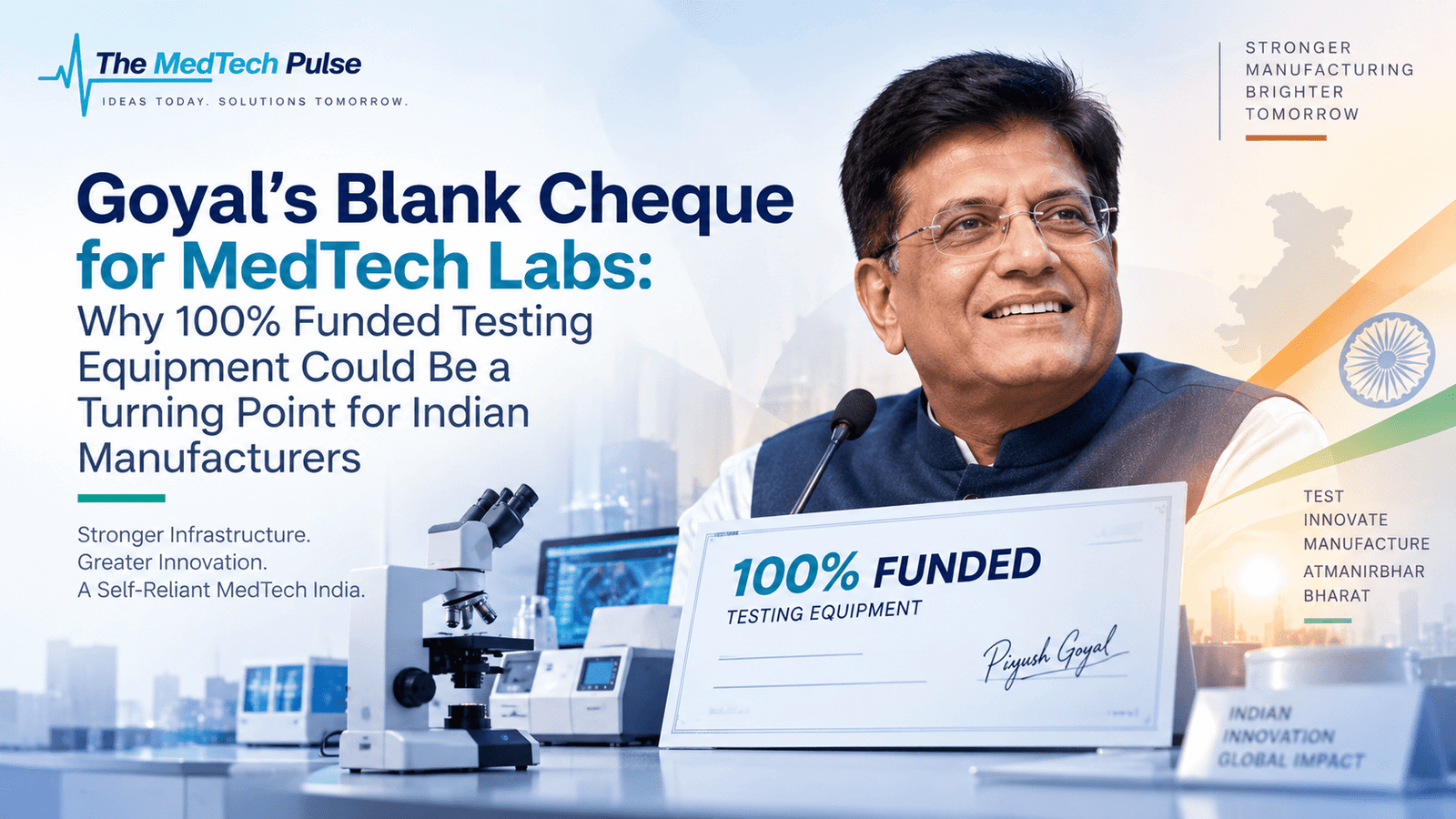
Every Indian medical device manufacturer trying to sell into a demanding export market eventually runs into the same wall: before a device can be certified for the US, Europe, or Japan, it has to be tested against exacting international benchmarks and the equipment capable of running those tests is expensive enough that many Indian companies, particularly smaller ones, simply can’t justify buying it themselves. Commerce and Industry Minister Piyush Goyal has just offered to remove that wall entirely. Addressing two pharma industry events in New Delhi, Goyal said the government is ready to fund 100% of the cost of acquiring advanced testing equipment for the medical device sector and the industry’s largest trade body has already responded with a public welcome.
What Goyal Actually Said
Goyal’s offer was specific and, notably, framed as open-ended rather than tied to a particular scheme with capped funding. “From BIS (Bureau of Indian Standards), we are willing to support 100 per cent cost of the best testing equipment for your equipment,” he said. “100 per cent government of India will fund the acquisition of testing equipment demand from us, there is no proposal from you. And we’ll set up the most modern labs.”
That last line is worth reading carefully: Goyal was explicit that the offer is currently unmet by industry demand “there is no proposal from you” suggesting this isn’t a programme industry has been queuing up for, but one the government is actively trying to get manufacturers to actually use. He tied the ask directly to building what he called a critical component ecosystem, framing shared testing infrastructure as the mechanism that would let Indian-made devices be “tested, benchmarked to the best in the world, certified and demonstrated to global customers” language that positions this squarely as an export-readiness initiative, not just a domestic quality upgrade.
Goyal’s broader remarks at the event extended beyond testing infrastructure into India’s ambitions as a medical value tourism destination he noted that around 3.5 million patients have benefited from India’s medical value tourism ecosystem over the past seven years, and said the country should aim to grow that to 10 million international patients annually, provided the industry maintains high standards of quality, ethics, and patient care. He also called for stronger technology partnerships, joint ventures with global innovators, and improvements to India’s design, copyright, and patent law ecosystem positioning the testing equipment offer as one piece of a broader push to make India a genuine hub of medical innovation, not simply a low-cost manufacturing base.
AiMeD’s Response: A Long-Standing Ask, Finally Answered
The Association of Indian Medical Device Industry (AiMeD) didn’t hold back its enthusiasm. In a statement released September 10, 2026, the association welcomed the announcement as a validation of years of advocacy work, not a surprise policy gift.
Rajiv Nath, Forum Coordinator of AiMeD, put it directly: “This announcement is a recognition of AiMeD’s persistent asks and lobbying efforts to strengthen India’s medical device ecosystem. It validates our shared vision of making India one of the top five global medical device manufacturing hubs.” That’s a meaningful framing from an industry body that has, across the past several years, repeatedly flagged testing infrastructure gaps, sterilisation loan-licence duplication, and CDSCO process friction as structural barriers to Indian manufacturers competing internationally, several of which have seen partial resolution through CDSCO’s own regulatory reforms this year.
AiMeD’s core argument for why this specific intervention matters is about competitive positioning, not just cost savings: the association has consistently argued that Indian manufacturers have historically competed primarily on price, while struggling to compete on quality and technology credentials against established global players. Shared, internationally accredited testing facilities reducing the capital burden of expensive testing equipment for individual companies is the kind of infrastructure that lets Indian manufacturers shift the basis of competition from “cheapest” to “most technically credible,” a distinction that matters enormously when trying to win contracts in regulated markets like the US, EU, or Japan rather than only price-sensitive developing markets.
Why This Specifically Helps MSMEs and Startups
The funding offer’s practical impact will be felt most acutely by small and medium enterprises and early-stage device startups precisely the segment of Indian MedTech that has historically been priced out of world-class testing infrastructure. Advanced testing equipment for medical devices, electromagnetic compatibility (EMC) chambers, biocompatibility testing systems, mechanical fatigue testing rigs, and equivalent internationally benchmarked instrumentation, routinely runs into the crores of rupees per unit, an investment that’s straightforward for an established multinational device manufacturer but often simply unaffordable for a smaller Indian company or startup trying to get a single product through international certification.
Under a shared infrastructure model, which is what Goyal’s remarks specifically pointed toward, calling for “shared testing infra facilities” rather than funding individual company purchases, a startup or MSME wouldn’t need to buy this equipment outright at all. It would access world-class testing capability through a shared facility, dramatically lowering the capital barrier to getting a device internationally certified, and meaningfully accelerating the product development timeline that currently gets bottlenecked waiting for testing slots or investment approval.
This connects directly to India’s existing shared-infrastructure model already operating at scale: the Andhra Pradesh MedTech Zone (AMTZ) in Visakhapatnam has built exactly this kind of common testing and certification infrastructure, including a TÜV Rheinland-operated EMC and safety testing facility, specifically to lower the barrier for smaller manufacturers who can’t justify standalone testing equipment investment. Goyal’s funding offer, if it materialises into a structured programme, would likely expand and multiply this model across more locations and more equipment categories, rather than replacing what already exists at AMTZ.
The Catch: Industry Needs to Actually Ask
The most striking detail in Goyal’s remarks is also the biggest open question hanging over this announcement: he explicitly said there’s currently no formal proposal from industry to actually access this funding. That’s an unusual thing for a minister to say about a major funding offer, it suggests the mechanism for accessing this support isn’t yet fully built out, or that industry associations and manufacturers haven’t yet organised a coordinated request detailing what equipment, at what facilities, and at what scale.
For AiMeD and individual manufacturers, the practical next step is clear: converting this verbal commitment into a concrete proposal, specifying which testing categories are the highest priority gaps (EMC, biocompatibility, sterility validation, mechanical durability), where shared facilities should be located to maximise MSME and startup access, and how eligibility and allocation would be structured across a fragmented industry with wildly different company sizes and product categories.
What This Means for Indian MedTech’s Export Ambitions
This announcement fits squarely into the broader pattern running through Indian MedTech policy in 2026, a government actively trying to remove structural barriers between Indian manufacturing capability and genuine international competitiveness, running alongside the PLI scheme’s manufacturing incentives, CDSCO’s regulatory modernisation, and AMTZ’s expanding shared-infrastructure model. Testing infrastructure has long been one of the quieter but more consequential bottlenecks in this chain, a device can be well-designed and well-manufactured, but without access to internationally accredited testing and certification, it simply can’t compete for regulated export markets.
If this funding offer converts into an actual, accessible programme, rather than remaining a verbal commitment awaiting an industry proposal that hasn’t yet arrived, it could meaningfully accelerate the timeline for more Indian device companies to follow the path already set by firms like Sahajanand Medical Technologies, whose Supraflex Cruz stent recently cleared Health Canada’s demanding Class IV certification. The ambition Goyal and AiMeD are both describing, India as a genuine top-five global medical device manufacturing hub, depends less on manufacturing capacity alone and more on whether Indian devices can consistently clear the world’s toughest testing and certification bars. This announcement is a step toward removing the cost barrier to doing exactly that; whether it becomes a functioning programme now depends on industry turning up with the proposal Goyal says he’s still waiting for.
References
- Daily Excelsior – Develop Best Medical Devices for Global Customers; Govt Will 100 pc Fund Acquisition of Testing Equipment: Goyal (https://www.dailyexcelsior.com/develop-best-medical-devices-for-global-customers-govt-will-100-pc-fund-acquisition-of-testing-equipment-goyal/)
- Deccan Chronicle – Goyal Calls Pharma Industry to Make India Medical Hub for Global Patients (https://www.deccanchronicle.com/business/goyal-calls-pharma-industry-to-make-india-medical-hub-for-global-patients-1985536)
- ArdorComm Media Group – India Must Build World-Class Medical Devices, Government to Fund Testing Equipment Fully: Goyal (https://ardorcomm-media.com/india-must-build-world-class-medical-devices-government-to-fund-testing-equipment-fully-goyal/)
- Medical Buyer – AiMeD Welcomes Government’s Support for Advanced Testing Infrastructure (https://medicalbuyer.co.in/aimed-welcomes-governments-support-for-advanced-testing-infrastructure/)
- MedGate Today – AiMeD Welcomes Government’s Full Support for Advanced Testing Infrastructure (https://medgatetoday.com/aimed-welcomes-governments-full-support-for-advanced-testing-infrastructure)
- MedGate Today – Piyush Goyal: Government to Fully Fund Medical Device Testing Equipment for Global Standards (https://medgatetoday.com/piyush-goyal-government-to-fully-fund-medical-device-testing-equipment-for-global-standards)
Note: This article reflects publicly available information as of September 10, 2026. At the time of writing, the funding offer had been announced verbally by Minister Goyal but had not yet been formalised into a structured scheme with defined eligibility criteria, application process, or budget allocation; readers should watch for a formal Department for Promotion of Industry and Internal Trade (DPIIT) or BIS notification for implementation details.