

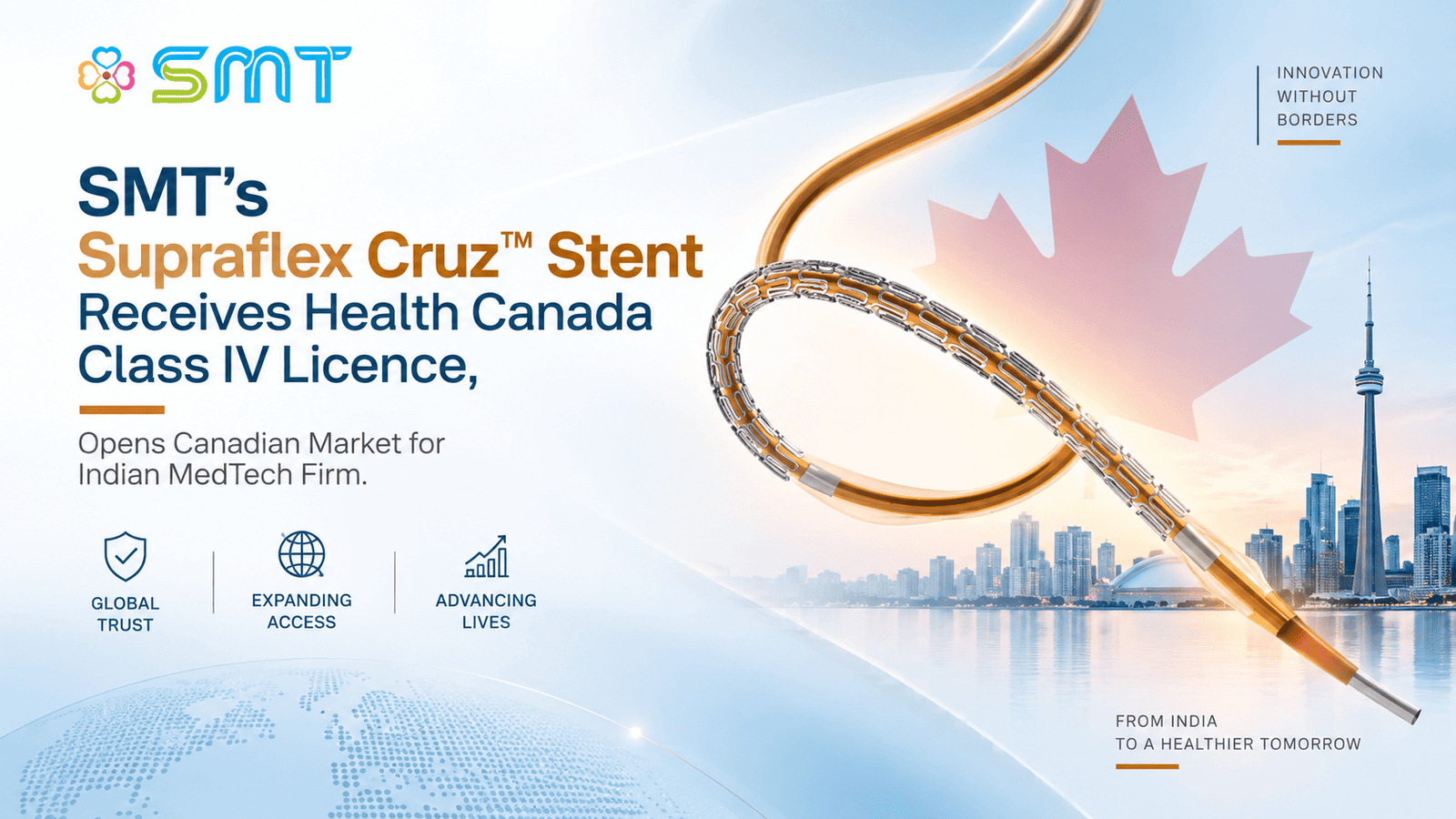
For a certain category of Indian medical device company, the real test of global credibility isn’t a domestic launch, it’s whether a regulator in North America or Europe is willing to put its name behind the product. Sahajanand Medical Technologies Limited (SMT), the Surat-headquartered cardiovascular device maker, just cleared exactly that bar. The company has received a Class IV medical device licence from Health Canada’s Medical Devices Directorate for its Supraflex Cruz sirolimus-eluting coronary stent system, its first formal entry into the North American market, and one of the highest-scrutiny regulatory clearances a coronary device can receive.
What Was Approved, and What Class IV Actually Means
Health Canada classifies medical devices on a four-tier risk scale, with Class IV reserved for devices carrying the highest potential risk to patients, implantable cardiovascular devices sit squarely in this category, alongside things like pacemakers and heart valves. Getting a Class IV licence isn’t a rubber stamp; it requires the most rigorous level of clinical and manufacturing evidence Health Canada demands of any device category, reviewed directly by the regulator’s Medical Devices Directorate rather than through a lighter-touch pathway.
The licence itself is structured as a family approval: it covers the broader Supraflex Sirolimus Eluting Stent System, with Supraflex Cruz listed as a specific licensed device within that family. Practically, this means SMT can now legally import and sell Supraflex Cruz in Canada, opening a market where the underlying clinical need is significant and well-documented. According to Statistics Canada, 6.3% of Canadians aged 18 and older reported being diagnosed with heart disease or having had a heart attack as of 2023, and heart disease claimed 57,890 lives that year, making it the country’s second-leading cause of death.
The Science Behind Supraflex Cruz
Supraflex Cruz is a drug-eluting stent (DES), a small mesh tube inserted into a blocked coronary artery that slowly releases medication (sirolimus, in this case) to prevent the artery from re-narrowing after the procedure, a complication known as restenosis. It belongs to SMT’s broader Supraflex stent family, which has built its clinical evidence base through a series of trials including the TALENT trial, demonstrating safety and effectiveness comparable to other drug-eluting stents evaluated in the same studies. That existing clinical track record is precisely what gave SMT the evidentiary foundation to clear Health Canada’s demanding Class IV bar without starting a validation process from scratch.
Why SMT, Specifically, Matters in This Story
This isn’t SMT’s first brush with regulatory distinction. The company holds a genuinely notable “first” in its history: SMT was the first company in the world to receive CE certification for a drug-eluting stent with a biodegradable polymer, a technical achievement that predates and underpins much of its current international credibility. Biodegradable polymer coatings are considered a meaningful advance over earlier-generation durable polymer stents, since the coating that carries the drug dissolves over time rather than remaining permanently in the artery, which some clinical evidence suggests may reduce long-term inflammation and late-stent complications.
Built on that foundation, SMT has grown into a company with a genuinely global export footprint: as of March 31, 2025, the company reports exporting its products to more than 75 countries, spanning vascular and structural heart intervention devices. The Health Canada approval extends that footprint into a market SMT hadn’t previously entered, and North America specifically carries outsized reputational weight in the global MedTech industry, given the depth of regulatory scrutiny both the US and Canadian systems apply to implantable cardiovascular devices.
The Timing: An IPO-Track Company Building Its Global Story
There’s a specific piece of context worth flagging for anyone tracking SMT as a business, not just a device maker: the company has filed a draft red herring prospectus (DRHP) with the Securities and Exchange Board of India (SEBI) and Indian stock exchanges, dated July 25, 2025, proposing an initial public offering of its equity shares, subject to regulatory approval and market conditions.
Against that backdrop, a high-profile, high-scrutiny regulatory win like Health Canada’s Class IV licence carries weight beyond the Canadian market opportunity itself, it’s precisely the kind of internationally validated regulatory milestone that strengthens a growth-stage medical device company’s credibility story ahead of a public listing, signaling to prospective investors that SMT’s technology and manufacturing quality can clear the world’s most demanding device regulators, not just India’s.
What This Signals for Indian MedTech More Broadly
SMT’s Health Canada approval fits into a broader, increasingly visible pattern across Indian MedTech in 2026: Indian-developed and Indian-manufactured devices clearing high-scrutiny international regulatory bars and reaching genuinely global markets, rather than remaining confined to domestic or price-sensitive export destinations. It’s the same underlying story running through SS Innovations’ surgical robotics expansion into 12 countries, and Immuno ACT’s CAR-T therapy licensing deal into African markets through Cipla, Indian-origin medical technology increasingly competing on clinical evidence and regulatory credibility in the world’s most demanding markets, not just on cost.
For India’s broader ambition of shifting from a net importer to a genuine exporter of high-value medical technology, a gap covered extensively elsewhere in Indian MedTech policy discussions, given India’s medical device import bill running well into the tens of thousands of crores, wins like this matter as proof points. Coronary stents are exactly the kind of precision-engineered, clinically regulated device category where “Made in India” has historically had to work harder to earn trust in premium international markets. A Class IV Health Canada licence is a concrete, independently verified answer to that trust question.
What to Watch Next
The practical next steps for SMT in Canada will include building distribution relationships, securing hospital and physician adoption, and generating real-world Canadian clinical usage data to sit alongside its existing international evidence base. Given the company’s stated strategy of expanding the international availability of its coronary-intervention technologies, this Health Canada approval is unlikely to be the last such announcement, and with an IPO process reportedly in motion, further international regulatory wins are likely to be closely watched as much for what they signal to investors as for their direct commercial impact in each new market.
References
- ANI News — SMT’s Supraflex Cruz Coronary Stent Receives Regulatory Approval in Canada (https://aninews.in/news/business/smts-supraflex-cruz-coronary-stent-receives-regulatory-approval-in-canada20260909121152/)
- Business Standard — SMT’s Supraflex Cruz Coronary Stent Receives Regulatory Approval in Canada (https://www.business-standard.com/content/press-releases-ani/smt-s-supraflex-cruz-coronary-stent-receives-regulatory-approval-in-canada-126090900638_1.html)
- The Tribune — SMT’s Supraflex Cruz Coronary Stent Receives Regulatory Approval in Canada (https://www.tribuneindia.com/news/advertorial-disclaimer/smts-supraflex-cruz-coronary-stent-receives-regulatory-approval-in-canada)
- LatestLY — SMT’s Supraflex Cruz Coronary Stent Receives Regulatory Approval in Canada (https://www.latestly.com/agency-news/business-news-smts-supraflex-cruz-coronary-stent-receives-regulatory-approval-in-canada-7596408.html)
- Aryan Age — Sahajanand Medical Technologies Wins Health Canada Licence for Supraflex Cruz Stent (https://www.aryanage.com/article/45524/smt-amp-apos-s-supraflex-cruz-coronary-stent-receives-regulatory-approval-in-canada)
Note: This article reflects publicly available information as of September 9, 2026. SMT’s proposed IPO remains subject to SEBI approval, market conditions, and other considerations, and had not been completed at the time of writing.